Read full video transcriptShowHide
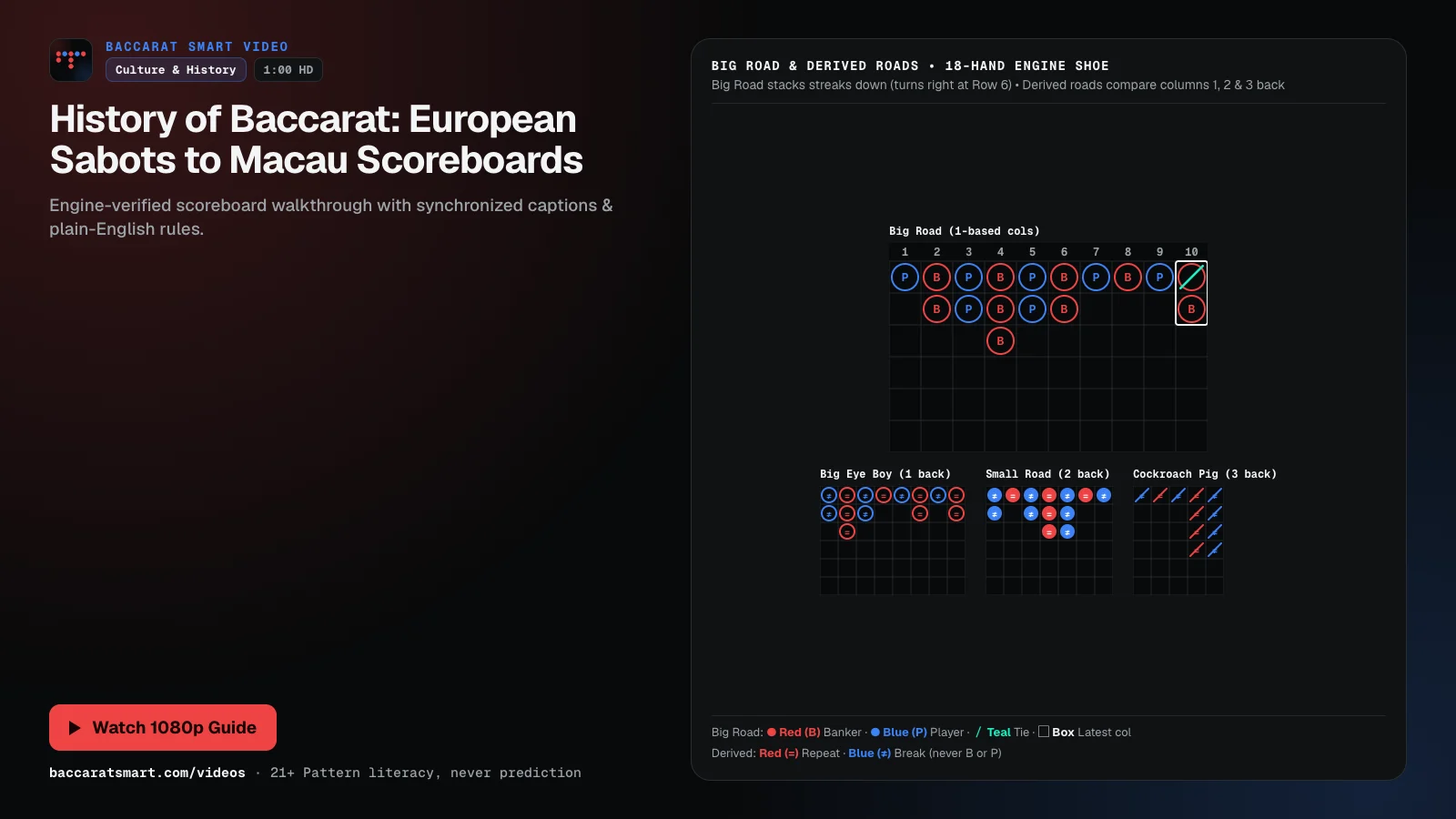
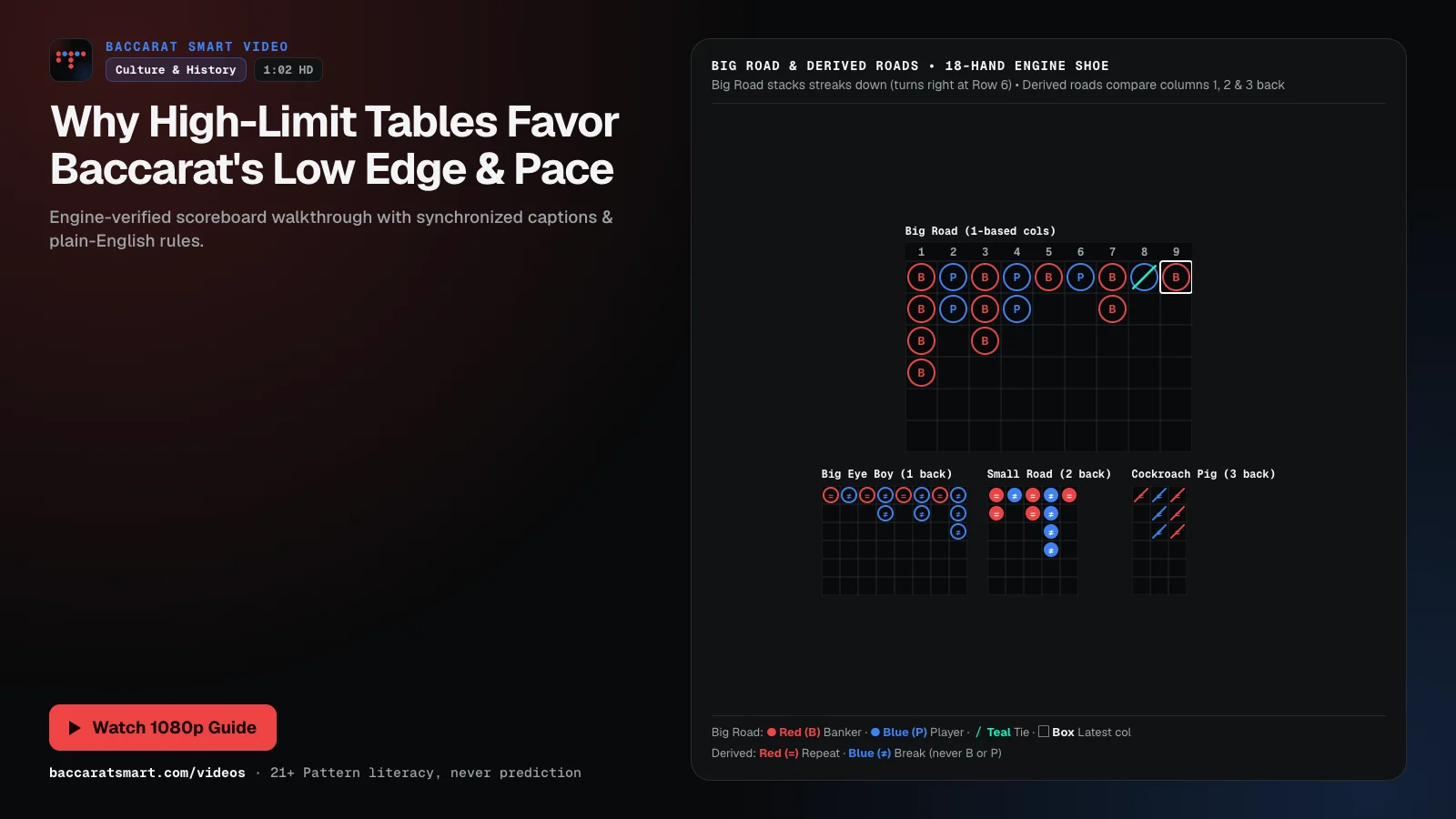
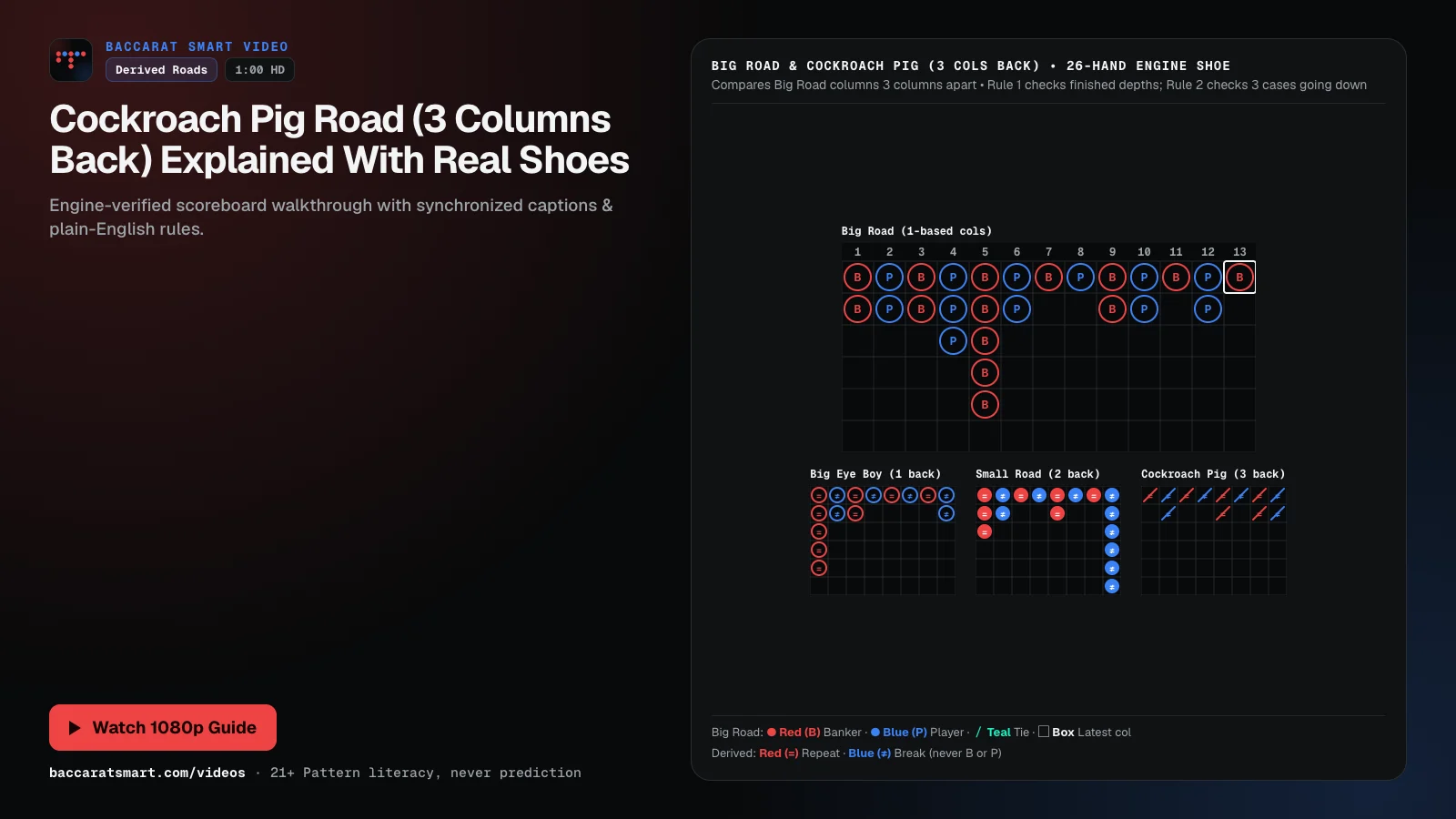
Modern baccarat displays owe their visual language to Macau gaming rooms, where Punto Banco grew to represent over 85% of table play. Beginning in the 1960s and 1970s, table clerks tracked streaks by hand with red and blue pencils on printed six-row grid cards. Over ensuing decades, Big Eye Boy, Small Road, and Cockroach Pig standardized 1-column, 2-column, and 3-column Big Road symmetry checks onto one sheet. Today every electronic tote display runs that exact five-road algorithm — inspect this 18-hand, 9-column shoe on baccaratsmart.com/calculator. 21+.
Adults 21+ educational content only. Baccarat scoreboards record completed outcomes and never change the mathematical odds of the next hand. Review our Responsible Gambling policy.
How Macau Table Culture Shaped Modern Baccarat Scoreboards
A 55-second historical walkthrough tracing how Macau gaming halls transformed baccarat from an exclusive salon pastime into the global standard with five-road scoreboards, illustrated on an 18-hand shoe.
Practice What You Just Watched
Paired written guide: Macau’s Gambling Culture: How Baccarat Became King
Key takeaways from this video
- Hand-penciled Macau road sheets established the 6-row grid height and rightward Row-6 dragon-tail convention used on electronic displays worldwide.
- Grouping Big Eye Boy (hollow rings), Small Road (solid dots), and Cockroach Pig (slashes) beneath the Big Road lets table readers scan three comparison distances at once.
- Shoe BBBPPBPBBPPPBBPPTB (18 hands, 9 Big Road columns) demonstrates all five standard boards with 13 Big Eye Boy, 11 Small Road, and 10 Cockroach Pig marks.
Interactive shoe sandbox (18 hands)Open interactive 4-road boardHide interactive board
Interactive 5-Road Sandbox · Bead Plate + Big Road + Derived Roads
Try this video's shoe live
Deal extra hands onto this shoe to watch the Bead Plate, Big Road, and all three casino derived roads react live. On derived roads, red = pattern repeating and blue = pattern breaking.
Bead Plate (Chronological)
Read ↓ then →Big Road (18 hands)
9 streak columnsBig Eye Boy
1 backSmall Road
2 backCockroach Pig
3 backHand #18 · Why the newest marks are red or blue
- Big Eye Boy: Column 8 has 2 beads. Column 7 has 2 beads. Same depth → red (=).
- Small Road: Column 8 has 2 beads. Column 6 has 3 beads. Different depth → blue (≠).
- Cockroach Pig: Column 8 has 2 beads. Column 5 has 2 beads. Same depth → red (=).
Opens with this exact 18-hand sequence preloaded—and archives any shoe already on your board first.
Frequently asked questions about this walkthrough
Show 4 FAQsHide FAQs
- Why did paper baccarat road cards standardize on six rows per column?
- Six rows fit cleanly across pocket-sized printed scorecards while matching six-hand Bead Plate columns; streaks past six simply turned right along the bottom line.
- Why do the three derived roads use rings, dots, and slashes instead of letters?
- Handwriting tiny hollow circles, solid dots, and slashes with red and blue pens was fast and unmistakable across a crowded table before digital screens existed.
- Did transitioning from paper scorecards to electronic screens change the road rules?
- No. Electronic casino displays encode the exact same Rule 1 and three-case Rule 2 definitions developed on traditional paper road sheets.
- Do scoreboards change the Punto Banco house edge in Macau versus Las Vegas?
- Never. Standard 8-deck Punto Banco carries the same 1.06% Banker and 1.24% Player house edge everywhere.