Read full video transcriptShowHide
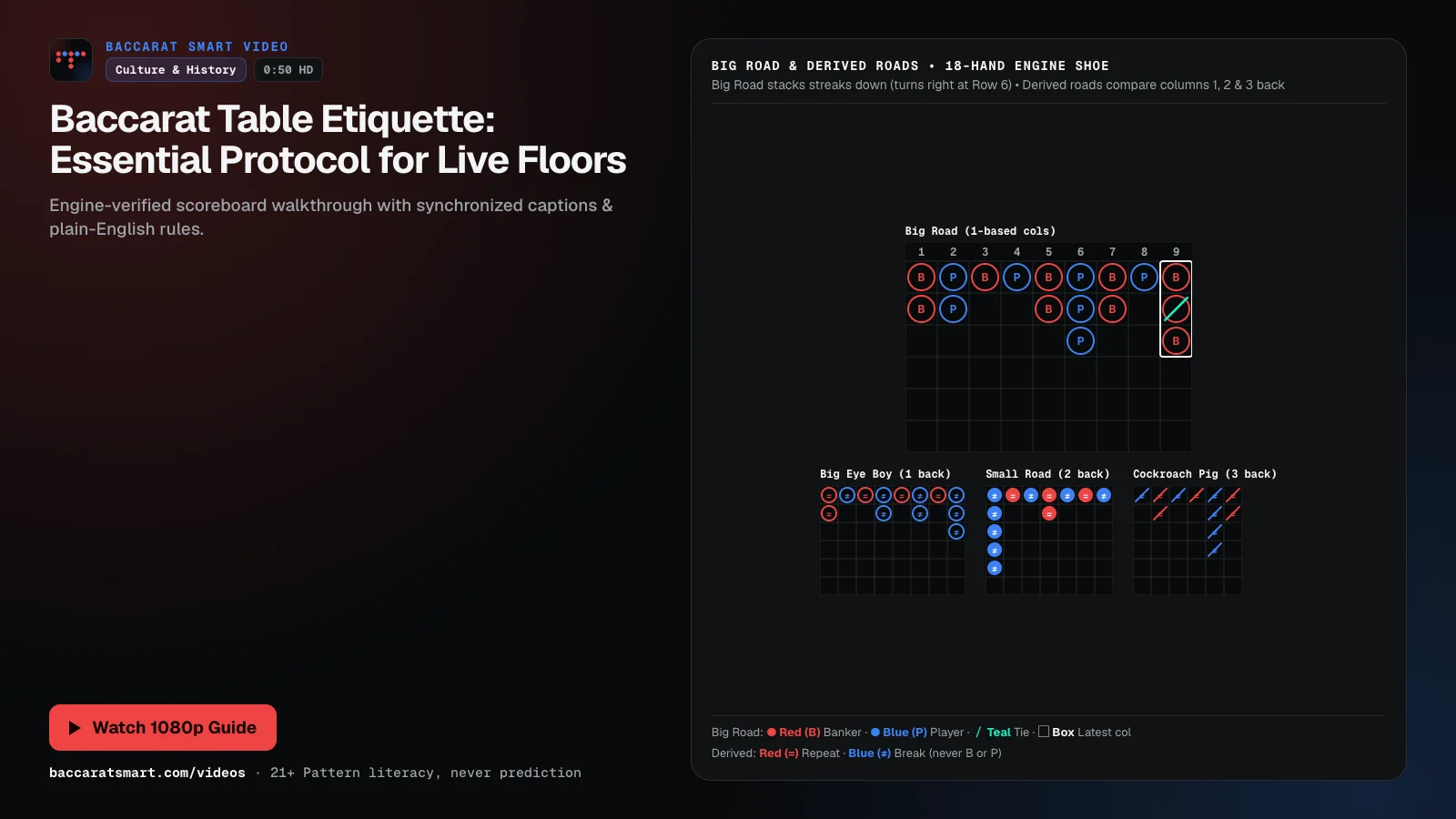
Across Macau, Singapore, and Las Vegas VIP salons, baccarat generates the vast majority of high-limit table turnover for four clear reasons. First is math: a 1.06% Banker edge and 1.24% Player edge keep statistical house hold thin even at high-denomination stakes. Second is transparency and camaraderie: everyone wagers on two shared hands governed by fixed rules, turning the top bettor's card squeeze into shared table theatre. Third is the five-road scoreboard — read all 9 Big Road columns and 12 Big Eye Boy marks of BBBBPPBBBPPBPBBPTB at baccaratsmart.com/courses. 21+.
Adults 21+ educational content only. Baccarat scoreboards record completed outcomes and never change the mathematical odds of the next hand. Review our Responsible Gambling policy.
Why High-Limit Tables Favor Baccarat's Low Edge & Pace
A 62-second cultural and mathematical overview explaining how a low 1.06% Banker edge, symmetric shared hands, card-squeeze theatre, and five-road scoreboards anchor VIP salon play across an 18-hand shoe.
Practice What You Just Watched
Paired written guide: Why High Rollers and Asian Players Love Baccarat
Key takeaways from this video
- At high limits, house-edge differences compound fast: 1.06% on Baccarat Banker costs a fraction of 2.70%–5.26% roulette without requiring 250-cell strategy charts.
- VIP rolling-chip (dead-chip) programs return a small measured rebate on total turnover while keeping the underlying game edge positive for the house.
- Sample salon shoe BBBBPPBBBPPBPBBPTB (18 hands, 9 Big Road columns) produces 12 Big Eye Boy, 10 Small Road, and 7 Cockroach Pig marks.
Interactive shoe sandbox (18 hands)Open interactive 4-road boardHide interactive board
Interactive 5-Road Sandbox · Bead Plate + Big Road + Derived Roads
Try this video's shoe live
Deal extra hands onto this shoe to watch the Bead Plate, Big Road, and all three casino derived roads react live. On derived roads, red = pattern repeating and blue = pattern breaking.
Bead Plate (Chronological)
Read ↓ then →Big Road (18 hands)
9 streak columnsBig Eye Boy
1 backSmall Road
2 backCockroach Pig
3 backHand #18 · Why the newest marks are red or blue
- Big Eye Boy: Column 8 has 1 bead. Column 7 has 2 beads. Different depth → blue (≠).
- Small Road: Column 8 has 1 bead. Column 6 has 1 bead. Same depth → red (=).
- Cockroach Pig: Column 8 has 1 bead. Column 5 has 1 bead. Same depth → red (=).
Opens with this exact 18-hand sequence preloaded—and archives any shoe already on your board first.
Frequently asked questions about this walkthrough
Show 4 FAQsHide FAQs
- Why do high-limit players prefer games where other seats cannot alter the cards?
- In blackjack, another guest's hit or split changes which card the dealer receives next; in Punto Banco, fixed rules govern one shared Player and Banker deal every coup.
- Do VIP salon rebates give high rollers a mathematical edge over the casino?
- No. Rolling-chip rebates (typically 0.5% to 0.8% of dead-chip turnover) narrow net expected cost while staying safely below the 1.06% Banker house edge.
- Why are cards destroyed after every shoe in VIP squeeze salons?
- Allowing guests to bend and peel corners reveals pips dramatically and marks the paper stock, so fresh sealed 8-deck shoes are opened for every new game.
- Are the derived-road rules in a $10,000 VIP salon identical to a $25 floor table?
- 100% identical — every table runs the same Bead Plate, Big Road, Big Eye Boy, Small Road, and Cockroach Pig algorithm.