Read full video transcriptShowHide
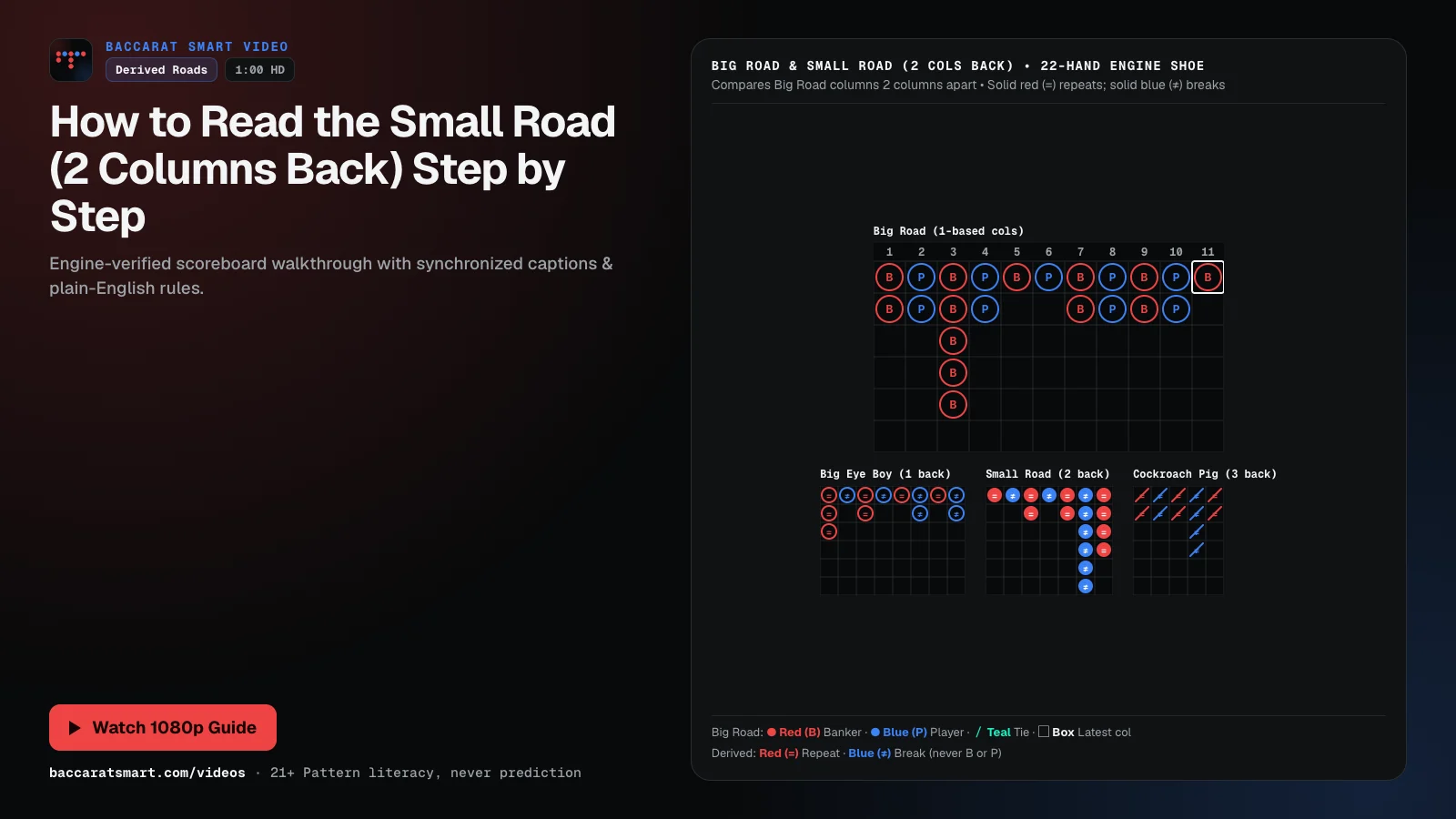
Cockroach Pig — the bottom-right derived road drawn with diagonal slashes — compares the Big Road 3 columns back. Its first slash appears on Column 4 Row 2 if Column 4 has at least two beads, or on Column 5 Row 1 if Column 4 stopped at one bead. At Row 1 of a new Big Road column, Rule 1 compares the just-finished column with the column 3 further back — equal depth paints red, different depth paints blue. From Row 2 downward, Rule 2 checks 3 columns back at the same row: bead present is red, stopped one row above is blue, stopped two or more above is red. 21+.
Adults 21+ educational content only. Baccarat scoreboards record completed outcomes and never change the mathematical odds of the next hand. Review our Responsible Gambling policy.
Cockroach Pig Road (3 Columns Back) Explained With Real Shoes
A 60-second visual guide to Cockroach Pig (Cockroach Road, 3 columns back): where diagonal slashes sit on the scoreboard, exact Big Road starting cells, and how Rule 1 and all three cases of Rule 2 compare columns 3 apart on a 26-hand shoe.
Practice What You Just Watched
Paired written guide: Cockroach Pig Road Explained
Key takeaways from this video
- Cockroach Pig uses diagonal red (=) and blue (≠) slashes and looks 3 columns back on the Big Road to track four-column symmetry cycles.
- Because it requires 3 prior reference columns, Cockroach Pig never records a mark until Big Road Column 4 Row 2 or Column 5 Row 1.
- On shoe BBPPBBPPPBBBBBPPBPBBPPBPPB (26 hands, 13 Big Road columns), Cockroach Pig records 19 verified marks following Rule 1 and three-case Rule 2.
Interactive shoe sandbox (26 hands)Open interactive 4-road boardHide interactive board
Interactive 5-Road Sandbox · Bead Plate + Big Road + Derived Roads
Try this video's shoe live
Deal extra hands onto this shoe to watch the Bead Plate, Big Road, and all three casino derived roads react live. On derived roads, red = pattern repeating and blue = pattern breaking.
Bead Plate (Chronological)
Read ↓ then →Big Road (26 hands)
13 streak columnsBig Eye Boy
1 backSmall Road
2 backCockroach Pig
3 backHand #26 · Why the newest marks are red or blue
- Big Eye Boy: Column 12 has 2 beads. Column 11 has 1 bead. Different depth → blue (≠).
- Small Road: Column 12 has 2 beads. Column 10 has 2 beads. Same depth → red (=).
- Cockroach Pig: Column 12 has 2 beads. Column 9 has 2 beads. Same depth → red (=).
Opens with this exact 26-hand sequence preloaded—and archives any shoe already on your board first.
Frequently asked questions about this walkthrough
Show 4 FAQsHide FAQs
- Why is Cockroach Pig drawn with diagonal slashes?
- Standard 5-road displays assign each derived road a distinct glyph — hollow rings for Big Eye Boy, solid circles for Small Road, and diagonal slashes for Cockroach Pig — so all three grids can be read at a glance.
- When does Cockroach Pig record its very first mark?
- Cockroach Pig starts on Big Road Column 4, Row 2 if Column 4 continues to a second bead; if Column 4 stops at a single bead, Cockroach Pig starts on Column 5, Row 1.
- Does Cockroach Pig compare same-winner or opposite-winner Big Road columns?
- Because Big Road columns alternate Banker and Player, looking 3 columns back (an odd offset) compares opposite-side columns — just like Big Eye Boy (1 column back).
- What does a red slash mean on Cockroach Pig?
- A red slash (=) means the Big Road column pattern is repeating relative to 3 columns back; a blue slash (≠) means the pattern broke — never Banker or Player.