Read full video transcriptShowHide
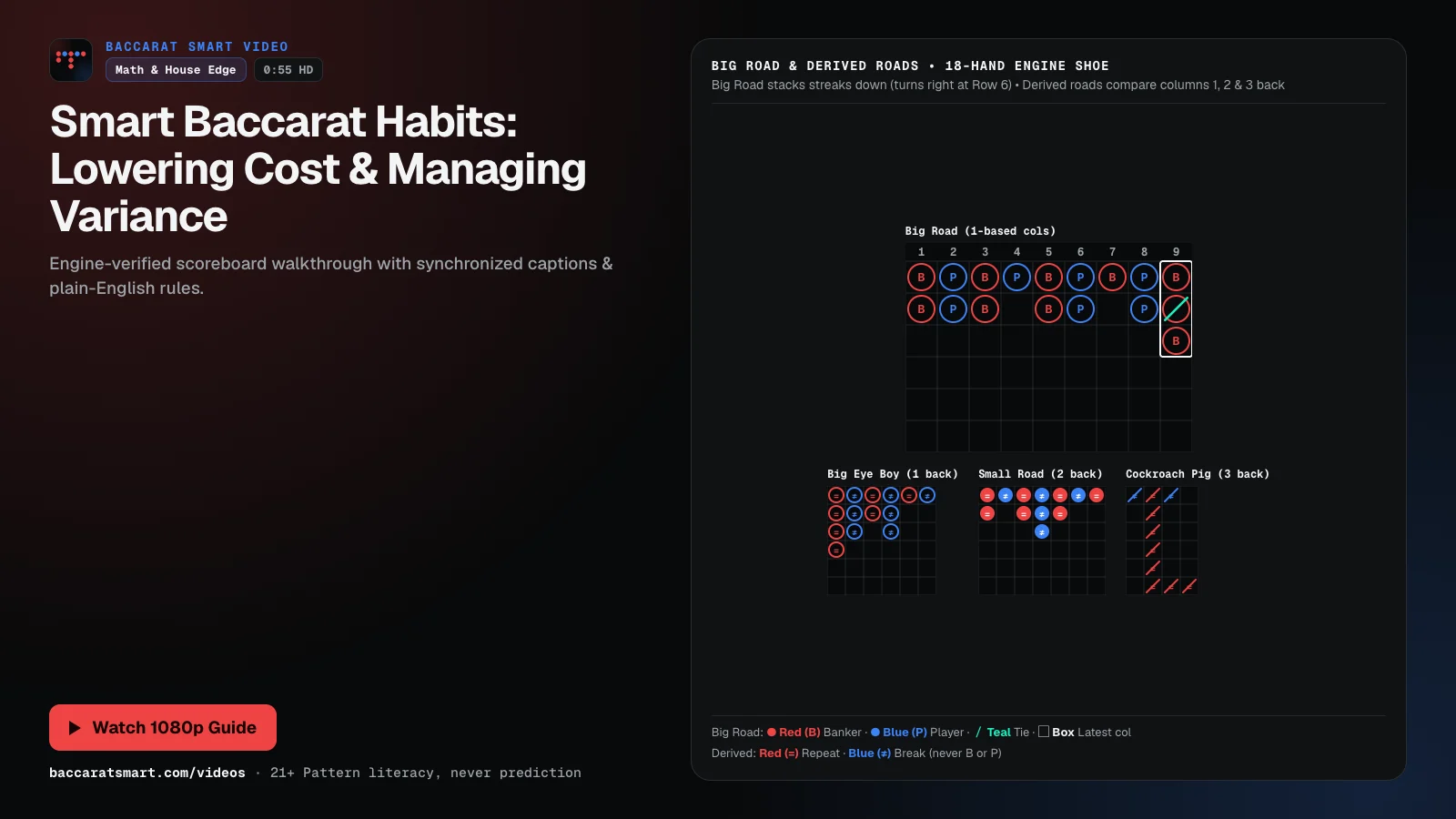
Mini, Midi, and Big Table baccarat look different on the casino floor, yet all three run the exact same Punto Banco third-card rules. Mini-Baccarat seats 7 guests with one dealer turning all cards face up at 120 to 150 hands per hour — fast, approachable, and hands-off. Midi-Baccarat seats 9 guests and lets the top Player and Banker bettors squeeze the cards, slowing pace to a relaxed 50 to 70 hands per hour. Full-pit 14-seat Big Baccarat adds a central caller and wooden palette while recording the same five roads shown on this 18-hand shoe. 21+.
Adults 21+ educational content only. Baccarat scoreboards record completed outcomes and never change the mathematical odds of the next hand. Review our Responsible Gambling policy.
Mini, Midi & Big Table Baccarat: Pace & Dealing Formats
A 55-second table-format walkthrough comparing 7-seat Mini-Baccarat, 9-seat Midi squeeze tables, and 14-seat full-pit Big Baccarat on pace, card handling, and shared 8-deck rules across an 18-hand shoe.
Practice What You Just Watched
Paired written guide: Mini vs Big vs Midi Baccarat: Format Differences
Key takeaways from this video
- Point values, Natural 8/9 rules, the Banker third-card tableau, and main-bet house edges (1.06% Banker, 1.24% Player) are identical across Mini, Midi, and Big tables.
- Table pace drives hourly cost: playing 140 hands/hr on Mini-Baccarat puts nearly triple the hourly action at risk compared with 50 hands/hr at a Midi squeeze table.
- Sample shoe BPPBPPBBBPPBBPBBTB (18 hands, 9 Big Road columns) generates identical Big Eye Boy (15), Small Road (13), and Cockroach Pig (12) marks on every format.
Interactive shoe sandbox (18 hands)Open interactive 4-road boardHide interactive board
Interactive 5-Road Sandbox · Bead Plate + Big Road + Derived Roads
Try this video's shoe live
Deal extra hands onto this shoe to watch the Bead Plate, Big Road, and all three casino derived roads react live. On derived roads, red = pattern repeating and blue = pattern breaking.
Bead Plate (Chronological)
Read ↓ then →Big Road (18 hands)
9 streak columnsBig Eye Boy
1 backSmall Road
2 backCockroach Pig
3 backHand #18 · Why the newest marks are red or blue
- Big Eye Boy: This bead is at Row 3. Column 8 stopped at Row 1, more than one row above → red (=).
- Small Road: This bead is at Row 3. Column 7 stopped at Row 2, one row above → blue (≠).
- Cockroach Pig: This bead is at Row 3. Column 6 stopped at Row 2, one row above → blue (≠).
Opens with this exact 18-hand sequence preloaded—and archives any shoe already on your board first.
Frequently asked questions about this walkthrough
Show 4 FAQsHide FAQs
- Do Mini-Baccarat and VIP Big Baccarat use different third-card rules?
- No. Every Punto Banco table — Mini, Midi, and Big — follows the exact same mandatory Player and Banker third-card tableau and 8-deck probabilities.
- Why can a lower-minimum Mini table cost more per hour than a slower Midi table?
- Expected hourly cost equals wager size × hands per hour × house edge. Dealing 140 hands/hr on Mini multiplies hourly turnover roughly 2.5x–3x compared with a 50-hand/hr squeeze game.
- Who passes the shoe in 14-seat Big Baccarat?
- In ceremonial Big Baccarat, the 8-deck shoe passes counterclockwise from seat to seat whenever the Banker hand loses, though the house still banks every wager under Punto Banco rules.
- Do all three table sizes display the same five-road electronic board?
- Yes. Modern Mini, Midi, and VIP salon tables alike mount electronic displays showing the Bead Plate, Big Road, Big Eye Boy, Small Road, and Cockroach Pig.