Read full video transcriptShowHide
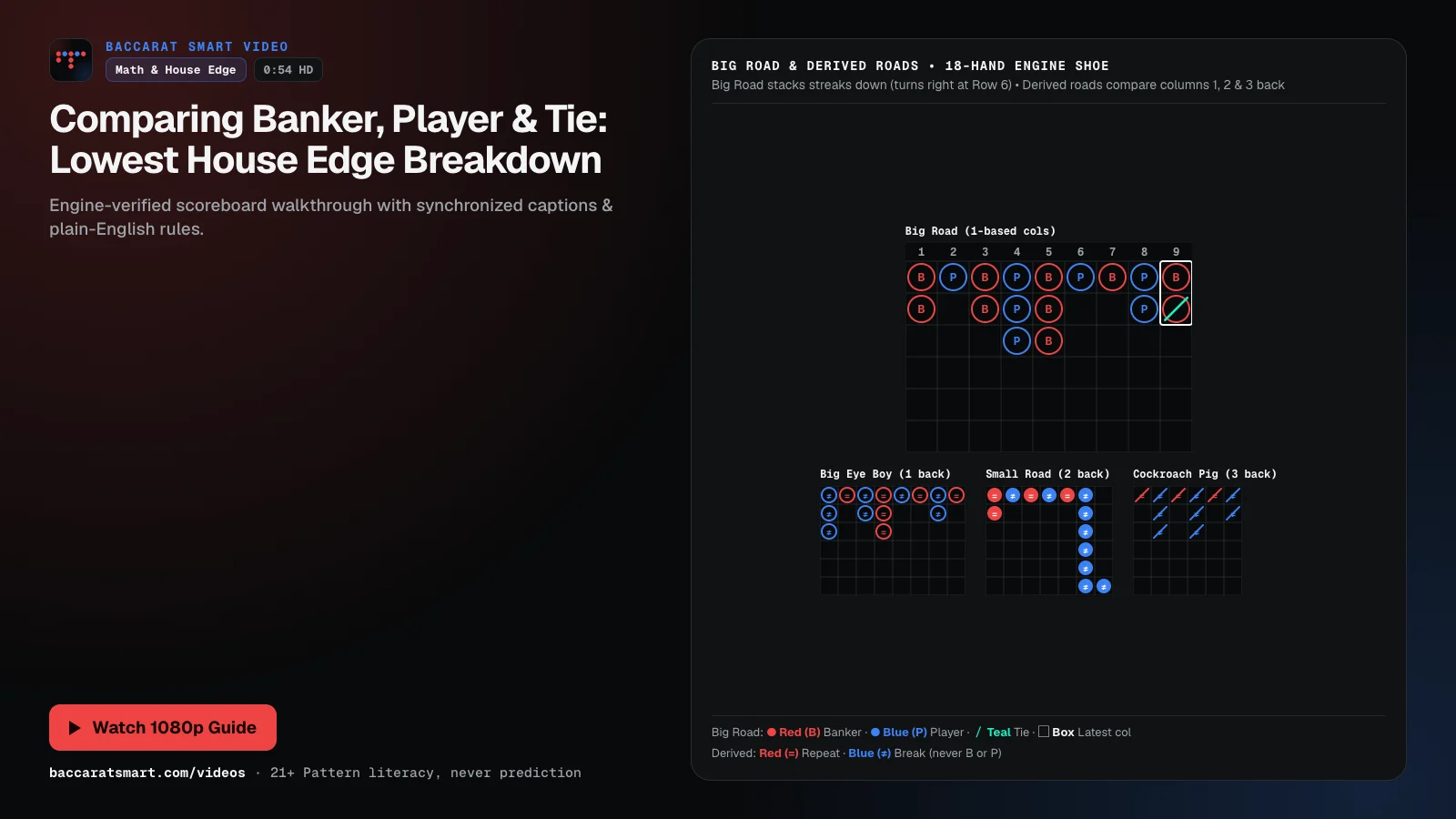
Practical baccarat habits focus on the four numbers you actually control: house edge, paytable rules, table speed, and session budget. Keep wagers on standard Banker (1.06%) or Player (1.24%), and verify whether a commission-free felt halves Banker 6 payouts to a 1.46% edge. Choose a comfortable dealing speed — 50 hands per hour puts less than half the hourly turnover in play compared with a 140-hand rapid table. Read Big Eye Boy, Small Road, and Cockroach Pig on this 18-hand, 9-column shoe as clear history — try 3 free lessons at /preview. 21+.
Adults 21+ educational content only. Baccarat scoreboards record completed outcomes and never change the mathematical odds of the next hand. Review our Responsible Gambling policy.
Smart Baccarat Habits: Lowering Cost & Managing Variance
A 55-second practical checklist covering four verifiable habits — main-bet math, paytable inspection, hourly hand pace, and calm session budgets — demonstrated alongside an 18-hand shoe (9 columns).
Practice What You Just Watched
Paired written guide: Honest Baccarat Tips: Lower the Edge, Manage Risk
Key takeaways from this video
- Skipping 8:1 Tie (14.36%) and 11:1 Pair (10.36%) wagers keeps your expected cost near 1.06%–1.24% per hand dealt.
- Checking felt print before sitting down distinguishes standard 5% commission (1.06%), EZ Dragon 7 push (1.02%), and No-Commission Banker 6 half-pay (1.46%).
- On shoe BBPPBBPBBPPBPPBBTB (18 hands, 9 Big Road columns), Big Eye Boy logs 14 marks, Small Road 12, and Cockroach Pig 10.
Interactive shoe sandbox (18 hands)Open interactive 4-road boardHide interactive board
Interactive 5-Road Sandbox · Bead Plate + Big Road + Derived Roads
Try this video's shoe live
Deal extra hands onto this shoe to watch the Bead Plate, Big Road, and all three casino derived roads react live. On derived roads, red = pattern repeating and blue = pattern breaking.
Bead Plate (Chronological)
Read ↓ then →Big Road (18 hands)
9 streak columnsBig Eye Boy
1 backSmall Road
2 backCockroach Pig
3 backHand #18 · Why the newest marks are red or blue
- Big Eye Boy: This bead is at Row 3. Column 8 stopped at Row 2, one row above → blue (≠).
- Small Road: This bead is at Row 3. Column 7 stopped at Row 1, more than one row above → red (=).
- Cockroach Pig: This bead is at Row 3. Column 6 stopped at Row 2, one row above → blue (≠).
Opens with this exact 18-hand sequence preloaded—and archives any shoe already on your board first.
Frequently asked questions about this walkthrough
Show 4 FAQsHide FAQs
- Why is checking the Banker 6 rule on the felt a top table habit?
- Many main-floor tables advertise 'No Commission' while paying 1:2 on winning Banker 6s, quietly raising the Banker house edge from 1.06% to 1.46% — above Player's 1.24%.
- Should you track exact 5% commissions or round bets to multiples of $20?
- Wagering in clean multiples of $20 ($20, $40, $100) makes every 5% Banker commission an exact whole dollar ($1, $2, $5), simplifying chip settlement and avoiding fractional rounding.
- Does skipping hands during a choppy shoe hurt your mathematical expectation?
- Never. Sitting out hands reduces your total hourly action, which proportionally lowers your expected hourly cost.
- Why is scoreboard literacy useful even when you bet flat?
- Understanding why every ring, dot, and slash appears lets you follow table conversation confidently without falling for progression traps.