Read full video transcriptShowHide
When Ian Fleming opened his 1953 novel Casino Royale at a French resort table, the game was Chemin de Fer — not modern Punto Banco. In 6-deck Chemin de Fer, one seated player holds the bank with their own chips, and a rival calls 'Banco!' to challenge the entire bank head to head. Unlike automatic Punto Banco, a Chemin de Fer player holding a two-card 5 decides whether to call 'Carte' for a third card or 'Non' to stand. Natural 9 ('la grande') and Natural 8 ('la petite') still ruled every coup — step through modern rules free at baccaratsmart.com/preview. 21+.
Adults 21+ educational content only. Baccarat scoreboards record completed outcomes and never change the mathematical odds of the next hand. Review our Responsible Gambling policy.
Chemin de Fer to Punto Banco: Baccarat in Classic Cinema
A 55-second literary and rules history comparing the player-banked 6-deck Chemin de Fer scenes of 1953 Casino Royale and 1962 Dr. No with modern house-banked Punto Banco across an 18-hand board.
Practice What You Just Watched
Paired written guide: How Baccarat Became James Bond’s Game
Key takeaways from this video
- Chemin de Fer is a peer-to-peer game (the casino takes a ~5% fee on Banker wins rather than banking the action), rotating the sabot counterclockwise on a Banker loss.
- Modern Punto Banco kept modulo-10 totals and Naturals 8 and 9 while locking every third-card draw into an automatic house-banked tableau.
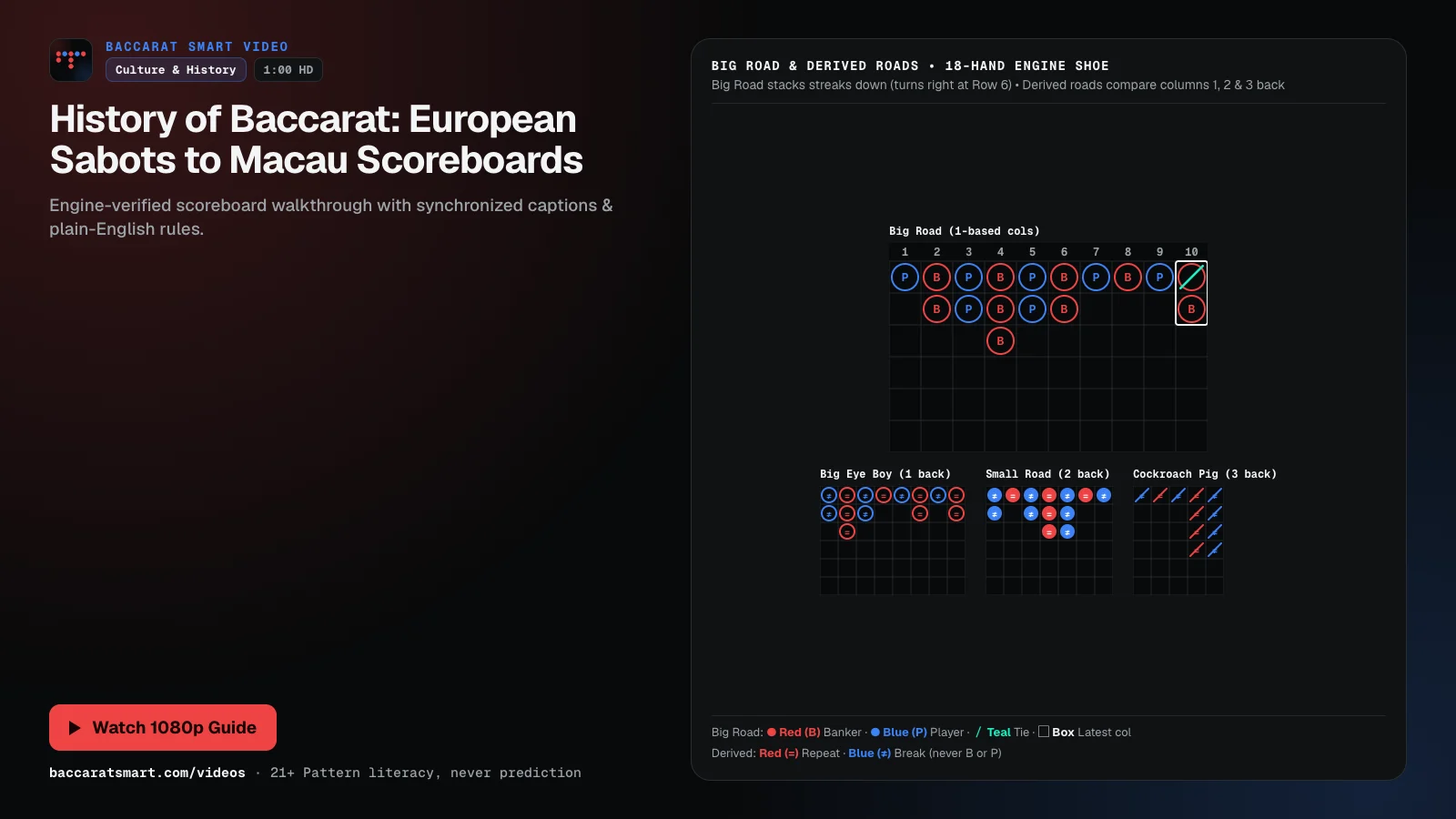
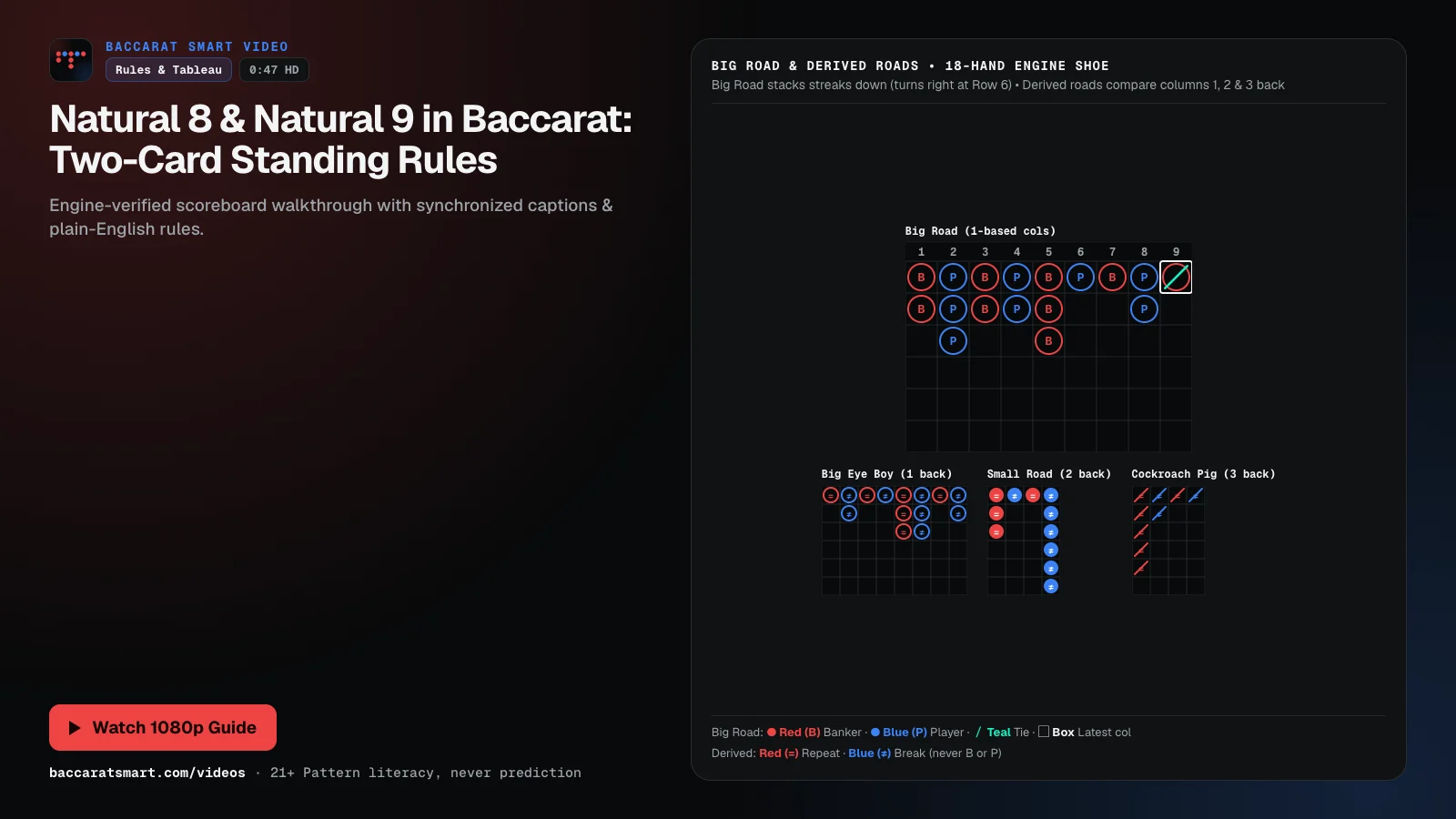
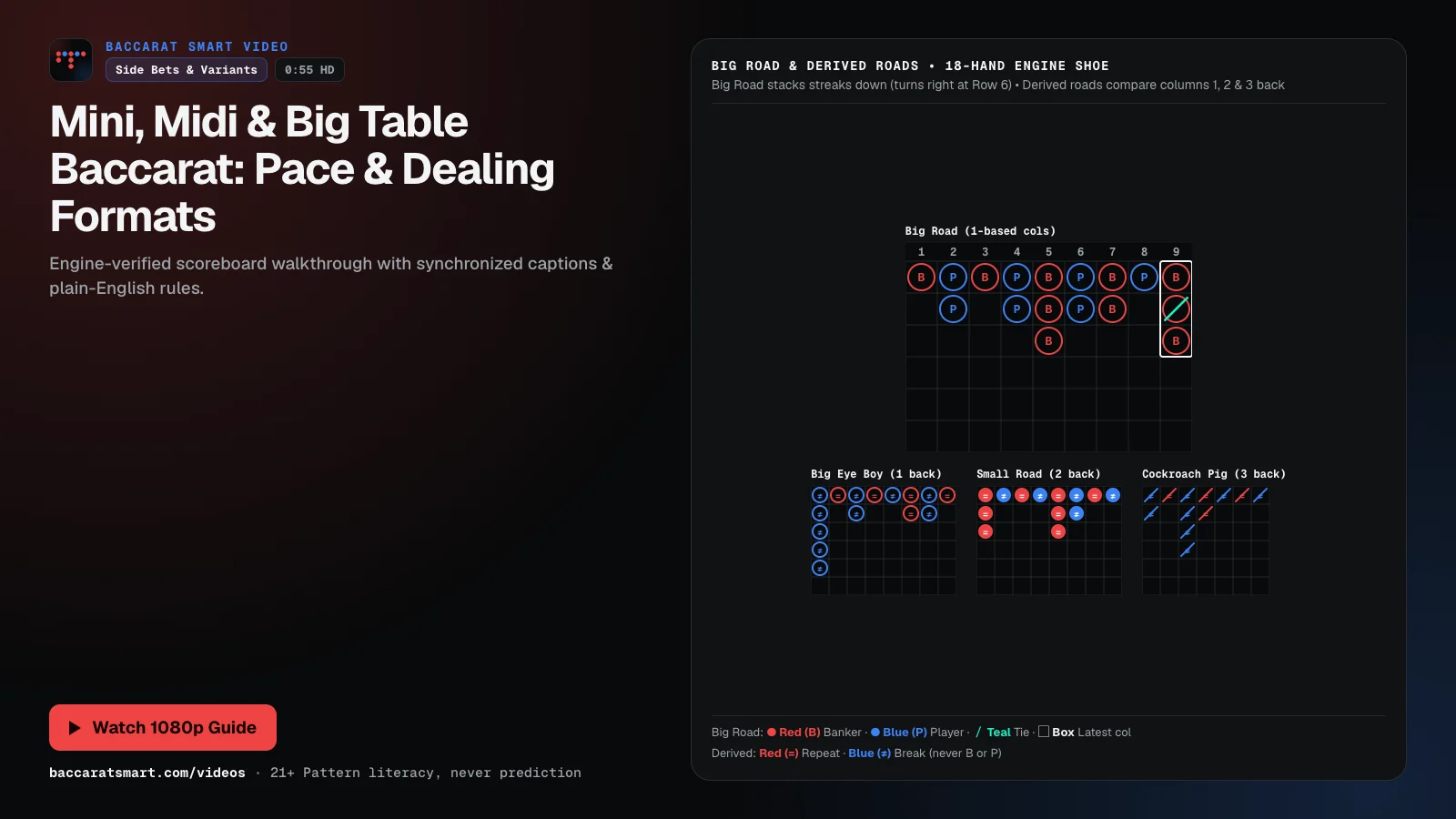
- Modern scoreboard shoe BBPBBPPPBBPPBBPBTB (18 hands, 9 Big Road columns) logs 14 Big Eye Boy, 13 Small Road, and 11 Cockroach Pig marks.
Interactive shoe sandbox (18 hands)Open interactive 4-road boardHide interactive board
Interactive 5-Road Sandbox · Bead Plate + Big Road + Derived Roads
Try this video's shoe live
Deal extra hands onto this shoe to watch the Bead Plate, Big Road, and all three casino derived roads react live. On derived roads, red = pattern repeating and blue = pattern breaking.
Bead Plate (Chronological)
Read ↓ then →Big Road (18 hands)
9 streak columnsBig Eye Boy
1 backSmall Road
2 backCockroach Pig
3 backHand #18 · Why the newest marks are red or blue
- Big Eye Boy: This bead is at Row 2. Column 8 stopped at Row 1, one row above → blue (≠).
- Small Road: This bead is at Row 2. Column 7 has a bead at Row 2 too → red (=).
- Cockroach Pig: This bead is at Row 2. Column 6 has a bead at Row 2 too → red (=).
Opens with this exact 18-hand sequence preloaded—and archives any shoe already on your board first.
Frequently asked questions about this walkthrough
Show 4 FAQsHide FAQs
- Why did classic 1950s and 1960s films feature Chemin de Fer instead of Punto Banco?
- Chemin de Fer was the premier salon game in French and British clubs of that era, offering dramatic head-to-head 'Banco!' challenges between two seated characters.
- What is the optimal strategy on a two-card 5 in Chemin de Fer?
- Game-theory analysis (solved in the 1950s by Kemeny and Snell) shows the active player mixes drawing and standing on 5 (roughly 4/5 draw, 1/5 stand) so the banker cannot exploit a fixed habit.
- Why did later 2006 adaptations switch the table scene away from Chemin de Fer?
- By 2006, televised Texas Hold'em was more familiar to Western moviegoers, whereas in global casinos house-banked Punto Banco had become the dominant table game by revenue.
- Can you still find Chemin de Fer tables today?
- A few traditional European casinos (such as Monte-Carlo and select French salons) still host occasional Chemin de Fer tables alongside standard Punto Banco.