Read full video transcriptShowHide
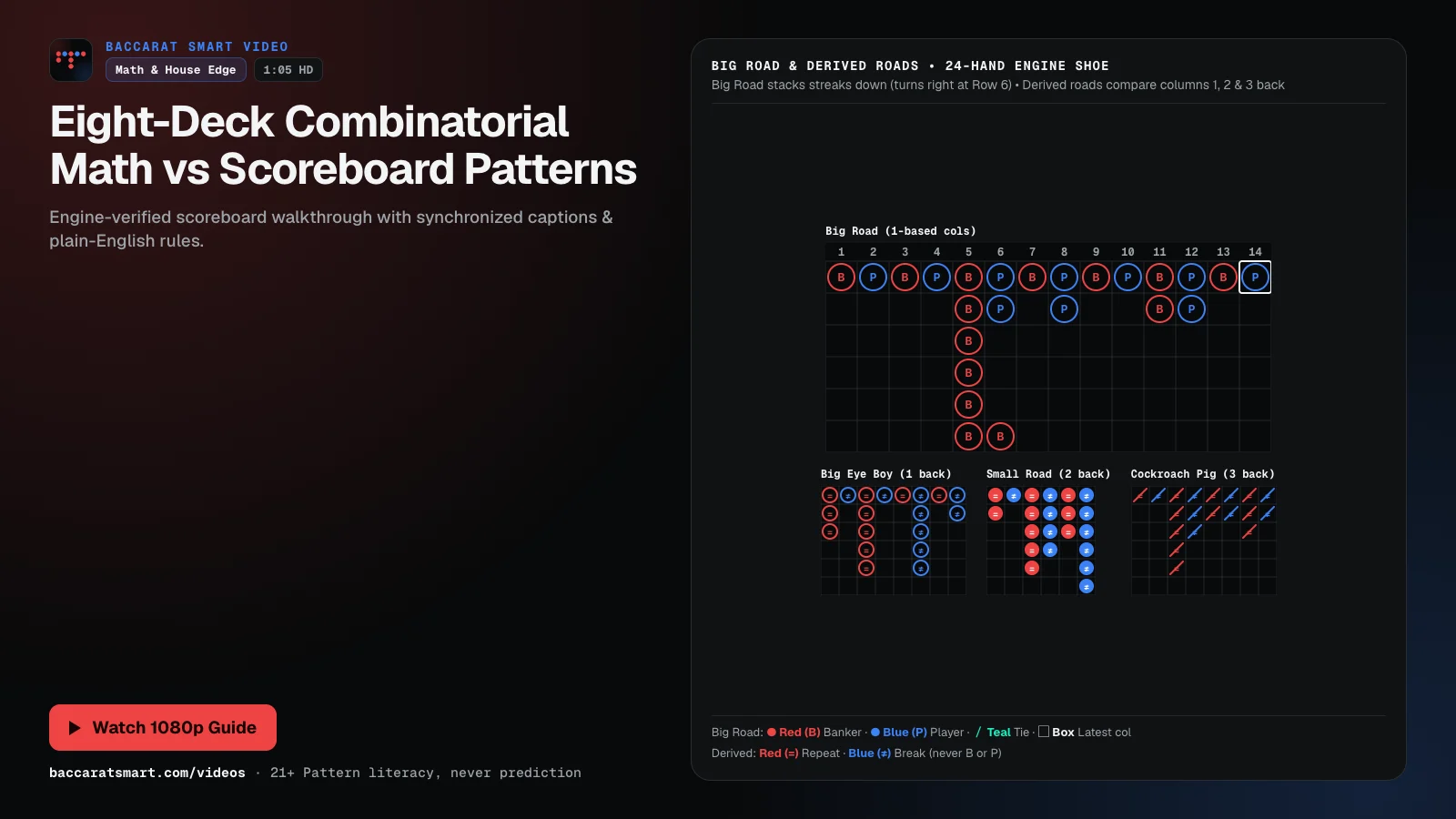
Let's test the exact math when one card of each rank is removed from a fresh 416-card eight-deck shoe. Removing one Ace, Two, Three, or Four nudges the math fractionally toward Banker — peaking on a removed Four at just 0.0116 percentage points! Removing one Five, Six, Seven, or Eight nudges the math fractionally toward Player — peaking on a removed Six at 0.0113 percentage points — while Tens and Faces shift under 0.002 points. Because scoreboard circles like BPBBPPPB record only B, P, and T without card ranks, road patterns never overcome the 1.06% or 1.24% house cost — audit more at /shoe-study. 21+.
Adults 21+ educational content only. Baccarat scoreboards record completed outcomes and never change the mathematical odds of the next hand. Review our Responsible Gambling policy.
8-Deck Card Removal Math: Banker & Player Edge Shifts
Quantitative 8-deck card-removal proof alongside BPBBPPPB (8 hands), charting rank-by-rank Banker and Player edge shifts (peaking at 0.0116 percentage points on Banker and ~0.0120 on Player for a removed 4) to show why past scoreboard shapes leave main-bet costs near 1.06% / 1.24%.
Practice What You Just Watched
Paired interactive surface: Open /shoe-study
Key takeaways from this video
- Peak single-card 8-deck main-bet shifts: `−4` shifts Banker cost from `1.0579%` to `1.0463%` (`0.0116` pp); `−6` shifts Player cost from `1.2351%` to `1.2238%` (`0.0113` pp).
- Even removing four 4s with zero balancing mid-cards shifts Banker by only ~0.046 percentage points — less than one-twentieth of the 1.06% house edge!
- Settles the 'are hands independent?' question with precision: hands are weakly coupled via physical card depletion, yet by far too little to change practical table odds.
Interactive shoe sandbox (8 hands)Open interactive 4-road boardHide interactive board
Interactive 5-Road Sandbox · Bead Plate + Big Road + Derived Roads
Try this video's shoe live
Deal extra hands onto this shoe to watch the Bead Plate, Big Road, and all three casino derived roads react live. On derived roads, red = pattern repeating and blue = pattern breaking.
Bead Plate (Chronological)
Read ↓ then →Big Road (8 hands)
5 streak columnsBig Eye Boy
1 backSmall Road
2 backCockroach Pig
3 backHand #8 · Why the newest marks are red or blue
- Big Eye Boy: Column 4 has 3 beads. Column 3 has 2 beads. Different depth → blue (≠).
- Small Road: Column 4 has 3 beads. Column 2 has 1 bead. Different depth → blue (≠).
- Cockroach Pig: Column 4 has 3 beads. Column 1 has 1 bead. Different depth → blue (≠).
Opens with this exact 8-hand sequence preloaded—and archives any shoe already on your board first.
Frequently asked questions about this walkthrough
Show 4 FAQsHide FAQs
- Why shouldn't baccarat writers say 'every hand in an 8-deck shoe is 100% statistically independent'?
- Because physical shoes deal without replacement until the cut card! The accurate truth is that earlier hands shift the next deal ONLY via used-up cards, and by far too little (~0.01% per card) to act on.
- Why do 9s and 10-value cards have the smallest Effect of Removal of all 13 ranks?
- Zero-value cards (10, J, Q, K) and 9s treat Player and Banker nearly symmetrically, moving main-bet house edges by only ~0.0018 to ~0.0023 percentage points per card.
- Does a streak of 6 Banker wins mean extra 4s were removed from the shoe?
- Not at all — a Banker win is slightly more likely WHEN 4s were already missing beforehand, yet a Banker coup itself consumes a virtually normal mix of ranks across both hands.
- Where can I inspect interactive charts of 8-deck shoe behavior?
- Visit `/shoe-study` for our 100,000-shoe simulation findings and `/blog/baccarat-cards-left-combinatorial-math` for full EOR tables.