Read full video transcriptShowHide
Through the opening four cards, Player and Banker are 100% symmetrical — each side hits a Natural 8 or 9 on 18.94% of deals. The asymmetry begins on Card 5: when Player holds 0 through 5, Player must draw a third card first — even when that card worsens a total of 4 or 5. Banker acts second on totals 3, 4, 5, and 6, consulting the tableau to draw only when Player's exposed third card makes drawing mathematically favorable. That positional rule lifts Banker to 50.68% of decided coups, which the 5% fee balances to a 1.06% edge — explore Module 1 free at /courses. 21+.
Adults 21+ educational content only. Baccarat scoreboards record completed outcomes and never change the mathematical odds of the next hand. Review our Responsible Gambling policy.
How Acting Second Gives Banker Its Structural Win Edge
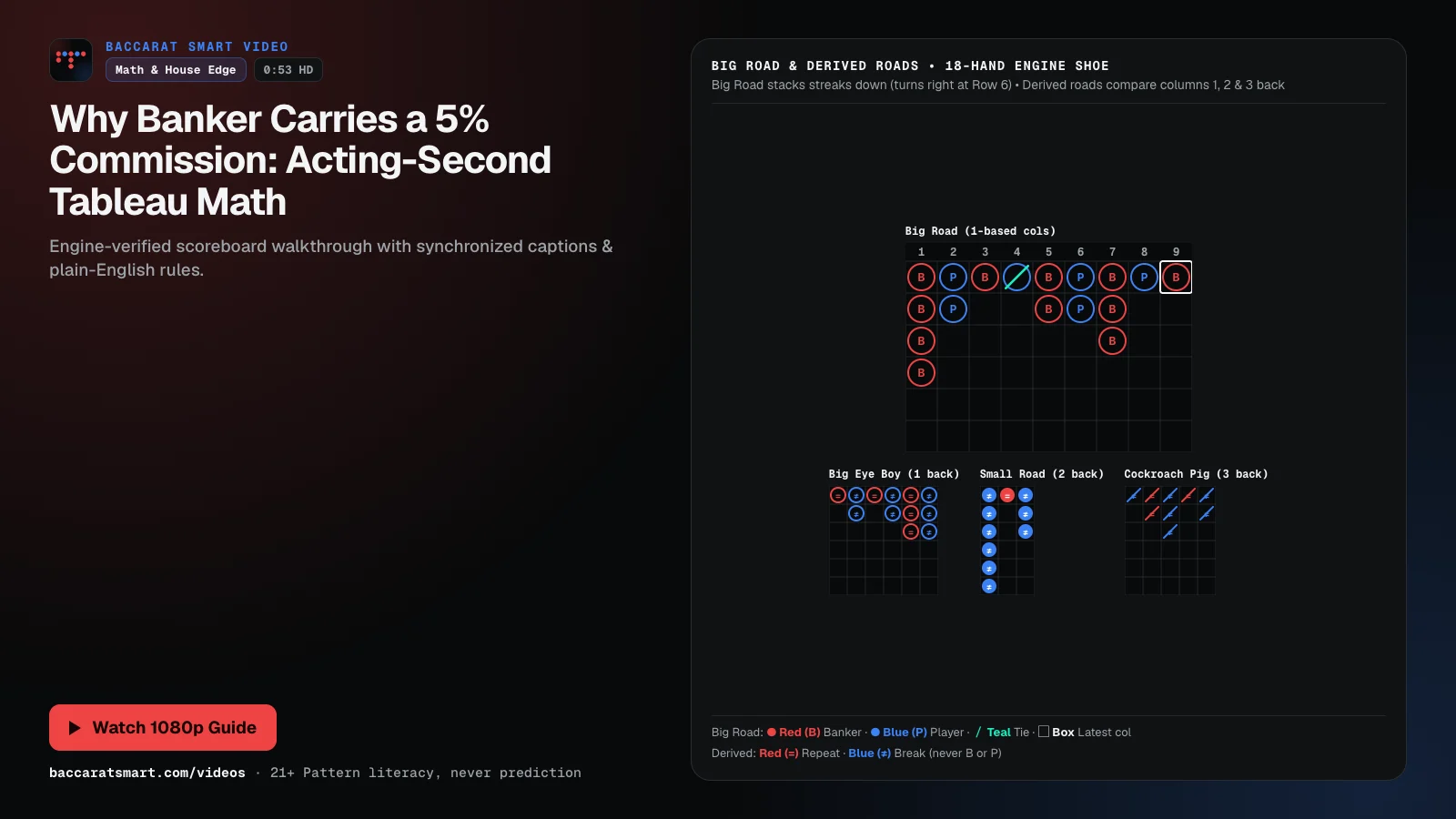
A 55-second combinatorial walkthrough showing why Player and Banker start identical through two cards yet diverge on third-card draws because Banker acts after inspecting Player's third card, paired with an 18-hand shoe.
Practice What You Just Watched
Paired written guide: How the Banker Draws Second: Baccarat’s Edge
Key takeaways from this video
- Famous example: when Banker holds 3 and Player draws an 8 as a third card, Player's most likely new totals are low (8 + 0..5 → 8..3), so Banker stands on 3 instead of risking busting down.
- When Player stands on 6 or 7 (no third card exposed), Banker drops the selective matrix and follows the exact same 0–5 draw / 6–7 stand rule as Player.
- On shoe BBPBPPBBBPPBBPBBTB (18 hands, 9 Big Road columns), Big Eye Boy's latest mark (#14): This bead is at Row 3. Column 8 stopped at Row 1, more than one row above → red (=).
Interactive shoe sandbox (18 hands)Open interactive 4-road boardHide interactive board
Interactive 5-Road Sandbox · Bead Plate + Big Road + Derived Roads
Try this video's shoe live
Deal extra hands onto this shoe to watch the Bead Plate, Big Road, and all three casino derived roads react live. On derived roads, red = pattern repeating and blue = pattern breaking.
Bead Plate (Chronological)
Read ↓ then →Big Road (18 hands)
9 streak columnsBig Eye Boy
1 backSmall Road
2 backCockroach Pig
3 backHand #18 · Why the newest marks are red or blue
- Big Eye Boy: This bead is at Row 3. Column 8 stopped at Row 1, more than one row above → red (=).
- Small Road: This bead is at Row 3. Column 7 stopped at Row 2, one row above → blue (≠).
- Cockroach Pig: This bead is at Row 3. Column 6 stopped at Row 2, one row above → blue (≠).
Opens with this exact 18-hand sequence preloaded—and archives any shoe already on your board first.
Frequently asked questions about this walkthrough
Show 4 FAQsHide FAQs
- If Banker followed the exact same 0–5 draw / 6–7 stand rule as Player on every hand, who would win more?
- They would split decided hands 50.00% / 50.00% identically! The entire 50.68% vs 49.32% gap comes from Banker conditioning totals 3–6 on Player's exposed third card.
- Why does Banker stand on 6 when Player stands, yet draw on 6 if Player drew a 6 or 7?
- If Player drew a third-card 6 or 7 onto a 0–5 base, Player frequently improved to 6, 7, 8, or 9 — making it mathematically superior for Banker's 6 to draw.
- Why doesn't Banker peek at Player's two-card total before drawing?
- Under Punto Banco rules, Banker's tableau uses ONLY Player's third card rank (not Player's two-card sum) whenever Player drew a third card.
- Where can learners drill Banker's 3-through-6 tableau calls interactively?
- Inside free Module 1 (Lessons 1-1b & 1-1c) and the untimed Third-Card Rule practice drill inside any free Baccarat Smart account.