Read full video transcriptShowHide
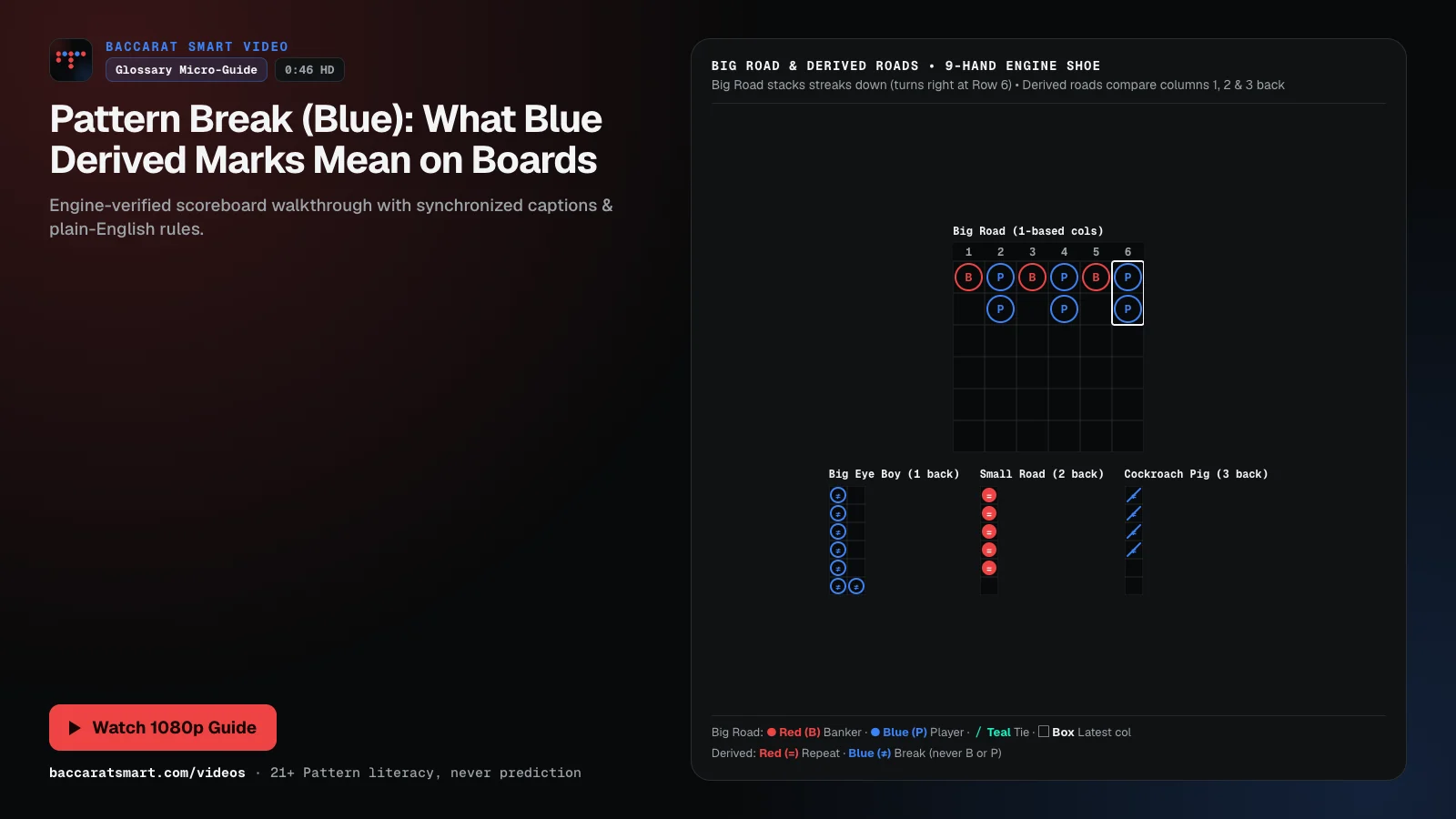
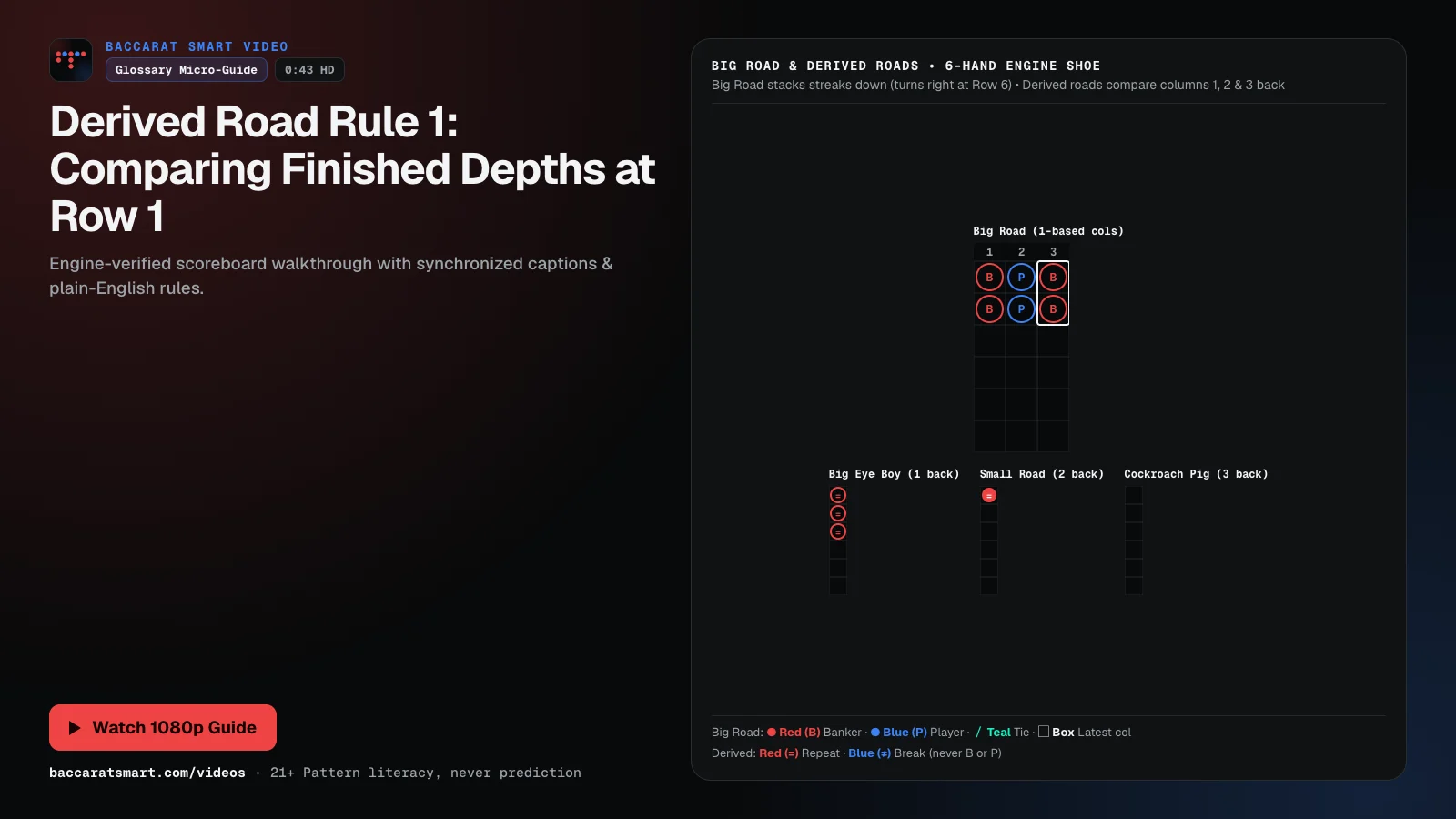
On Big Eye Boy, Small Road, and Cockroach Pig, a red mark means Big Road column symmetry repeated — never that Banker won the hand. Red appears in three exact situations: equal finished column depths at Row 1 under Rule 1, a bead beside at the same row under Rule 2, or stopping two-plus rows above. Look at shoe BBBPPPBBBPPP: four three-bead columns alternate Banker and Player, yet every single mark on all three derived roads is pure red. Five of those 8 red Big Eye Boy rings were painted by Player hands — tap each mark on /calculator to see why. 21+.
Adults 21+ educational content only. Baccarat scoreboards record completed outcomes and never change the mathematical odds of the next hand. Review our Responsible Gambling policy.
Repetition & Symmetry (Red): What Red Derived Marks Mean
Visual glossary proof of Repetition (Red =) on BBBPPPBBBPPP (12 hands, four depth-3 columns), showing 8 red Big Eye Boy, 5 red Small Road, and 2 red Cockroach marks across Banker and Player coups.
Practice What You Just Watched
Paired glossary definition: Repetition / Symmetry (Red)
Key takeaways from this video
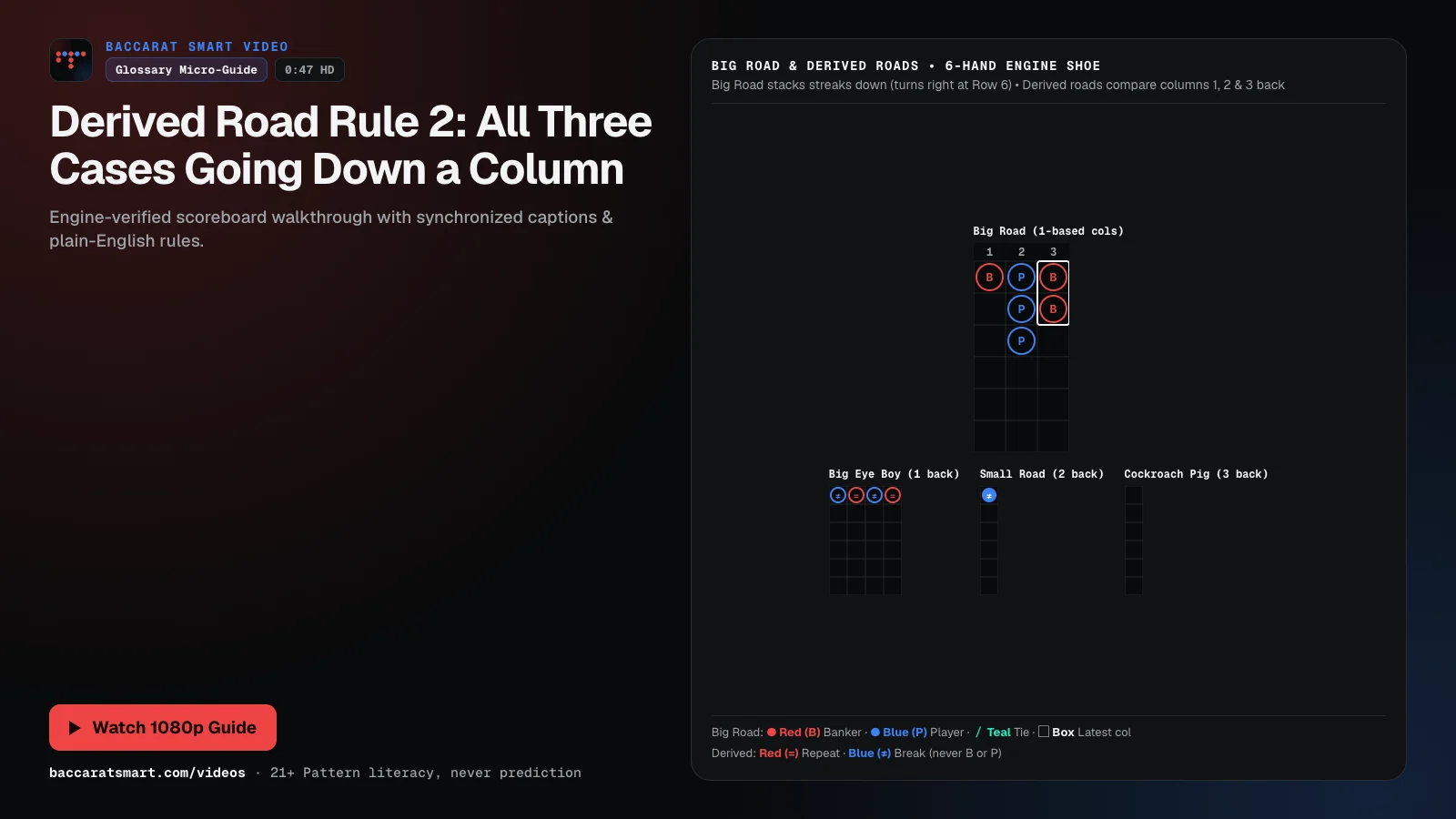
- Three red (=) triggers: (1) Rule 1 equal finished column depths, (2) Rule 2 Case 1 reference column has a bead at this row, (3) Rule 2 Case 3 reference stopped 2+ rows above.
- In Cantonese, derived red is often called Yau Bin ('has pattern/order'), describing past column regularity rather than either betting side.
- Shoe BBBPPPBBBPPP (12 hands, depths 3-3-3-3) generates 8 red Big Eye Boy, 5 red Small Road, and 2 red Cockroach marks with 0 blue.
Interactive shoe sandbox (12 hands)Open interactive 4-road boardHide interactive board
Interactive 5-Road Sandbox · Bead Plate + Big Road + Derived Roads
Try this video's shoe live
Deal extra hands onto this shoe to watch the Bead Plate, Big Road, and all three casino derived roads react live. On derived roads, red = pattern repeating and blue = pattern breaking.
Bead Plate (Chronological)
Read ↓ then →Big Road (12 hands)
4 streak columnsBig Eye Boy
1 backSmall Road
2 backCockroach Pig
3 backHand #12 · Why the newest marks are red or blue
- Big Eye Boy: This bead is at Row 3. Column 3 has a bead at Row 3 too → red (=).
- Small Road: This bead is at Row 3. Column 2 has a bead at Row 3 too → red (=).
- Cockroach Pig: This bead is at Row 3. Column 1 has a bead at Row 3 too → red (=).
Opens with this exact 12-hand sequence preloaded—and archives any shoe already on your board first.
Frequently asked questions about this walkthrough
Show 4 FAQsHide FAQs
- Why did scoreboard designers pick red for repetition when red already meant Banker on the Big Road?
- Traditional Chinese culture associates red with regularity and alignment ('yau bin'), so scoreboard grids reused red/blue pens to contrast symmetry (=) with change (≠).
- On shoe BBBPPPBBBPPP, which rule produces the red mark at Hand 7 (the first B of Column 3)?
- Hand 7 opens Column 3 at Row 1, so Rule 1 compares completed Column 2 (depth 3) with Column 1 (depth 3) — equal depths produce red (=).
- Why does Rule 2 Case 3 count a deep streak as 'repeating' (red) when the reference column was short?
- Once Column 2 Row 2 already recorded the blue depth break against a depth-1 column, continuing the streak at Rows 3, 4, and 5 extends an established run rather than breaking anew.
- Does a wall of red marks across all three derived roads mean the pattern will keep repeating?
- No. Derived red certifies that earlier columns matched; the next coup still resolves from the remaining 8-deck cards.