Read full video transcriptShowHide
Payout ratios state how many units you win per unit staked — plus your original wager back — whenever a betting box settles in your favor. On standard eight-deck Punto Banco, Player pays one-to-one even money (1.24% cost) and Banker pays 0.95-to-1 after the five percent commission (1.06% cost). Tie pays eight-to-one on most floors (14.36% cost) or nine-to-one on select layouts (4.84% cost), while Player and Banker Pairs pay eleven-to-one (10.36% cost). Comparing payout ratios against exact 8-deck frequencies reveals the real cost of every box — review the full table at /blog/baccarat-payouts-and-odds. 21+.
Adults 21+ educational content only. Baccarat scoreboards record completed outcomes and never change the mathematical odds of the next hand. Review our Responsible Gambling policy.
Payout Ratios in Baccarat: Main Bets & Optional Side Bets
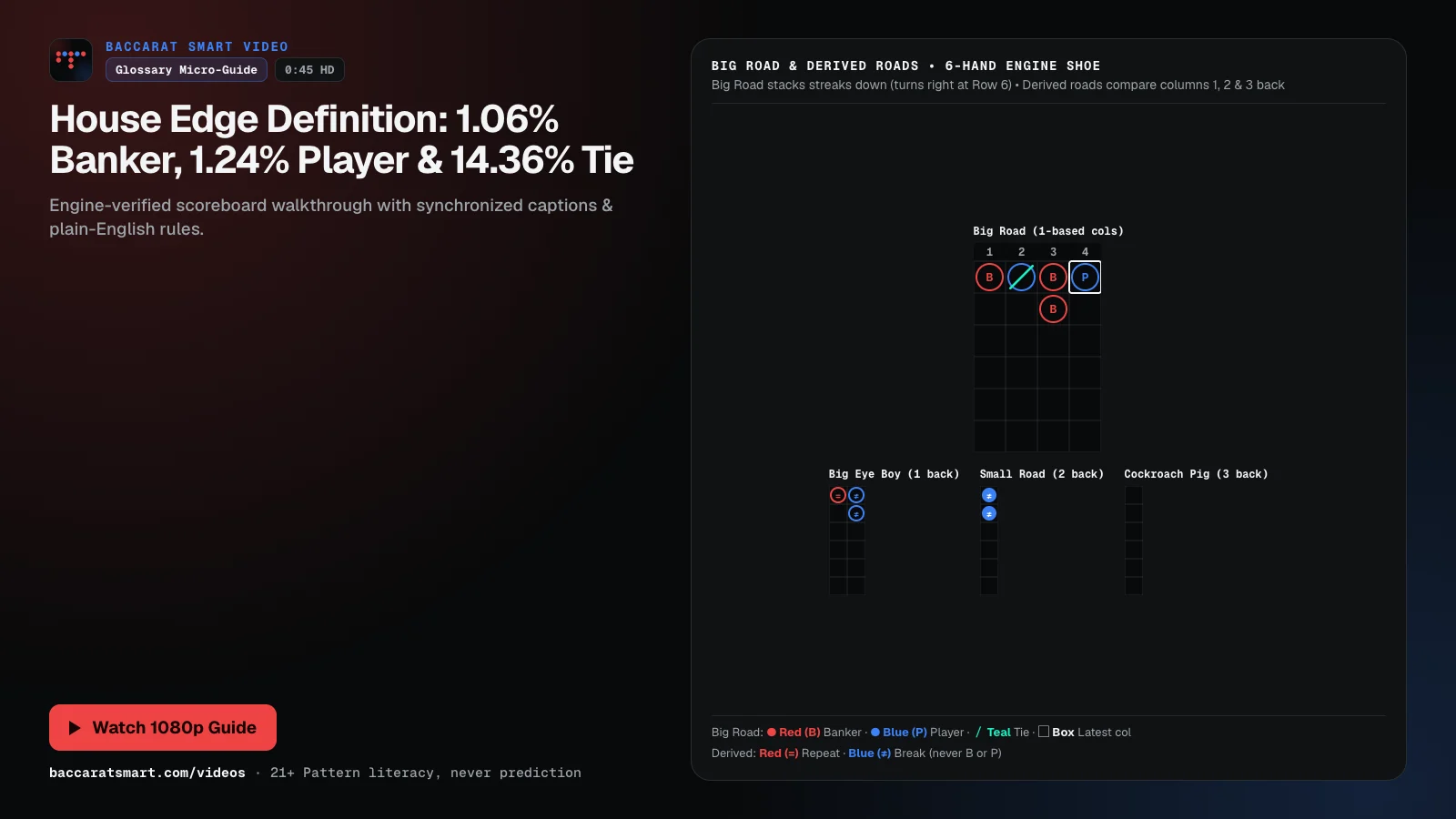
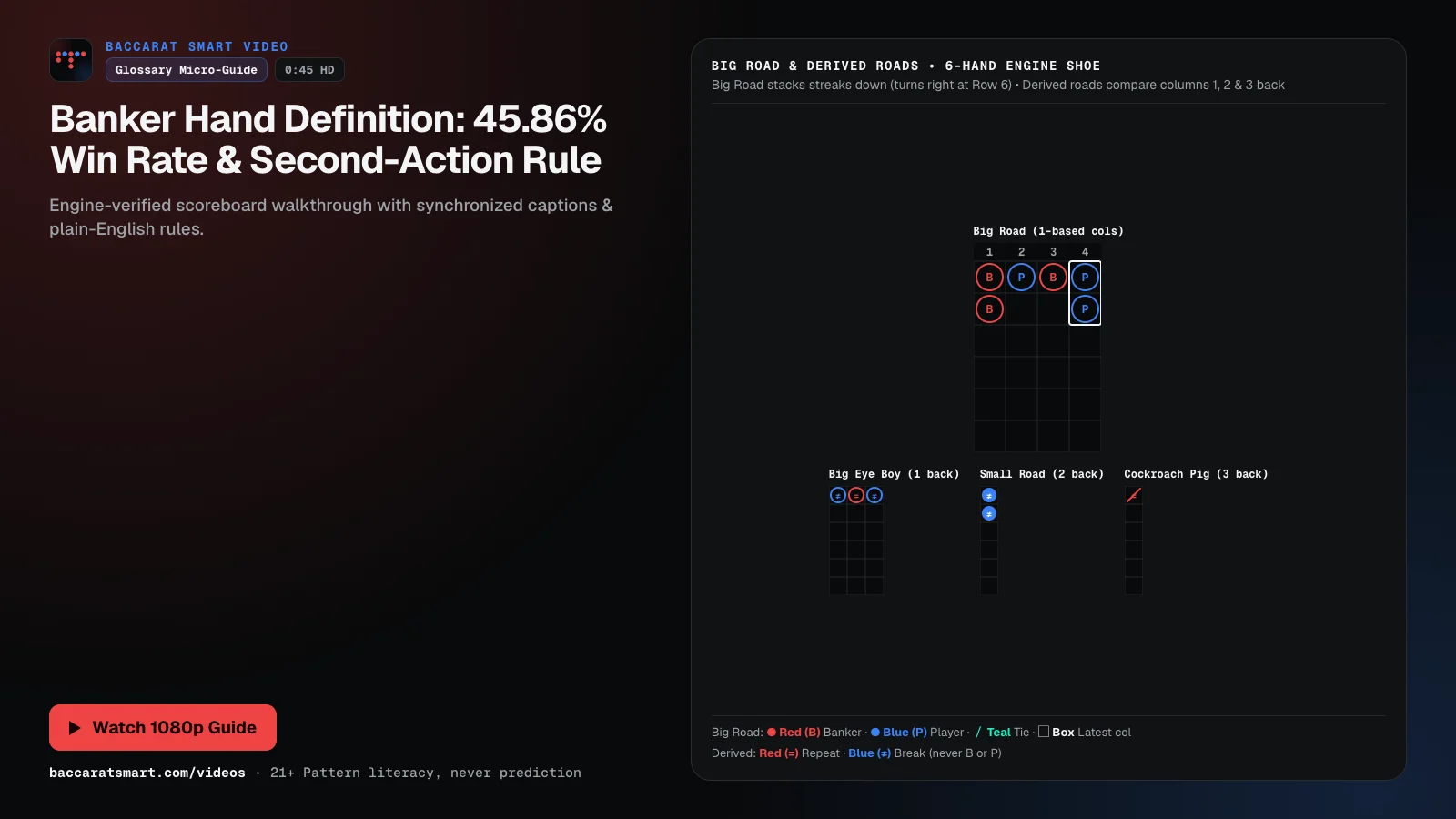
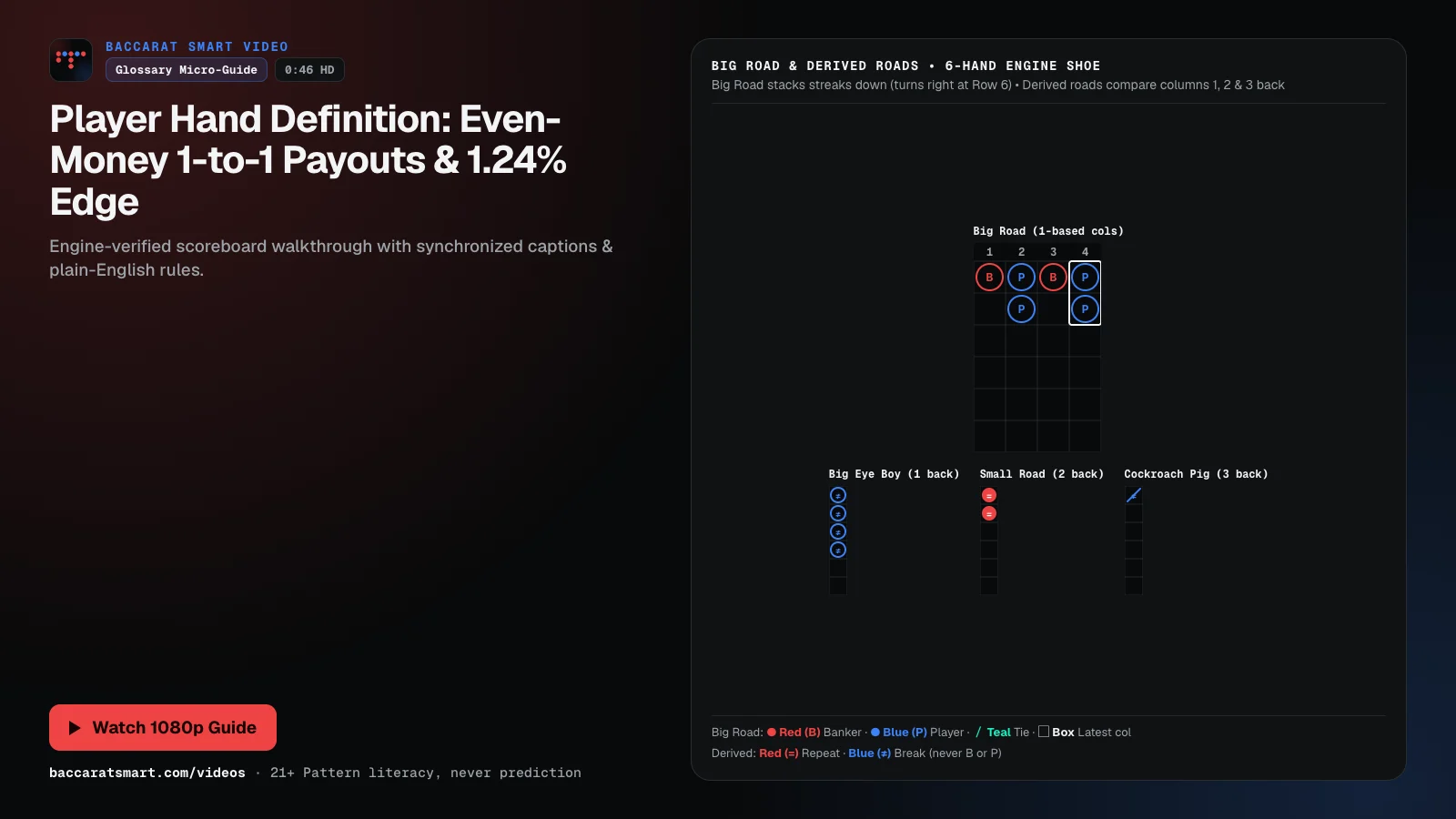
Visual glossary summary of Baccarat Payouts alongside BPTBBP (6 hands), pairing every main and bonus settlement ratio with its exact 8-deck hit rate and house cost.
Practice What You Just Watched
Paired glossary definition: Payouts & Odds
Key takeaways from this video
- Standard payouts: Banker 0.95:1 (1.06% cost), Player 1:1 (1.24% cost), Tie 8:1 (14.36% cost), Pair 11:1 (10.36% cost), Dragon 7 40:1 (7.61% cost), Panda 8 25:1 (10.19% cost).
- A 'to 1' payout returns your original stake on top of winnings (8 to 1 on $10 returns $80 net plus $10 stake = $90 total).
- Higher headline payouts like 25:1 or 40:1 nearly always carry 7x to 13x the statistical cost of the 1:1 and 0.95:1 main boxes.
Interactive shoe sandbox (6 hands)Open interactive 4-road boardHide interactive board
Interactive 5-Road Sandbox · Bead Plate + Big Road + Derived Roads
Try this video's shoe live
Deal extra hands onto this shoe to watch the Bead Plate, Big Road, and all three casino derived roads react live. On derived roads, red = pattern repeating and blue = pattern breaking.
Bead Plate (Chronological)
Read ↓ then →Big Road (6 hands)
4 streak columnsBig Eye Boy
1 backSmall Road
2 backCockroach Pig
3 backHand #6 · Why the newest marks are red or blue
- Big Eye Boy: Column 3 has 2 beads. Column 2 has 1 bead. Different depth → blue (≠).
- Small Road: Column 3 has 2 beads. Column 1 has 1 bead. Different depth → blue (≠).
Opens with this exact 6-hand sequence preloaded—and archives any shoe already on your board first.
Frequently asked questions about this walkthrough
Show 4 FAQsHide FAQs
- What is the difference between '8 to 1' and '8 for 1' on a table layout?
- '8 to 1' pays 8 units of net winnings plus your 1-unit stake back (9 units returned), whereas '8 for 1' includes your stake inside the 8 (only 7 units net).
- Why does raising the Tie payout by one unit (from 8:1 to 9:1) cut the house cost by nearly two-thirds?
- Because Tie hits on 9.516% of hands, one extra unit paid on every winning Tie returns an additional +9.516% of turnover to the customer (14.36% − 9.52% = 4.84%).
- What would true zero-edge fair odds be on a Tie in an 8-deck shoe?
- With a 9.516% hit probability, fair zero-edge Tie odds would be roughly 9.509 to 1.
- Do payouts ever change mid-shoe when a streak bends into a dragon tail?
- Never. Casino payouts are fixed by the printed felt schedule before the shoe begins.