Read full video transcriptShowHide
Effect of Removal — shortened to E-O-R — measures how many fractions of a percent the Banker or Player edge shifts when one card of a given rank leaves the shoe. Because Banker's tableau draws differently against mid cards than low cards, removing a four produces the largest shift toward Banker — just 0.0116 percentage points. Conversely, removing a six produces the largest shift toward Player — just 0.0113 percentage points — while zero-value cards barely budge either main wager. Shifts under twelve thousandths of one percent inside 416 cards explain why road shapes like BPBBPPPB leave odds virtually unchanged. 21+.
Adults 21+ educational content only. Baccarat scoreboards record completed outcomes and never change the mathematical odds of the next hand. Review our Responsible Gambling policy.
Effect of Removal (EOR): Banker & Player Edge Shifts Explained
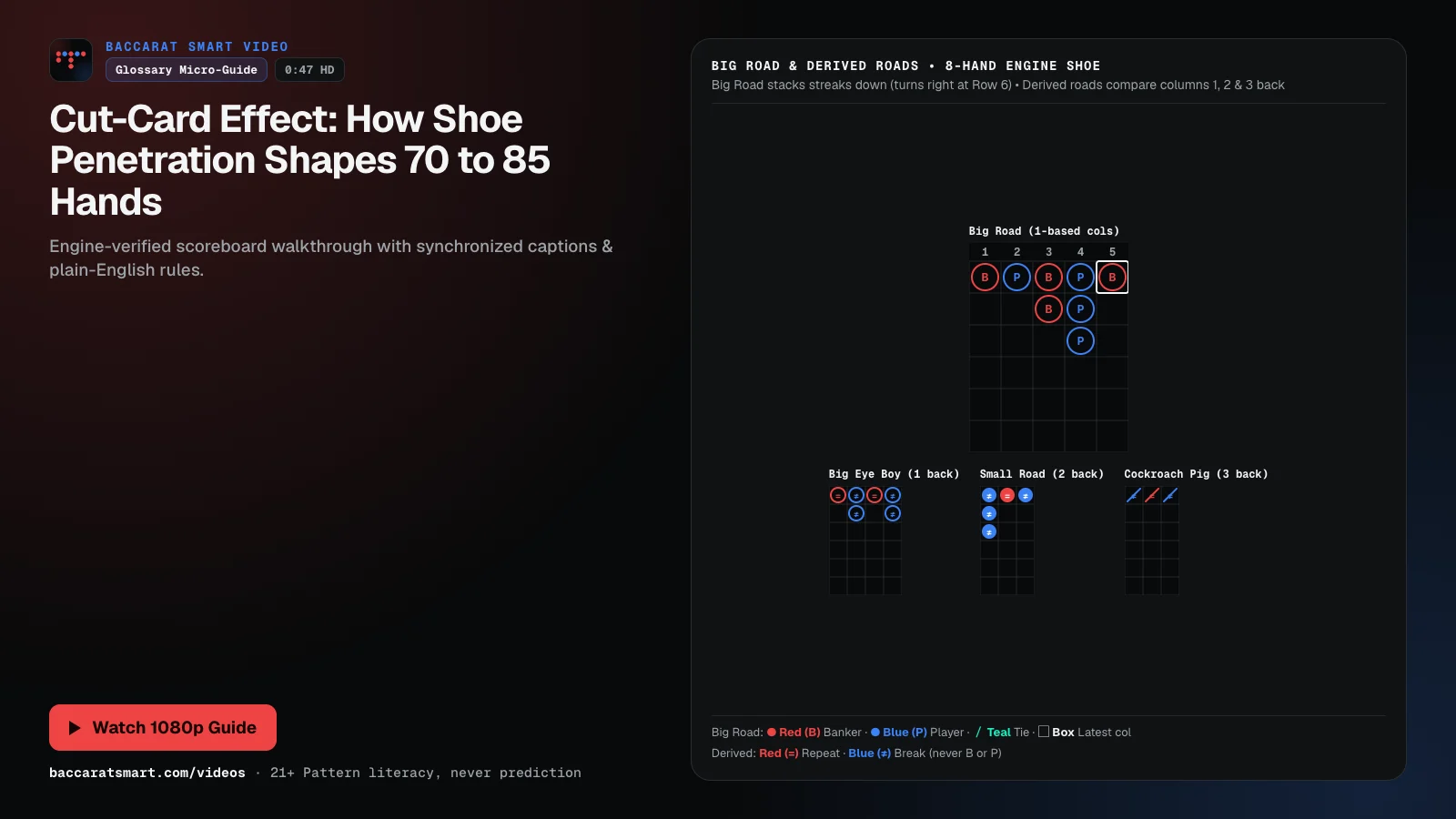
Visual glossary breakdown of Effect of Removal (EOR) alongside BPBBPPPB (8 hands), showing exact single-card Banker and Player edge shifts inside a 416-card shoe.
Practice What You Just Watched
Paired glossary definition: Effect of Removal (EOR)
Key takeaways from this video
- Largest single-card EOR in an 8-deck shoe: removing one 4 lowers Banker's house edge by ~0.0116 percentage points; removing one 6 lowers Player's by ~0.0113 percentage points.
- Contrast with blackjack: removing one 5 or Ace in 6-deck blackjack shifts player expectation by ~0.50% to ~0.65% — roughly 50 times stronger than baccarat!
- EOR proves mathematically that earlier coups connect to the next deal ONLY through physical card depletion, never through scoreboard geometry.
Interactive shoe sandbox (8 hands)Open interactive 4-road boardHide interactive board
Interactive 5-Road Sandbox · Bead Plate + Big Road + Derived Roads
Try this video's shoe live
Deal extra hands onto this shoe to watch the Bead Plate, Big Road, and all three casino derived roads react live. On derived roads, red = pattern repeating and blue = pattern breaking.
Bead Plate (Chronological)
Read ↓ then →Big Road (8 hands)
5 streak columnsBig Eye Boy
1 backSmall Road
2 backCockroach Pig
3 backHand #8 · Why the newest marks are red or blue
- Big Eye Boy: Column 4 has 3 beads. Column 3 has 2 beads. Different depth → blue (≠).
- Small Road: Column 4 has 3 beads. Column 2 has 1 bead. Different depth → blue (≠).
- Cockroach Pig: Column 4 has 3 beads. Column 1 has 1 bead. Different depth → blue (≠).
Opens with this exact 8-hand sequence preloaded—and archives any shoe already on your board first.
Frequently asked questions about this walkthrough
Show 4 FAQsHide FAQs
- Why do Tens and Face cards have an almost microscopic Effect of Removal on main bets?
- Because zero-value cards leave two-card totals unchanged symmetrically for both Player and Banker, removing one 10-value card shifts Banker/Player by under 0.002 percentage points.
- Why does removing 4s help Banker slightly while removing 6s helps Player slightly?
- When extra 6s leave the shoe, Player hits fewer standing 6s and Banker loses favorable 6-draws; when 4s leave, Banker's selective 3/4/5 tableau thresholds perform slightly better.
- How many 4s would have to vanish early just to overcome Player's 1.24% or Banker's 1.06% house cost?
- Overcoming a ~1.1% baseline with ~0.011% single-card shifts requires extreme late-shoe imbalances that appear roughly once in several thousand shoes.
- Do side bets like Dragon 7 have larger Effects of Removal than main bets?
- Yes — because Dragon 7 specifically requires a three-card Banker 7, specific ranks (like 8s, 9s, Aces, 2s, 3s) shift its 7.61% baseline more noticeably than main wagers.