Read full video transcriptShowHide
Edge sorting was a rare physical card-inspection method tied to tiny factory cutting differences on decorative borderless card backs. If guests persuaded a salon dealer to rotate key cards 6, 7, 8, and 9 by 180 degrees during play and reuse the same decks, the leading card in the shoe became identifiable. In 2017, both the UK Supreme Court and US federal courts ruled that inducing card rotation breached table rules. Today casinos use white-bordered symmetrical backs, automatic shufflers, and single-use squeeze decks — leaving every shoe fair like BBPPPB on /calculator. 21+.
Adults 21+ educational content only. Baccarat scoreboards record completed outcomes and never change the mathematical odds of the next hand. Review our Responsible Gambling policy.
Edge Sorting in Baccarat: Card-Back Symmetry & Shoe Controls
A 48-second integrity history explaining how microscopic card-back cut asymmetries were used in famous 2012 salon cases, why courts ruled against it, and how modern casinos secure 8-deck shoes.
Practice What You Just Watched
Paired glossary definition: Edge Sorting
Key takeaways from this video
- Edge sorting required three conditions vanished from modern floors: asymmetric borderless backs, dealer-assisted 180° turns, and multi-shoe reuse without a wash turn.
- Standard white-bordered casino decks and single-use pre-shuffled VIP shoes eliminate physical back-orientation signals completely.
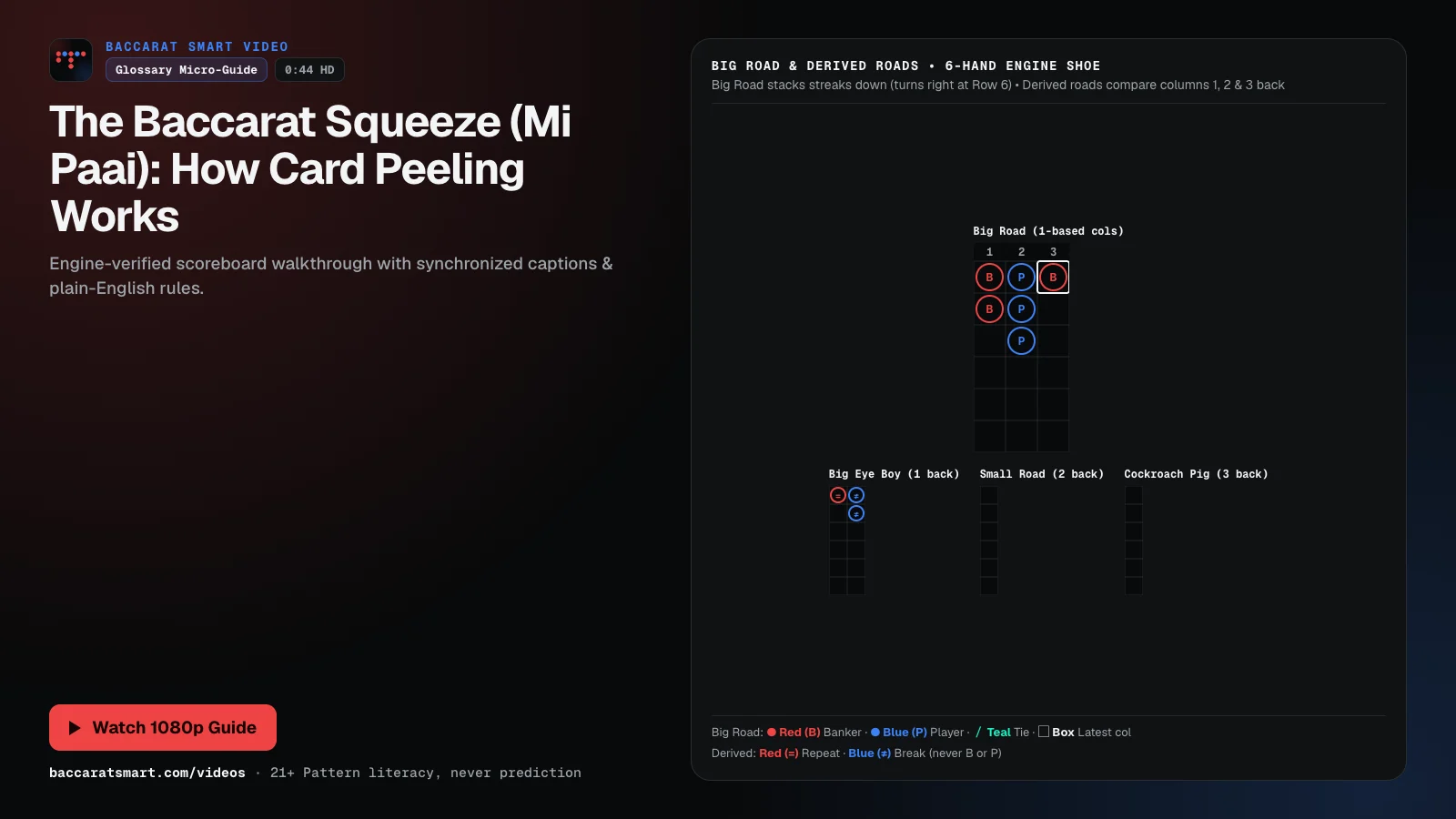
- Scoreboard roads (BBPPPB: 6 hands, 3 Big Road columns, 3 Big Eye Boy marks) record public hand winners and have zero link to physical card backs.
Interactive shoe sandbox (6 hands)Open interactive 4-road boardHide interactive board
Interactive 5-Road Sandbox · Bead Plate + Big Road + Derived Roads
Try this video's shoe live
Deal extra hands onto this shoe to watch the Bead Plate, Big Road, and all three casino derived roads react live. On derived roads, red = pattern repeating and blue = pattern breaking.
Bead Plate (Chronological)
Read ↓ then →Big Road (6 hands)
3 streak columnsBig Eye Boy
1 backSmall Road
2 backCockroach Pig
3 backHand #6 · Why the newest marks are red or blue
- Big Eye Boy: Column 2 has 3 beads. Column 1 has 2 beads. Different depth → blue (≠).
Opens with this exact 6-hand sequence preloaded—and archives any shoe already on your board first.
Frequently asked questions about this walkthrough
Show 4 FAQsHide FAQs
- Why did knowing only the very first card of a coup shift the edge in historical edge sorting?
- If the top card in the shoe (dealt as Player's first card) was known to be a 6, 7, 8, or 9, Player's Natural probability jumped dramatically on that coup.
- Why can't edge sorting happen at a standard Midi squeeze table?
- Squeeze tables open fresh factory-sealed 8-deck bricks for a single shoe and destroy all 416 cards immediately when the cut card ends play.
- How does a dealer's 180-degree wash turn ('the turn') neutralize card asymmetries on reused decks?
- Rotating half the deck 180 degrees during Shuffle Up randomizes card orientations across all 416 cards before the next shoe.
- Is edge sorting possible on RNG or provably-fair digital baccarat?
- Impossible — digital cards are integer indices generated by cryptographic algorithms with zero physical back geometry.