Read full video transcriptShowHide
In casino math, shoe penetration — and the cut-card effect — describes how deep into the 416-card shoe play continues before reshuffling. With ~7 opening burn cards and a 14-card stop marker, baccarat deals roughly 390 to 402 cards — over 94% of the entire 8-deck shoe! At ~4.94 cards per coup, that deep penetration produces 70 to 85 hands per shoe — enough to fill wide five-road displays. Even at 95% penetration, symmetric Player/Banker draws keep main-bet house edges anchored — inspect BPBBPPPB (8 hands) on /calculator. 21+.
Adults 21+ educational content only. Baccarat scoreboards record completed outcomes and never change the mathematical odds of the next hand. Review our Responsible Gambling policy.
Cut-Card Effect: How Shoe Penetration Shapes 70 to 85 Hands
A 47-second math guide explaining baccarat's deep ~95% shoe penetration (~390–402 dealt cards yielding 70–85 coups) and why fixed cut-card depth keeps Banker and Player edges stable alongside an 8-hand board.
Practice What You Just Watched
Paired glossary definition: Cut-Card Effect (Shoe Penetration)
Key takeaways from this video
- Casinos restrict blackjack penetration to ~75%–80% against counters, yet happily deal ~95% of baccarat shoes because main-bet EOR swings are tiny.
- Across our 100,000-shoe 8-deck study (16-card cut from bottom, no opening burn), shoes averaged 81.4 coups (~37–40 Big Road columns).
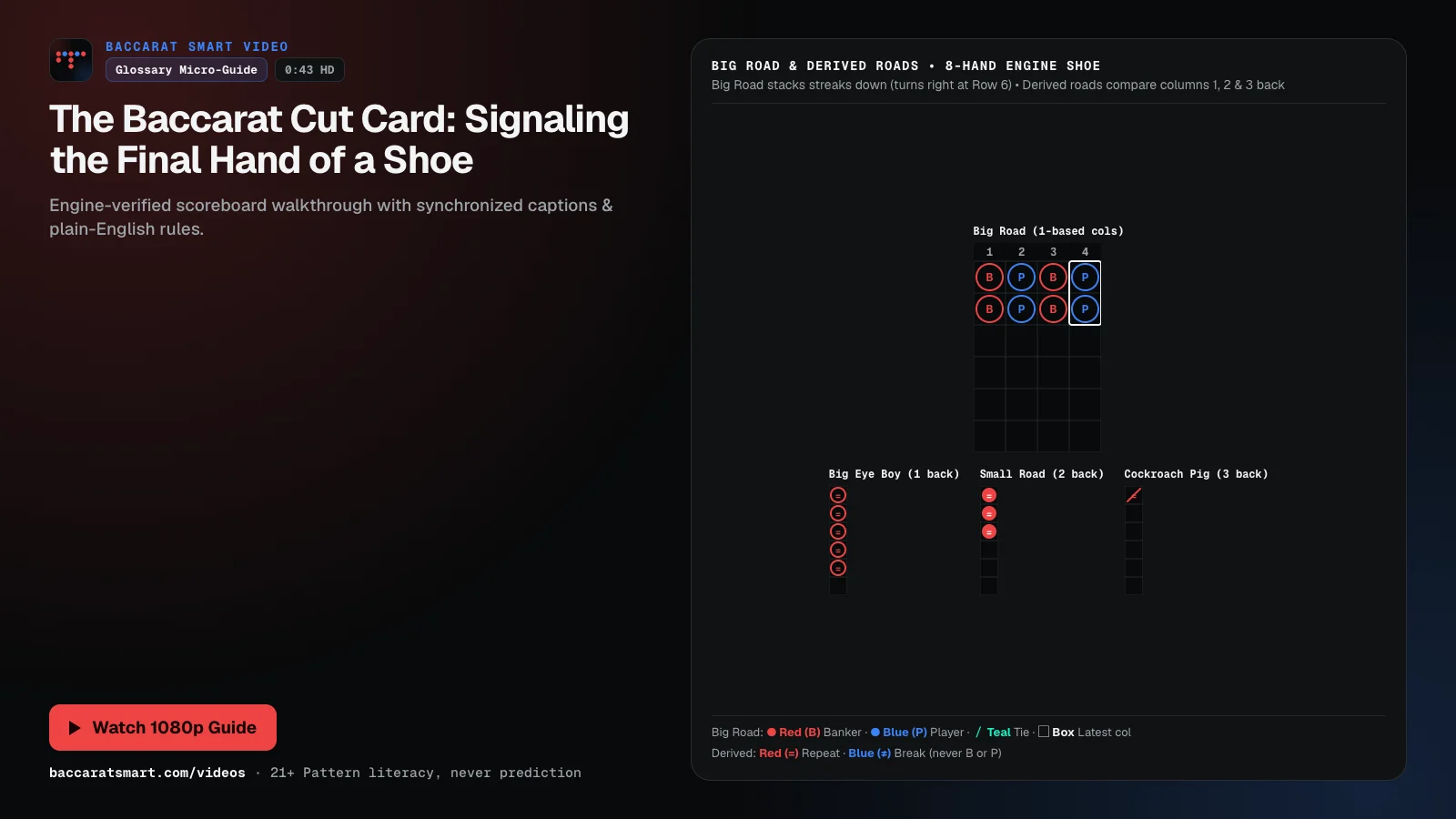
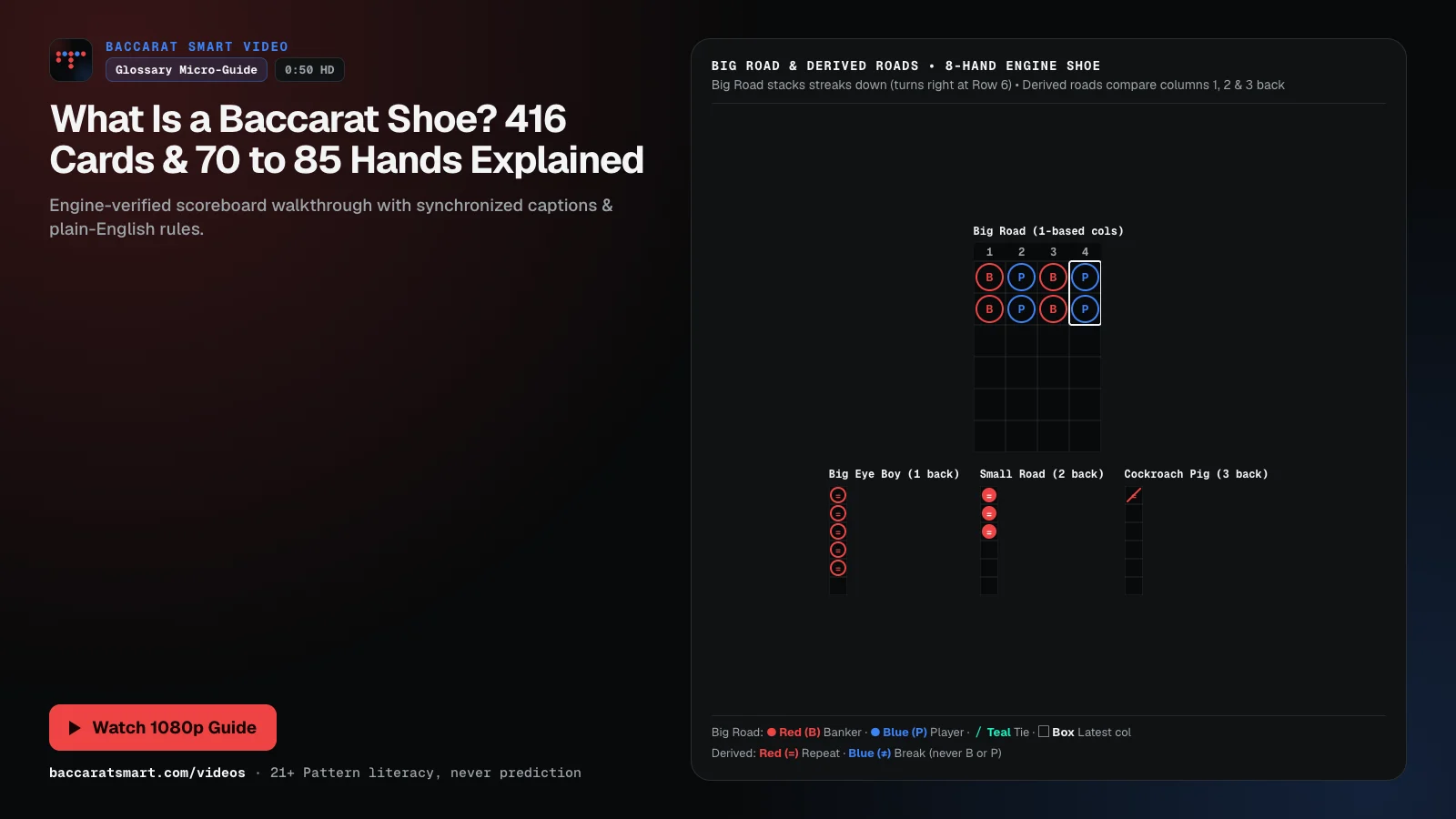
- Sample segment BPBBPPPB (8 hands, 5 Big Road columns) logs 6 Big Eye Boy, 5 Small Road, and 3 Cockroach Pig marks.
Interactive shoe sandbox (8 hands)Open interactive 4-road boardHide interactive board
Interactive 5-Road Sandbox · Bead Plate + Big Road + Derived Roads
Try this video's shoe live
Deal extra hands onto this shoe to watch the Bead Plate, Big Road, and all three casino derived roads react live. On derived roads, red = pattern repeating and blue = pattern breaking.
Bead Plate (Chronological)
Read ↓ then →Big Road (8 hands)
5 streak columnsBig Eye Boy
1 backSmall Road
2 backCockroach Pig
3 backHand #8 · Why the newest marks are red or blue
- Big Eye Boy: Column 4 has 3 beads. Column 3 has 2 beads. Different depth → blue (≠).
- Small Road: Column 4 has 3 beads. Column 2 has 1 bead. Different depth → blue (≠).
- Cockroach Pig: Column 4 has 3 beads. Column 1 has 1 bead. Different depth → blue (≠).
Opens with this exact 8-hand sequence preloaded—and archives any shoe already on your board first.
Frequently asked questions about this walkthrough
Show 4 FAQsHide FAQs
- Why do some shoes deal 84 hands while others end at 72 hands with the same 14-card cut?
- Shoes rich in Naturals (4 cards per coup) consume fewer cards per round and deal more coups; shoes with frequent 5-card and 6-card third-card draws reach the cut card in fewer coups.
- What strictly defines the 'cut-card effect' in advantage-play literature?
- Stopping at a fixed card count (rather than a fixed hand count) creates a tiny correlation on the boundary coup when counting specific ranks — negligible on baccarat main bets.
- Does a shallow cut card (e.g., cutting off 2 decks) hurt non-counting flat bettors?
- Not on percentage house edge (still 1.06% Banker / 1.24% Player); it only adds more frequent shuffle pauses, dealing fewer hands per hour.
- What happens when a 75-hand shoe exceeds the width of an electronic Big Road screen?
- The electronic display scrolls older left-hand columns smoothly off-screen so the active right-hand columns and dragon tails stay clearly visible.