Read full video transcriptShowHide
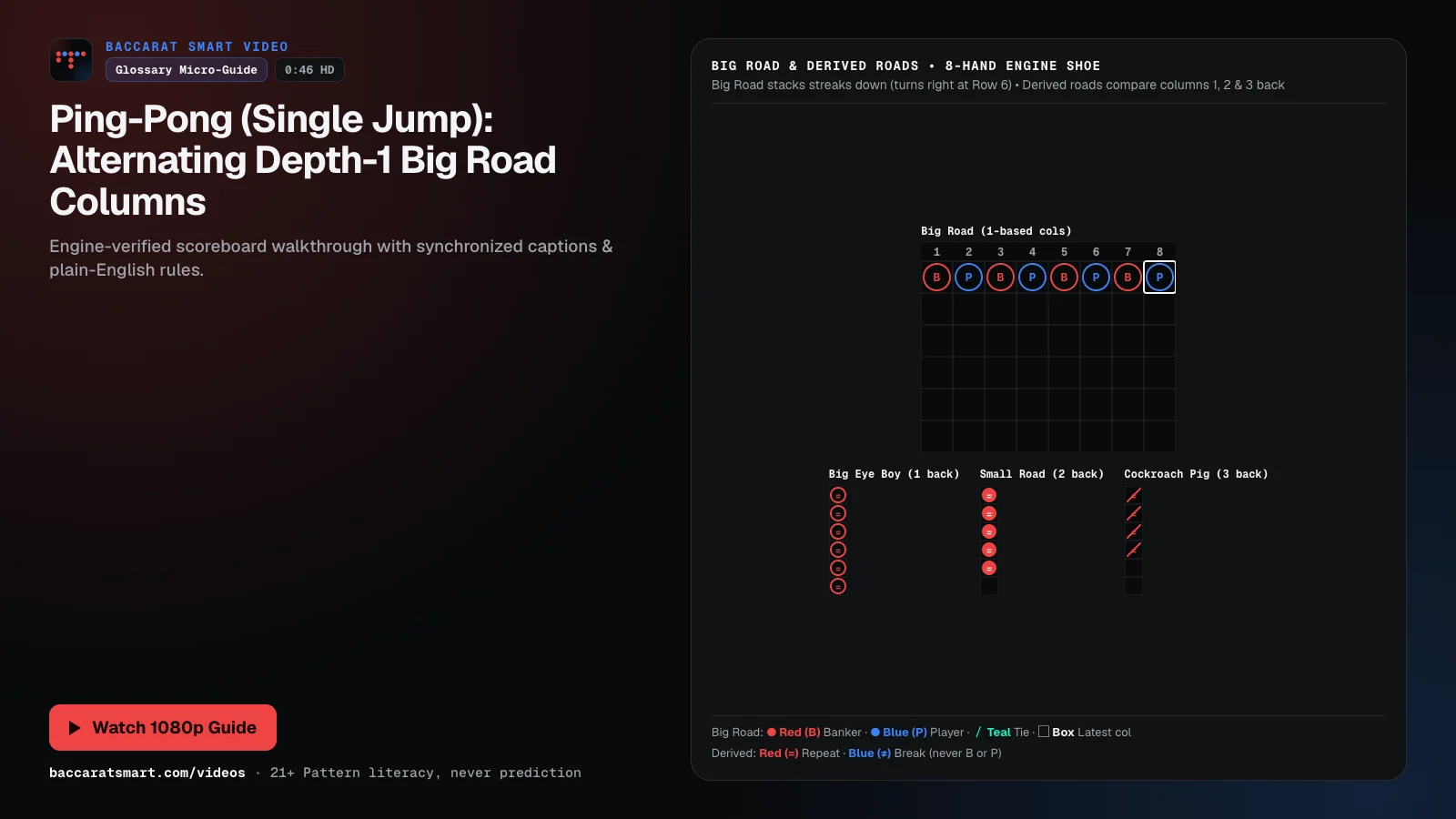
In table vocabulary, a chop — Tiu in Cantonese — describes a stretch of a shoe where outcomes jump frequently between Banker and Player after one or two hands. Visually, the Big Road stays shallow near Rows 1 and 2 across many narrow columns instead of dropping into deep vertical streaks. A steady single-hand chop paints red across derived roads, whereas mixing one-bead and two-bead columns flips Rule 1 and Rule 2 between red and blue. On choppy shoe BPBBPBPPBBPP (12 hands, 8 columns), Big Eye Boy splits 5 red and 5 blue — explore it free on /calculator. 21+.
Adults 21+ educational content only. Baccarat scoreboards record completed outcomes and never change the mathematical odds of the next hand. Review our Responsible Gambling policy.
Chop in Baccarat: Reading Short 1-Bead & 2-Bead Columns
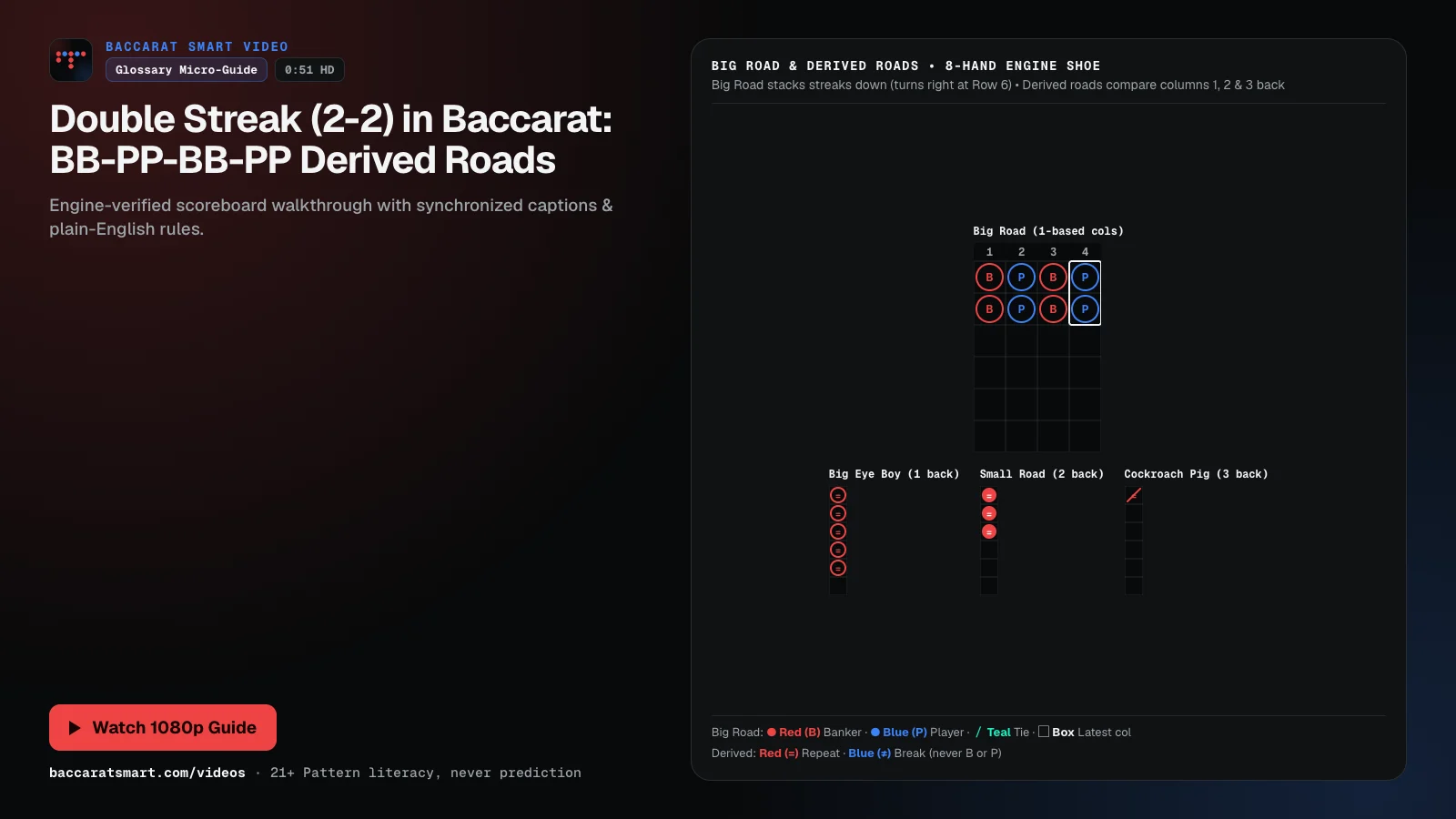
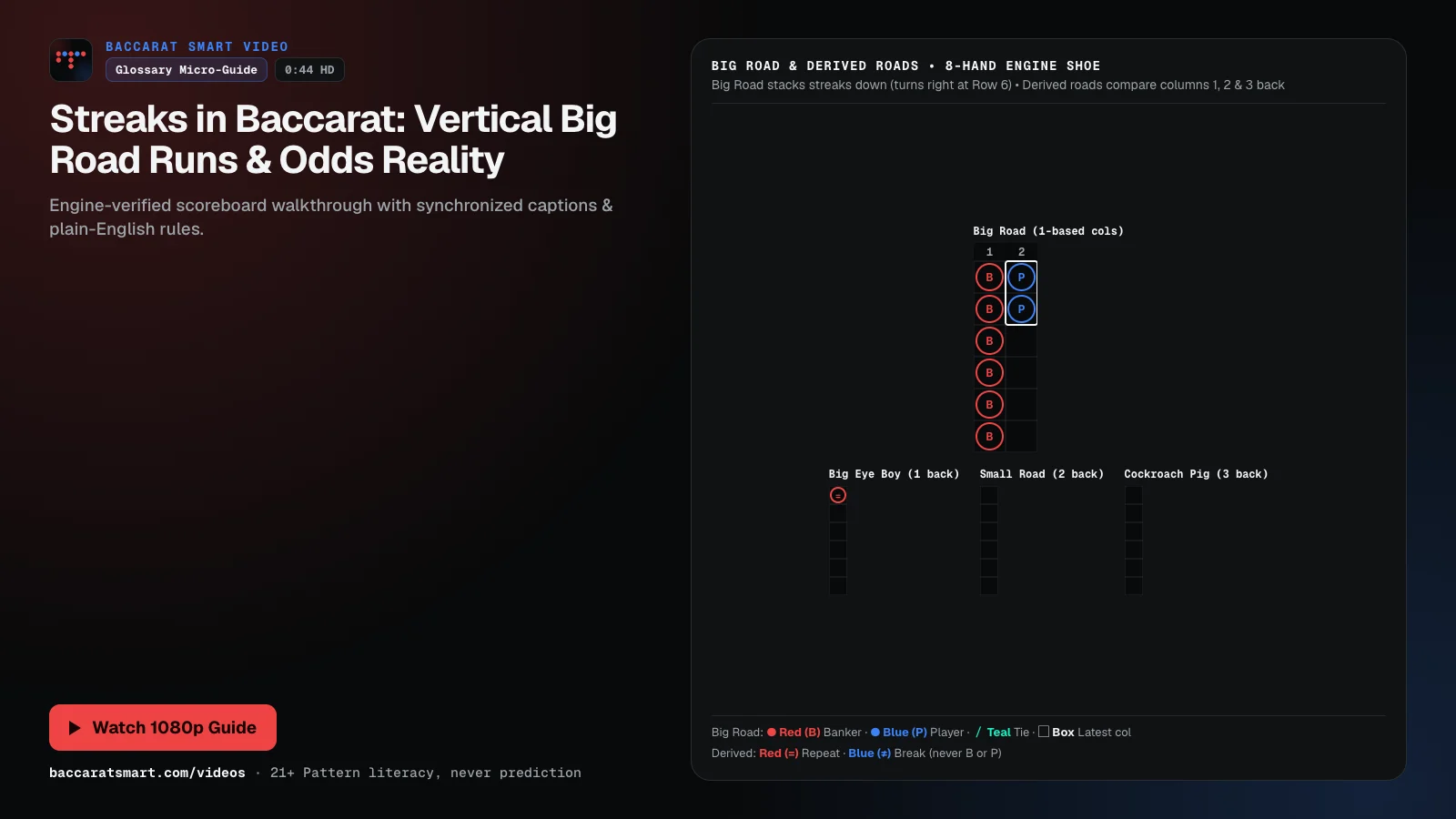
Visual glossary definition of a Chop (跳) on BPBBPBPPBBPP (12 hands across 8 short Big Road columns), contrasting mixed 1- and 2-bead switches with steady ping-pong alternation.
Practice What You Just Watched
Paired glossary definition: Chop
Key takeaways from this video
- Choppy stretches keep Big Road columns at depth 1 or 2; derived roads show whether those short switches follow a steady rhythm (red) or uneven depths (blue).
- In an 8-deck shoe, roughly 75% of all Big Road columns end at depth 1 or depth 2 naturally by probability (~50% depth 1, ~25% depth 2).
- Shoe BPBBPBPPBBPP (12 hands, 8 columns) produces 10 Big Eye Boy marks (5R/5B) and 9 Small Road marks (2R/7B).
Interactive shoe sandbox (12 hands)Open interactive 4-road boardHide interactive board
Interactive 5-Road Sandbox · Bead Plate + Big Road + Derived Roads
Try this video's shoe live
Deal extra hands onto this shoe to watch the Bead Plate, Big Road, and all three casino derived roads react live. On derived roads, red = pattern repeating and blue = pattern breaking.
Bead Plate (Chronological)
Read ↓ then →Big Road (12 hands)
8 streak columnsBig Eye Boy
1 backSmall Road
2 backCockroach Pig
3 backHand #12 · Why the newest marks are red or blue
- Big Eye Boy: This bead is at Row 2. Column 7 has a bead at Row 2 too → red (=).
- Small Road: This bead is at Row 2. Column 6 has a bead at Row 2 too → red (=).
- Cockroach Pig: This bead is at Row 2. Column 5 stopped at Row 1, one row above → blue (≠).
Opens with this exact 12-hand sequence preloaded—and archives any shoe already on your board first.
Frequently asked questions about this walkthrough
Show 4 FAQsHide FAQs
- Why do most shoes look 'choppy' across large portions of the Big Road?
- Because each new column has roughly a 50% chance to switch after 1 bead and a 25% chance after 2 beads, three-quarters of all columns in random 8-deck shoes are 1 or 2 beads tall.
- What is the difference between 'Ping-Pong' and 'Chop'?
- Ping-Pong specifically means strict 1-1-1-1 single-hand alternation, while 'chop' broadly covers any stretch of short 1- and 2-hand switches without deep streaks.
- Can Small Road paint pure red during a choppy shoe while Big Eye Boy paints pure blue?
- Yes! On a repeating 1-2-1-2 chop (B-PP-B-PP), adjacent columns differ (Big Eye Boy all blue) while every column matches two columns back (Small Road all red).
- Does a choppy first half of a shoe make deep streaks more likely in the second half?
- No. Earlier hands shift the next deal only through the cards already used up, and by far too little to act on; streak probabilities stay near baseline throughout the shoe.