Read full video transcriptShowHide
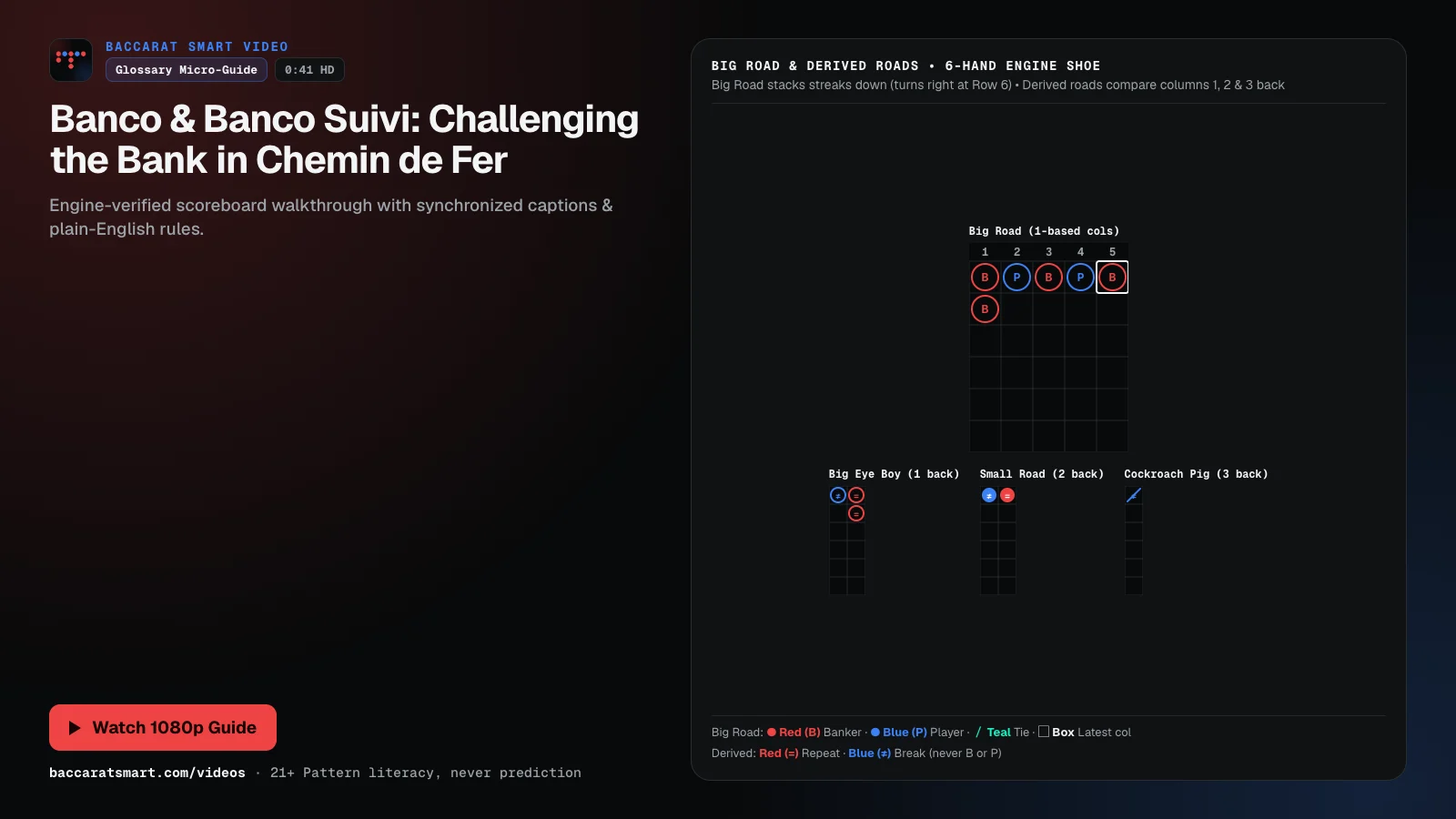
Chemin de Fer — French for 'iron road' or railway, nicknamed Chemmy — is the classic 6-deck salon ancestor of modern casino baccarat. Instead of the casino banking the table, one seated guest risks their own bank stake while fellow players wager against them and the house collects a 5% fee on Banker wins. Whenever the Banker hand loses a coup, the wooden sabot slides counterclockwise along the felt like a train car to the next player. Modulo-10 totals and Naturals 8 and 9 carry straight into modern 8-deck Punto Banco — inspect BBPPBP (6 hands) on /calculator. 21+.
Adults 21+ educational content only. Baccarat scoreboards record completed outcomes and never change the mathematical odds of the next hand. Review our Responsible Gambling policy.
Chemin de Fer Explained: Historic 6-Deck Player-Banked Play
A 45-second historical walkthrough of Chemin de Fer ('iron road / railway'), explaining how players bank against one another with a 6-deck rotating sabot contrasted against modern Punto Banco on a 6-hand board.
Practice What You Just Watched
Paired glossary definition: Chemin de Fer ('Chemmy')
Key takeaways from this video
- Three core differences from Punto Banco: (1) 6 decks vs 8 decks, (2) players bank against other players rather than the house, and (3) optional draw/stand on totals of 5.
- If the active Banker wins in Chemin de Fer, they keep the shoe ('parole') or may voluntarily retire their bank ('passer la main').
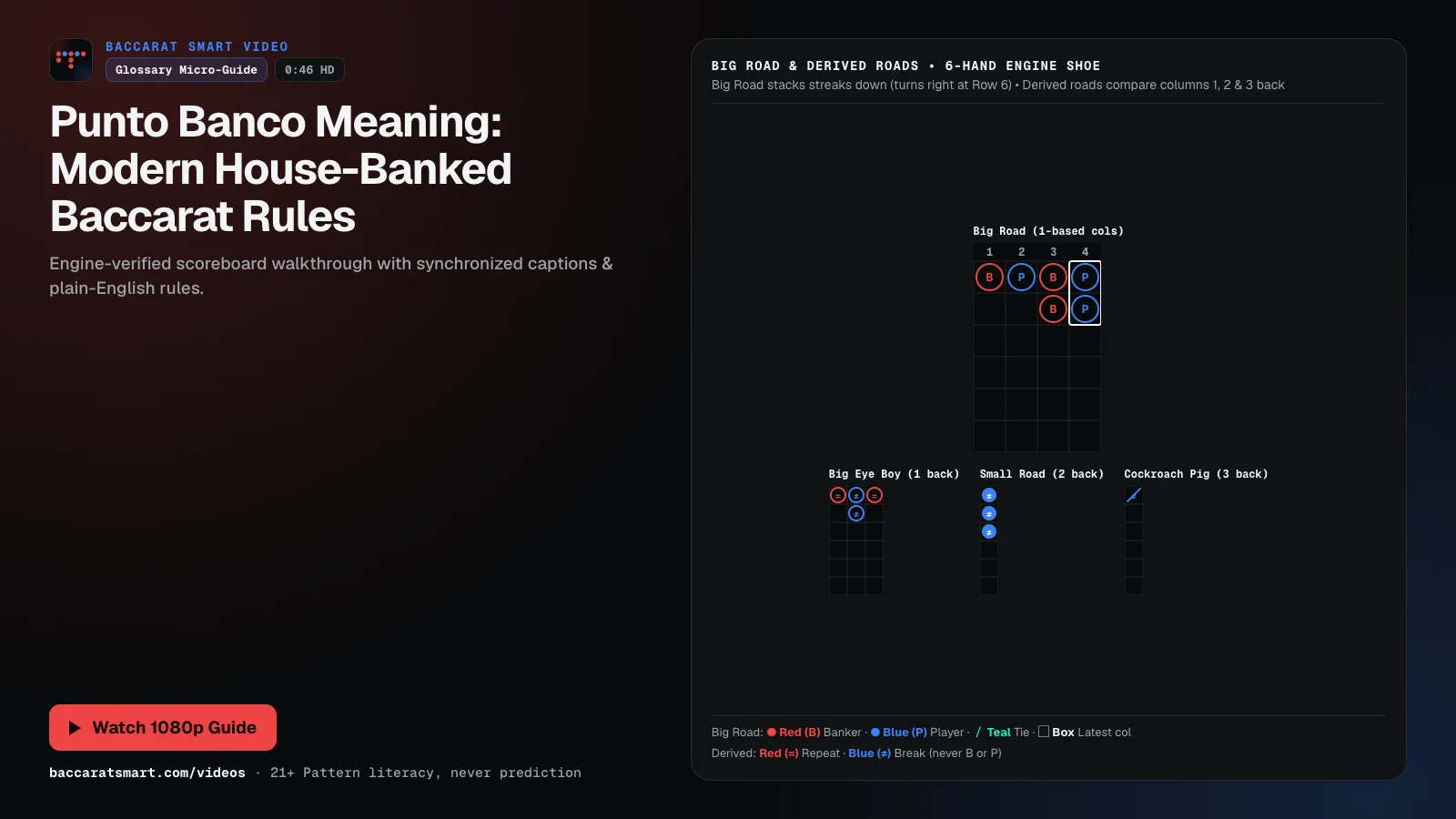
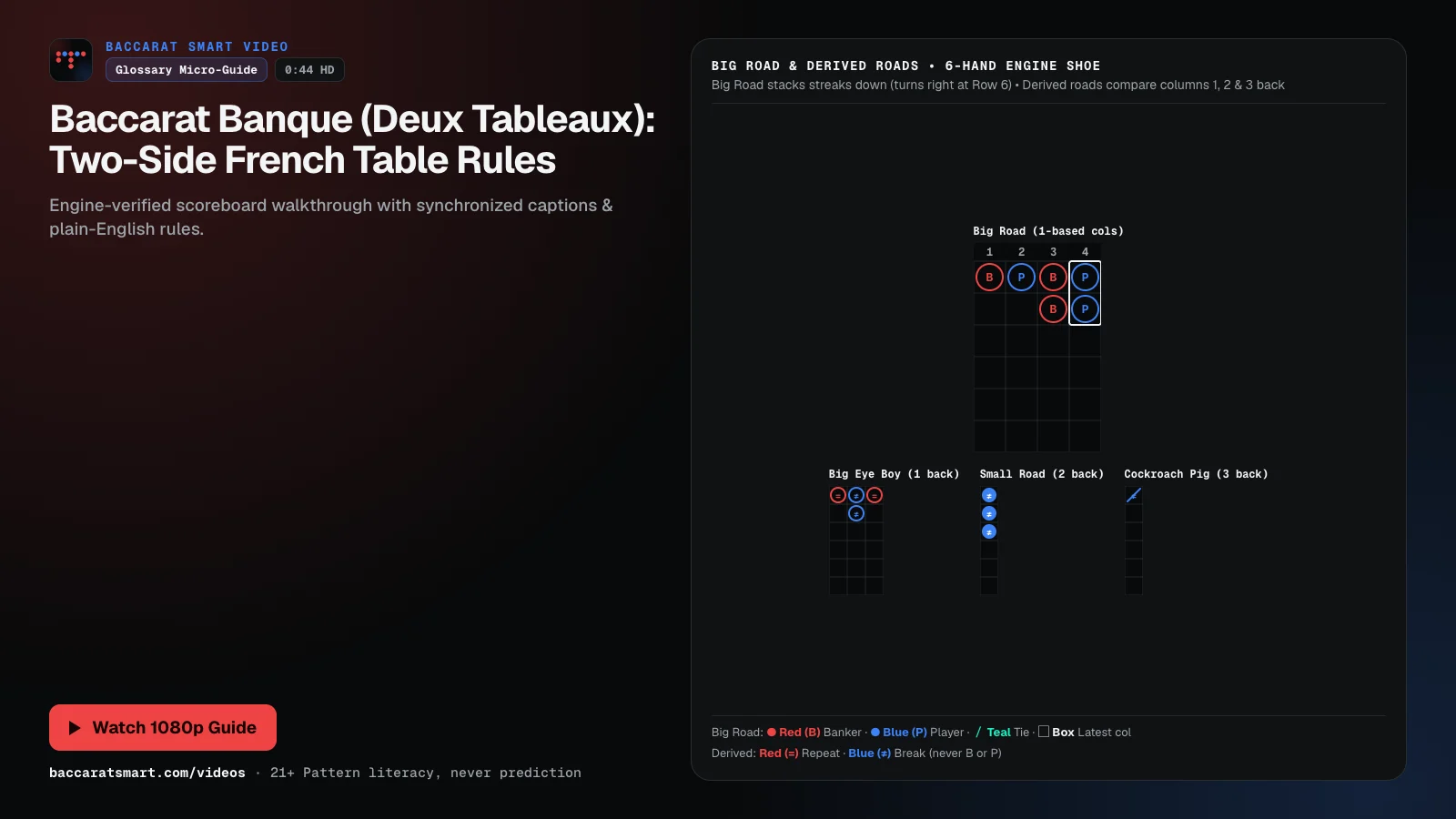
- Sample 6-hand sequence BBPPBP forms 4 Big Road columns and 3 Big Eye Boy marks.
Interactive shoe sandbox (6 hands)Open interactive 4-road boardHide interactive board
Interactive 5-Road Sandbox · Bead Plate + Big Road + Derived Roads
Try this video's shoe live
Deal extra hands onto this shoe to watch the Bead Plate, Big Road, and all three casino derived roads react live. On derived roads, red = pattern repeating and blue = pattern breaking.
Bead Plate (Chronological)
Read ↓ then →Big Road (6 hands)
4 streak columnsBig Eye Boy
1 backSmall Road
2 backCockroach Pig
3 backHand #6 · Why the newest marks are red or blue
- Big Eye Boy: Column 3 has 1 bead. Column 2 has 2 beads. Different depth → blue (≠).
- Small Road: Column 3 has 1 bead. Column 1 has 2 beads. Different depth → blue (≠).
Opens with this exact 6-hand sequence preloaded—and archives any shoe already on your board first.
Frequently asked questions about this walkthrough
Show 4 FAQsHide FAQs
- How does the casino earn revenue in Chemin de Fer if players bank against each other?
- The house takes zero risk on the cards and instead deducts a ~5% cagnotte (table fee) from winning Banker coups for providing the salon, cards, and croupier.
- What happens if a seated player does not wish to hold the bank when the sabot reaches them?
- Any guest may say 'Je passe' (I pass), sliding the wooden sabot counterclockwise to the next willing seat.
- Why did Chemin de Fer give way to Punto Banco across global casinos?
- Player-banked games cap total action at whatever one guest puts in the bank, whereas house-banked Punto Banco lets every seat wager freely on either Banker or Player.
- Are card point values identical in Chemin de Fer and Punto Banco?
- Yes — Ace = 1, 2–9 = face value, 10/J/Q/K = 0, modulo 10, with Natural 8 and Natural 9 topping all draws.