Read full video transcriptShowHide
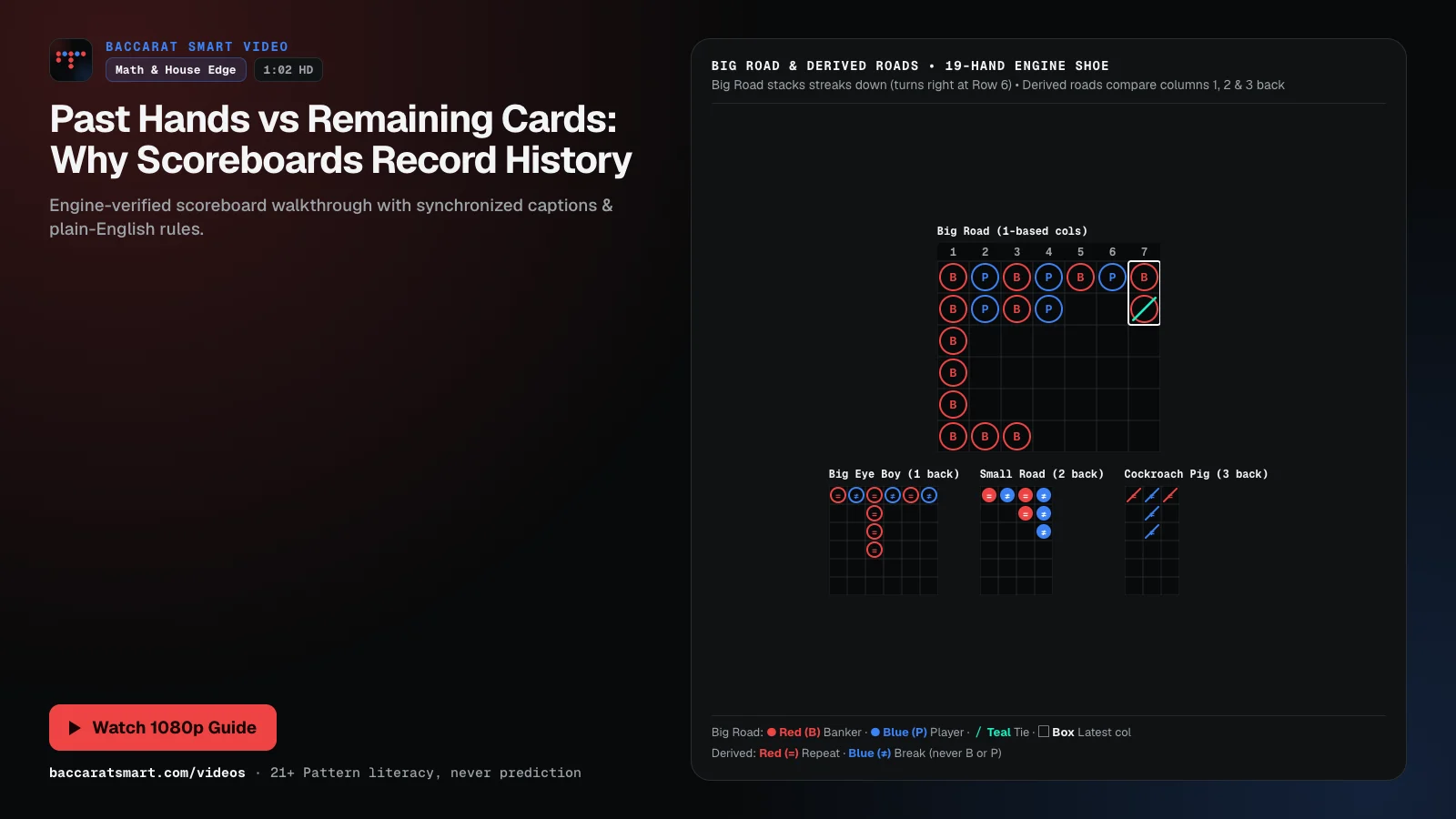
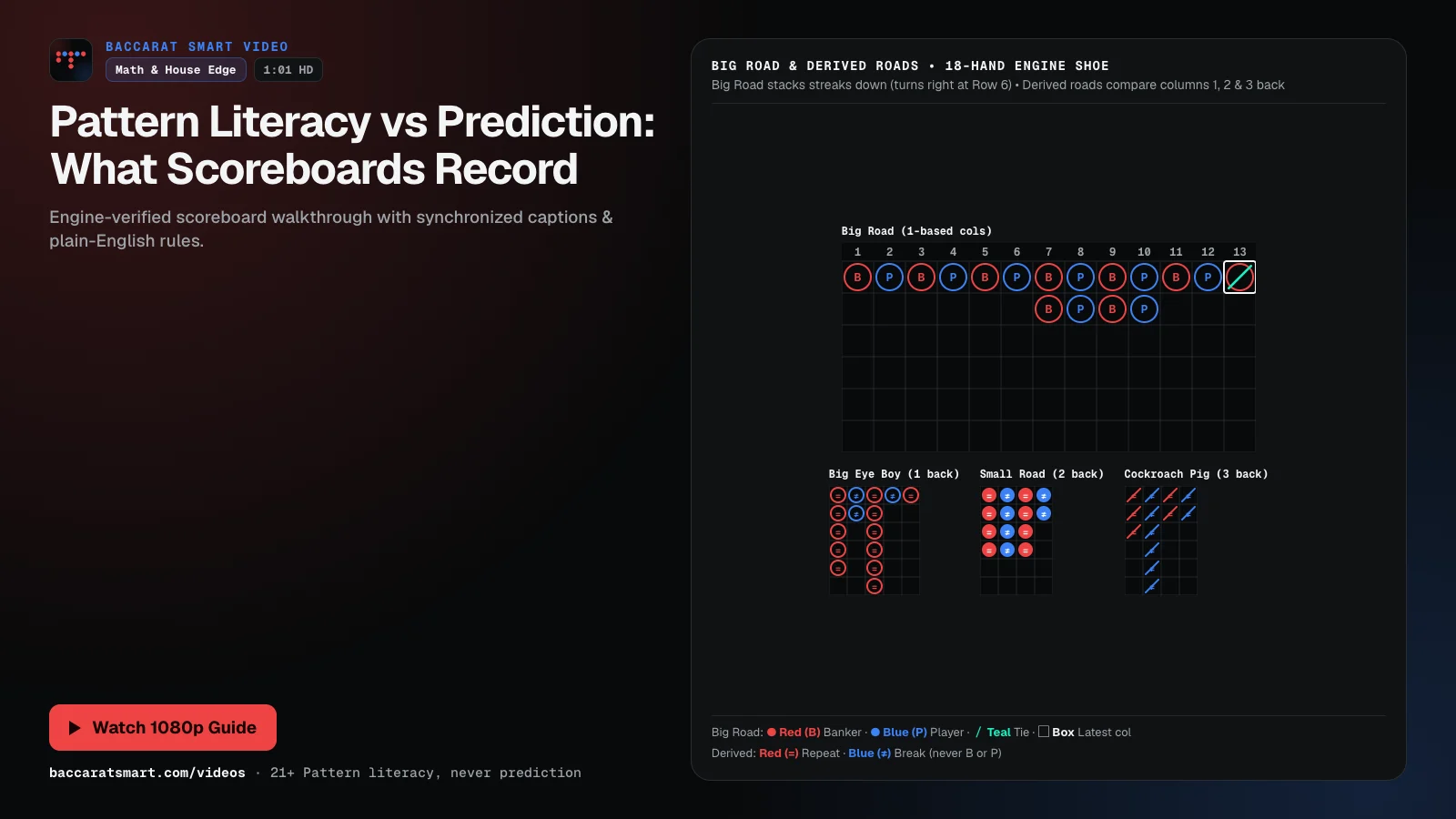
Gambler's fallacy is the belief that a long Banker or Player streak makes the opposite side 'due' on the very next hand. In this 18-hand shoe (BBBBBBBPPBBPBBPPTB), Column 1 opens with 7 straight Banker wins that bend right along Row 6 as a dragon tail. Cards lack a balancing mechanism: dealt ranks shift 8-deck odds by tiny hundredths of a percent, leaving the next decided hand near 50.68% Banker. Read Big Eye Boy, Small Road, and Cockroach Pig as clear records of completed streaks at baccaratsmart.com/calculator. 21+.
Adults 21+ educational content only. Baccarat scoreboards record completed outcomes and never change the mathematical odds of the next hand. Review our Responsible Gambling policy.
Streaks & Probability in Baccarat: Understanding Gambler's Fallacy
A 60-second probability breakdown tracing a 7-bead Banker dragon tail inside an 18-hand shoe (7 Big Road columns) to show why long runs neither force a reversal nor lock in a repeat.
Practice What You Just Watched
Paired written guide: Gambler’s Fallacy in Baccarat: Streaks & Bias
Key takeaways from this video
- Neither 'the opposite side is due' (gambler's fallacy) nor 'the streak must continue' (hot-hand bias) alters the physical cards left in the shoe.
- Across our 100,000-shoe 8-deck study, 7-plus decided runs occurred in 43.22% of shoes, and the very next decided hand still split ~50.7% Banker / ~49.3% Player.
- Shoe BBBBBBBPPBBPBBPPTB (18 hands, 7 Big Road columns) opens with depth 7 in Column 1 and logs 9 Big Eye Boy, 7 Small Road, and 5 Cockroach Pig marks.
Interactive shoe sandbox (18 hands)Open interactive 4-road boardHide interactive board
Interactive 5-Road Sandbox · Bead Plate + Big Road + Derived Roads
Try this video's shoe live
Deal extra hands onto this shoe to watch the Bead Plate, Big Road, and all three casino derived roads react live. On derived roads, red = pattern repeating and blue = pattern breaking.
Bead Plate (Chronological)
Read ↓ then →Big Road (18 hands)
7 streak columnsBig Eye Boy
1 backSmall Road
2 backCockroach Pig
3 backHand #18 · Why the newest marks are red or blue
- Big Eye Boy: Column 6 has 2 beads. Column 5 has 2 beads. Same depth → red (=).
- Small Road: Column 6 has 2 beads. Column 4 has 1 bead. Different depth → blue (≠).
- Cockroach Pig: Column 6 has 2 beads. Column 3 has 2 beads. Same depth → red (=).
Opens with this exact 18-hand sequence preloaded—and archives any shoe already on your board first.
Frequently asked questions about this walkthrough
Show 4 FAQsHide FAQs
- What is the difference between gambler's fallacy and hot-hand bias at a baccarat table?
- Gambler's fallacy assumes a long Banker run makes Player overdue on the next coup, while hot-hand bias assumes the streak carries momentum. Both overlook that only remaining shoe cards determine the next deal.
- How much do seven consecutive Banker wins shift the 8-deck odds?
- Single-card depletion in a 416-card shoe shifts Banker or Player house edge by hundredths of a percentage point per card, keeping main-bet odds anchored near 1.06% Banker and 1.24% Player.
- How often should players expect to see a 7-hand dragon tail in a real shoe?
- In simulated 8-deck Punto Banco shoes, at least one streak of 7 or more decided wins appears in roughly 43.22% of shoes — nearly half of all shoes dealt.
- Do red marks on Big Eye Boy confirm that a streak will continue?
- No. On derived roads, red (=) records that a completed Big Road step matched the column 1, 2, or 3 back; it never forecasts the next coup.