Read full video transcriptShowHide
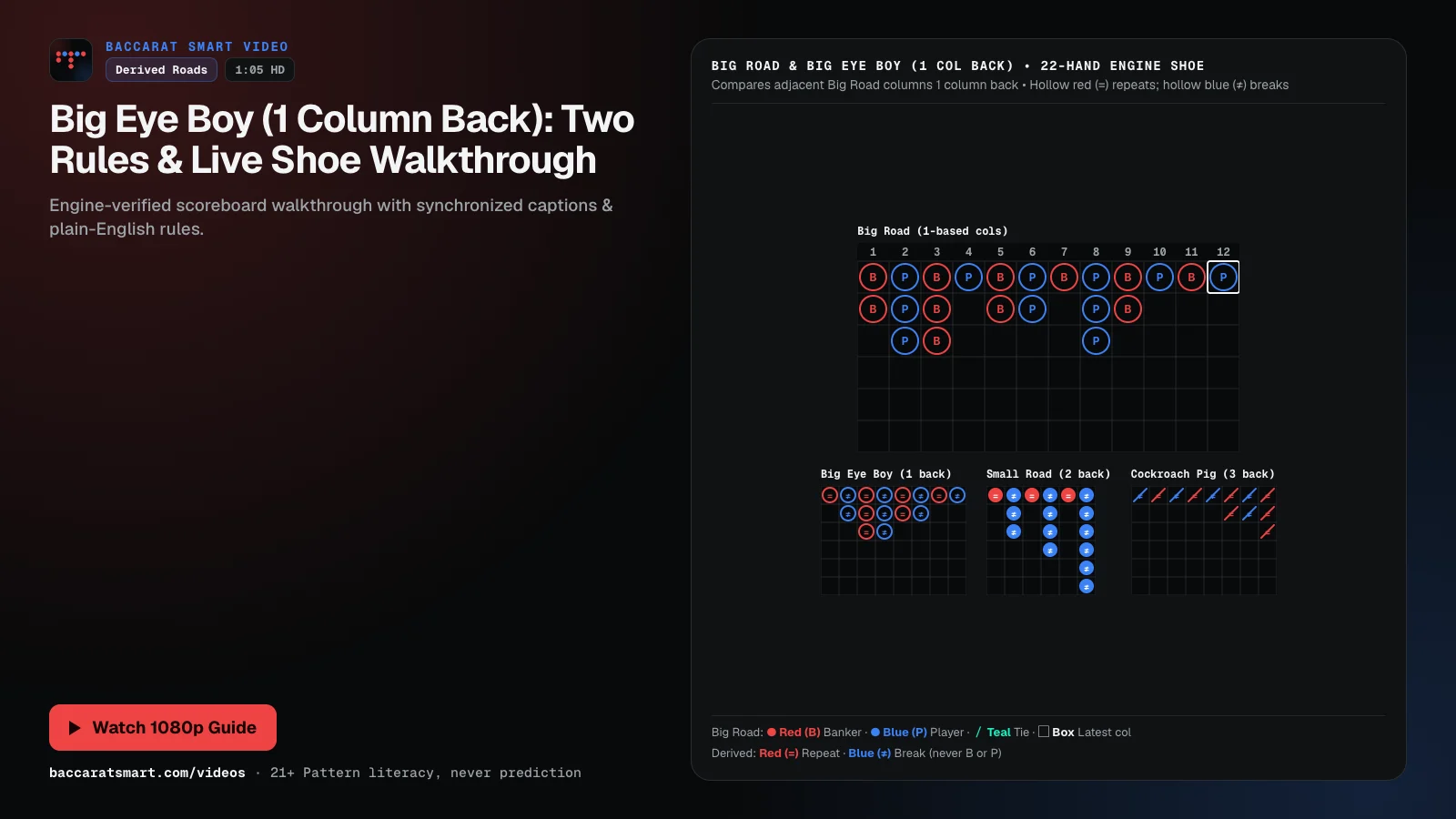
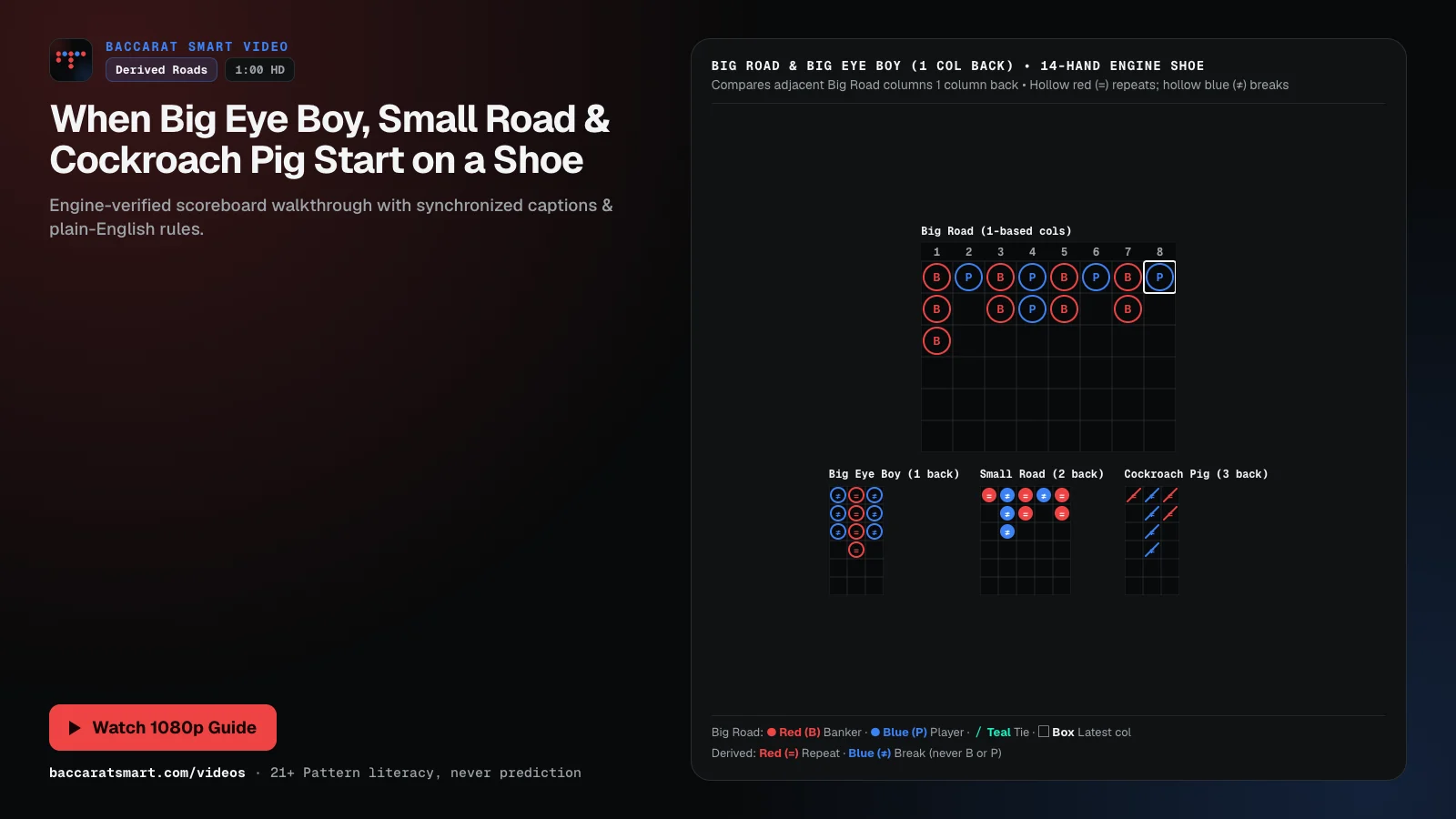
Every mark on Big Eye Boy, Small Road, and Cockroach Pig comes from one simple branch: Row 1 uses Rule 1, and Row 2 or deeper uses Rule 2. When a hand opens a new Big Road column at Row 1, Rule 1 compares the column that just finished with 1 column further back: matching depths paint red, different depths paint blue. When a streak continues down to Row 2 or deeper, Rule 2 checks 1 column back at the same row: a bead there paints red, and stopping one row above paints blue. In BBPBBBBPPBBP (12 hands), Column 3 Row 3 and Row 4 show Case 3: Column 2 stopped at Row 1 — more than one row above — so both paint red! 21+.
Adults 21+ educational content only. Baccarat scoreboards record completed outcomes and never change the mathematical odds of the next hand. Review our Responsible Gambling policy.
Rule 1 vs Rule 2: How Every Derived-Road Mark Is Computed
A 67-second algorithm deep dive on a 12-hand shoe (6 Big Road columns) contrasting Row 1 new-column depth checks (Rule 1) against Row 2-plus downward checks across all three cases of Rule 2.
Practice What You Just Watched
Paired written guide: Big Eye Boy Rule 1 vs Rule 2 Explained
Key takeaways from this video
- Check the Big Road row of the hand just dealt first: Row 1 always runs Rule 1 (comparing two completed column lengths); Row 2+ always runs Rule 2.
- Rule 2 has three cases, never two: reference column has a bead at this row → red (=); stopped one row above → blue (≠); stopped two or more rows above → red (=).
- On shoe BBPBBBBPPBBP (12 hands, depths 2-1-4-2-2-1), Big Eye Boy records 9 marks (5 red, 4 blue) — Big Eye Boy's latest mark (#9): Column 5 has 2 beads. Column 4 has 2 beads. Same depth → red (=).
Interactive shoe sandbox (12 hands)Open interactive 4-road boardHide interactive board
Interactive 5-Road Sandbox · Bead Plate + Big Road + Derived Roads
Try this video's shoe live
Deal extra hands onto this shoe to watch the Bead Plate, Big Road, and all three casino derived roads react live. On derived roads, red = pattern repeating and blue = pattern breaking.
Bead Plate (Chronological)
Read ↓ then →Big Road (12 hands)
6 streak columnsBig Eye Boy
1 backSmall Road
2 backCockroach Pig
3 backHand #12 · Why the newest marks are red or blue
- Big Eye Boy: Column 5 has 2 beads. Column 4 has 2 beads. Same depth → red (=).
- Small Road: Column 5 has 2 beads. Column 3 has 4 beads. Different depth → blue (≠).
- Cockroach Pig: Column 5 has 2 beads. Column 2 has 1 bead. Different depth → blue (≠).
Opens with this exact 12-hand sequence preloaded—and archives any shoe already on your board first.
Frequently asked questions about this walkthrough
Show 4 FAQsHide FAQs
- Why can't Rule 1 compare the brand-new Big Road column's own depth?
- At Row 1 the new column has only one bead and is not finished yet, so Rule 1 steps one column left to compare the column that just finished against the column 1, 2, or 3 further back.
- What is the most common mistake beginners make on Rule 2?
- Saying 'empty cell means blue.' Empty is blue ONLY when the reference column stopped one row above; once it stopped two or more rows above (Case 3, as in BPPP), the mark turns red (=).
- How do Small Road and Cockroach Pig apply Rule 1 and Rule 2 at wider distances?
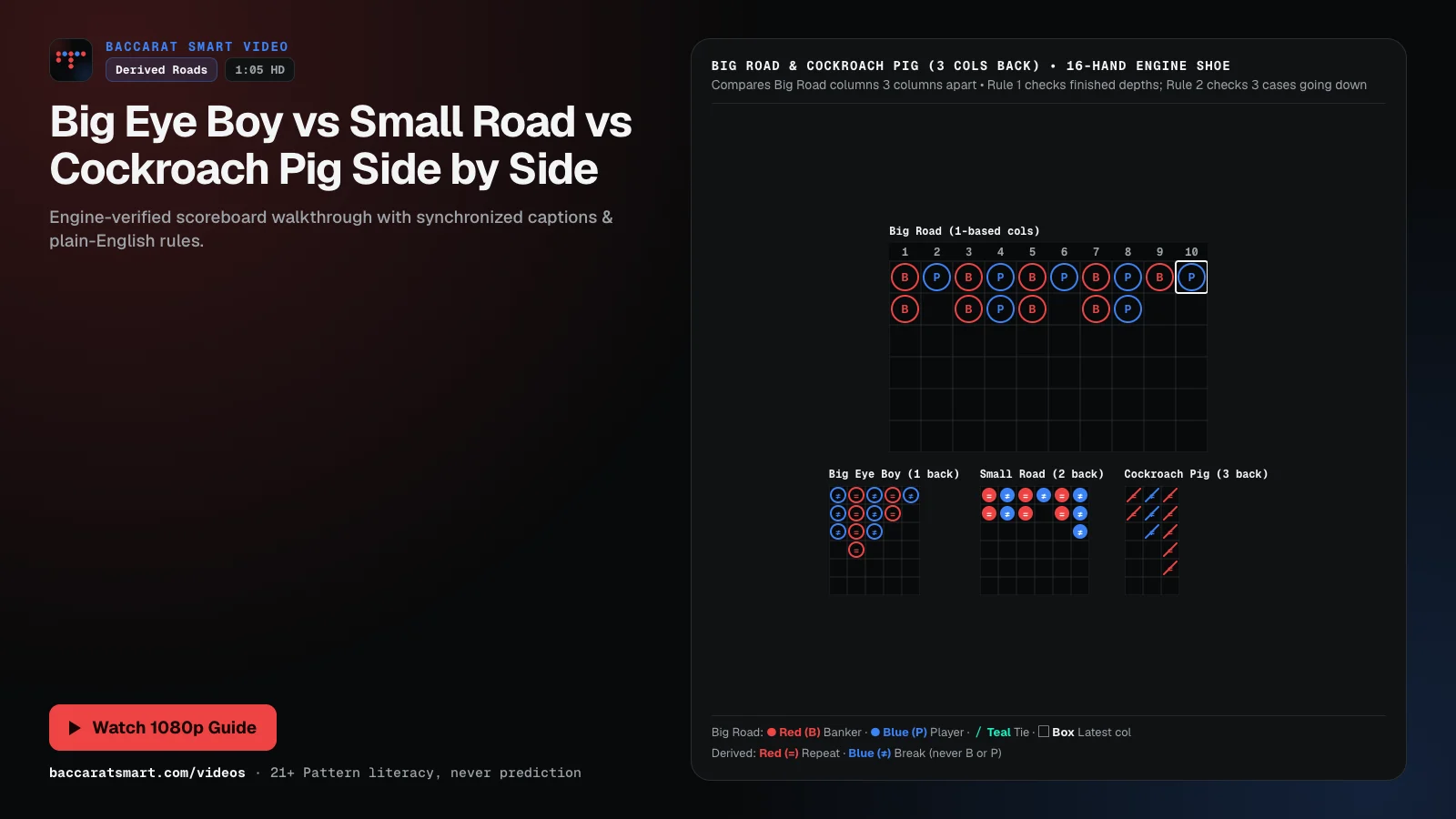
- They run 100% identical logic: only the horizontal comparison distance changes from 1 column back (Big Eye Boy) to 2 columns back (Small Road) and 3 columns back (Cockroach Pig).
- How does a Row 6 dragon tail affect Rule 1 and Rule 2?
- Both rules always read logical column depth (total beads in that streak, such as row 7 or depth 8), ignoring the visual rightward turn at Row 6.