Read full video transcriptShowHide
Why do some baccarat math tables list Banker at 45.86% while others quote 50.68%? Both figures come from the exact same 8-deck shoe. Across every dealt hand, Banker lands 45.86% of the time, Player 44.62%, and Tie 9.52% — adding up to 100%. Because main Banker and Player wagers push on a Tie, dividing 45.8597% by the 90.4844% non-tie hands yields 50.68% Banker versus 49.32% Player on decided coups. Applying the 5% fee gives 1.17% per decided bet — or 1.06% per coup across all hands including Ties — inspect this 18-hand shoe on /calculator. 21+.
Adults 21+ educational content only. Baccarat scoreboards record completed outcomes and never change the mathematical odds of the next hand. Review our Responsible Gambling policy.
Why Banker Wins 50.68% of Decided Hands & How Ties Fit In
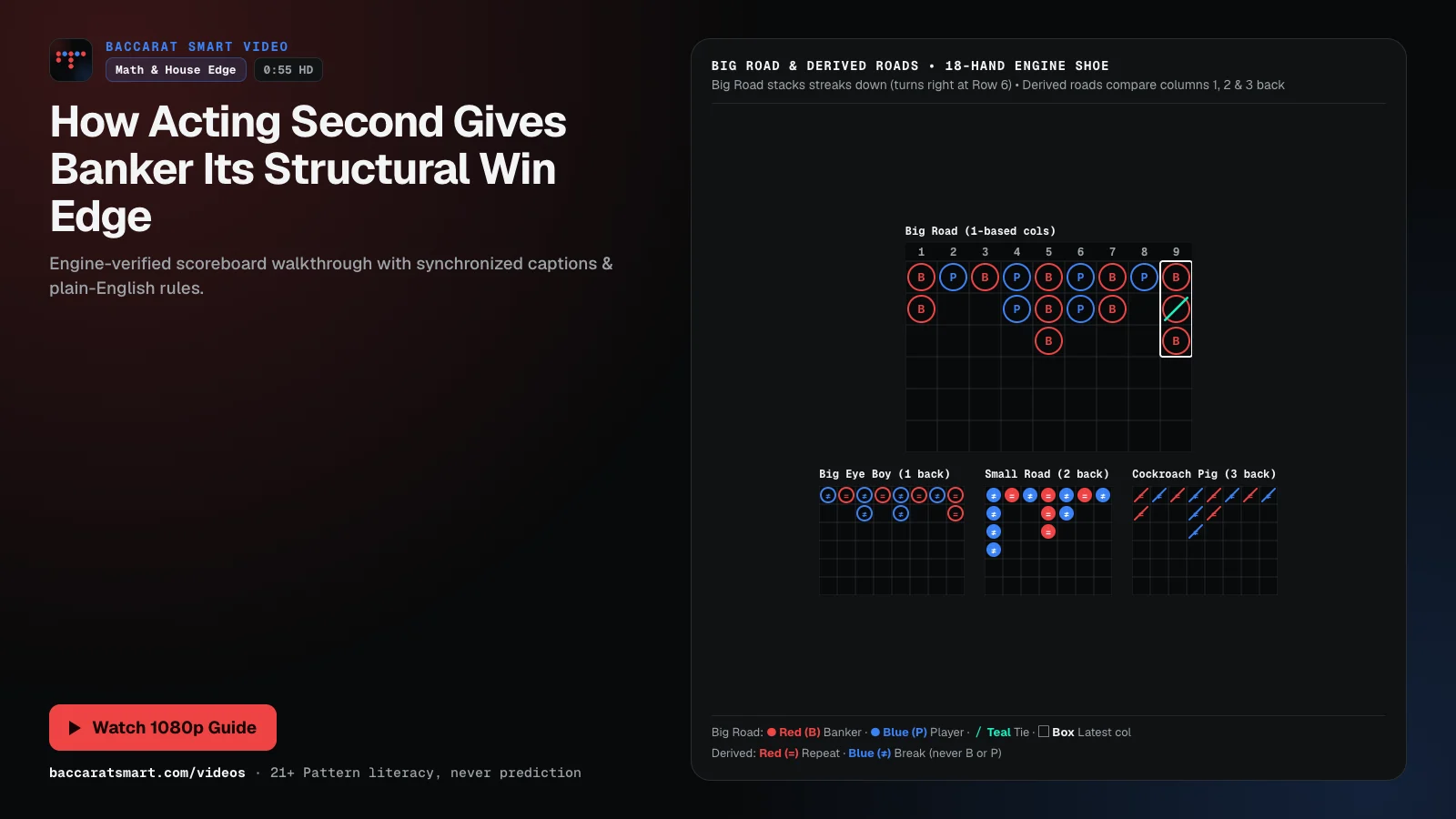
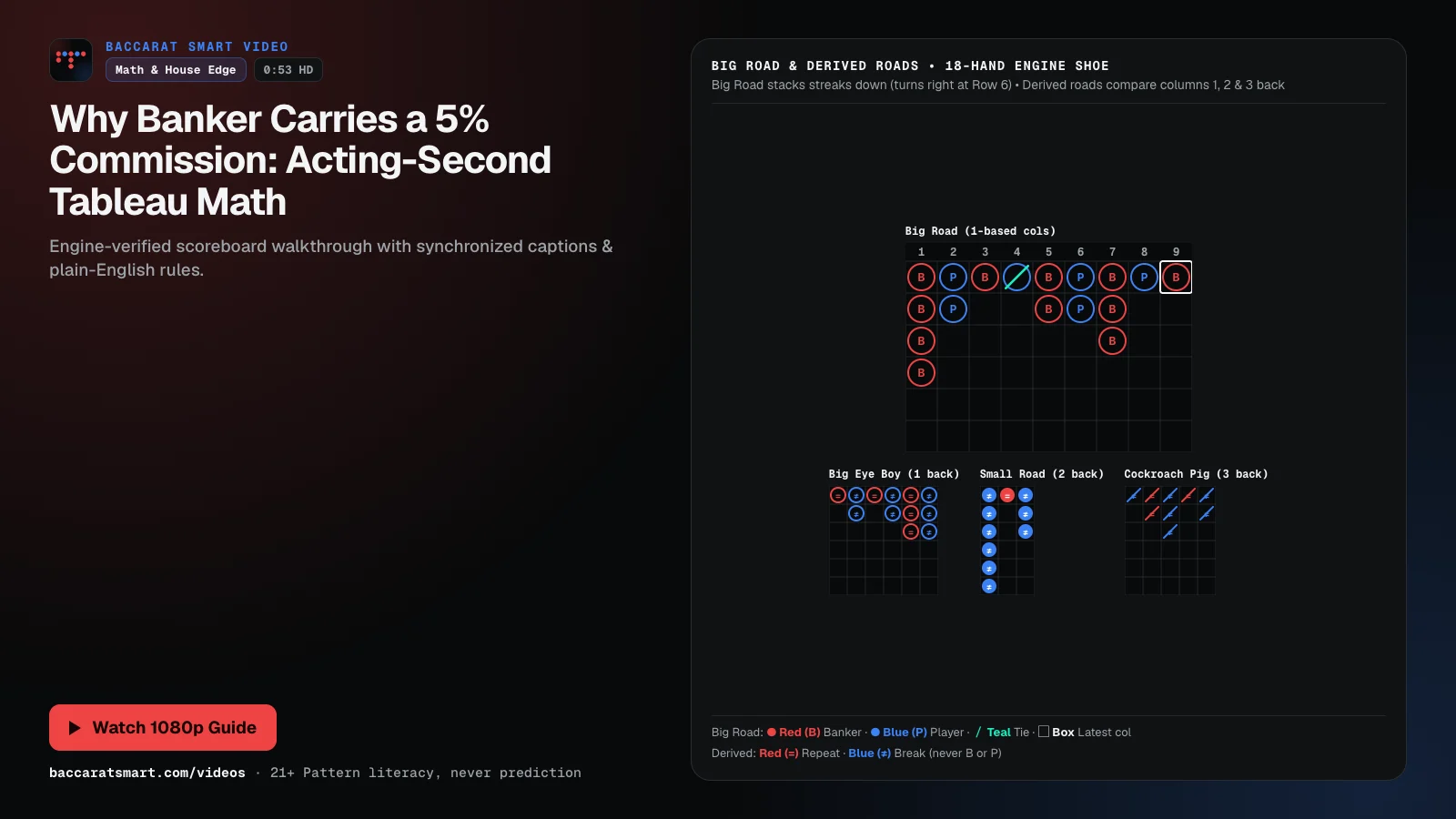
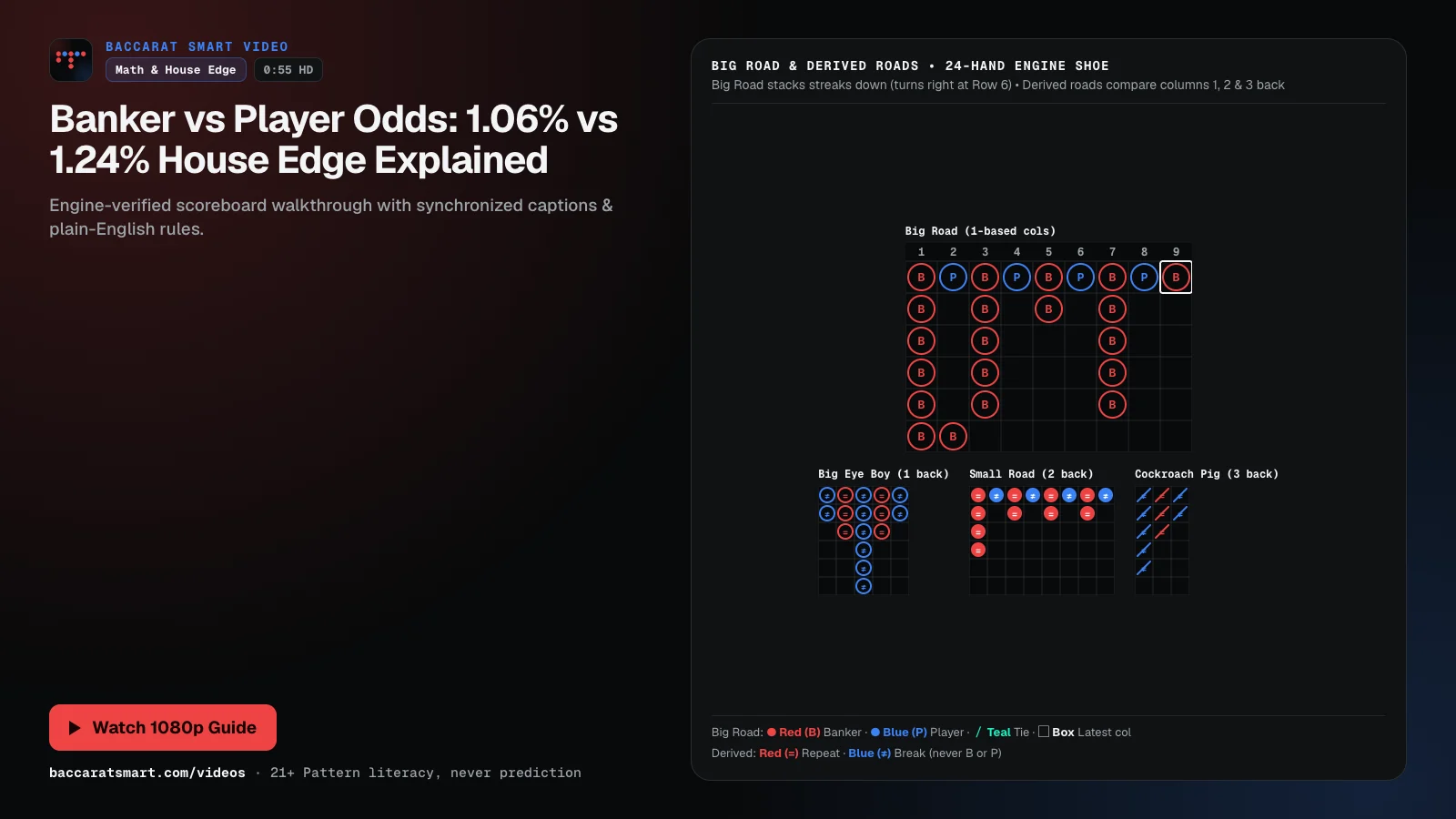
A 55-second probability walkthrough reconciling Banker's 45.86% raw 8-deck rate with its 50.68% decided share once 9.52% Tie pushes are factored out, illustrated on an 18-hand shoe (9 columns).
Practice What You Just Watched
Paired written guide: Banker Wins 50.68% (Excluding Ties): What It Means
Key takeaways from this video
- Exact 8-deck split: 45.8597% Banker, 44.6247% Player, and 9.5156% Tie across all 4,998,398,275,503,360 six-card shoe permutations.
- Among decided hands where chips actually change hands (45.8597% ÷ 90.4844%), Banker captures 50.6825% and Player captures 49.3175%.
- Sample shoe BBBPPBPPBBPBBPPBTB (18 hands, 9 Big Road columns) records 10 Banker, 7 Player, and 1 Tie across 13 Big Eye Boy marks.
Interactive shoe sandbox (18 hands)Open interactive 4-road boardHide interactive board
Interactive 5-Road Sandbox · Bead Plate + Big Road + Derived Roads
Try this video's shoe live
Deal extra hands onto this shoe to watch the Bead Plate, Big Road, and all three casino derived roads react live. On derived roads, red = pattern repeating and blue = pattern breaking.
Bead Plate (Chronological)
Read ↓ then →Big Road (18 hands)
9 streak columnsBig Eye Boy
1 backSmall Road
2 backCockroach Pig
3 backHand #18 · Why the newest marks are red or blue
- Big Eye Boy: This bead is at Row 2. Column 8 has a bead at Row 2 too → red (=).
- Small Road: This bead is at Row 2. Column 7 has a bead at Row 2 too → red (=).
- Cockroach Pig: This bead is at Row 2. Column 6 stopped at Row 1, one row above → blue (≠).
Opens with this exact 18-hand sequence preloaded—and archives any shoe already on your board first.
Frequently asked questions about this walkthrough
Show 4 FAQsHide FAQs
- If Banker captures 50.68% of decided hands, why does it still carry a house edge?
- The 5% commission pays 0.95 units instead of 1.00 unit on Banker wins: (0.458597 × 0.95) − 0.446247 = −0.010579, or a 1.06% house edge per coup dealt.
- Why do Ties leave the 1.06% per-coup Banker house edge slightly higher per resolved bet?
- Per coup dealt (including pushes) the cost is 1.06%; per resolved non-push decision (dividing by 0.904844), the expected cost per settled bet is 1.17% on Banker and 1.36% on Player.
- Why does Banker finish ahead of Player by 1.36 percentage points on decided hands?
- Banker acts second after seeing Player's exposed third card (when Player draws), giving Banker extra positional information built into the printed tableau.
- Does a Tie add a bead to derived roads when computing shoe statistics?
- No. Ties paint a green slash on the active Big Road bead without changing column depths, leaving Big Eye Boy, Small Road, and Cockroach Pig unchanged.