Read full video transcriptShowHide
Across all eight-deck baccarat deals, Banker wins 45.86% of hands, Player wins 44.62%, and 9.52% finish as a Tie push. Excluding Ties, Banker wins 50.68% of decided hands versus 49.32% for Player because Banker acts after seeing Player's third card. Paying 0.95-to-1 on Banker wins converts that positional edge into a 1.06% house edge, compared with 1.24% on even-money Player. That 18-basis-point difference equals 18 cents per $100 wagered, and past scoreboard streaks leave both percentages intact. 21+.
Adults 21+ educational content only. Baccarat scoreboards record completed outcomes and never change the mathematical odds of the next hand. Review our Responsible Gambling policy.
Banker vs Player Odds: 1.06% vs 1.24% House Edge Explained
A 55-second head-to-head comparison of Banker vs Player in 8-deck baccarat: exact win/tie percentages, why acting after Player's third card gives Banker 50.68% of decided hands, and how the 5% commission sets the 1.06% vs 1.24% gap.
Practice What You Just Watched
Paired written guide: Banker vs Player: House Edge and Odds Explained
Key takeaways from this video
- Banker's 1.24-percentage-point raw win-rate lead (45.86% vs 44.62%) comes entirely from acting second with knowledge of Player's third card.
- Without a commission, paying 1:1 on Banker would give the bettor a 1.24% mathematical advantage — which is why standard tables charge 5% on Banker wins.
- Per $100 wagered, expected mathematical cost is $1.06 on Banker versus $1.24 on Player.
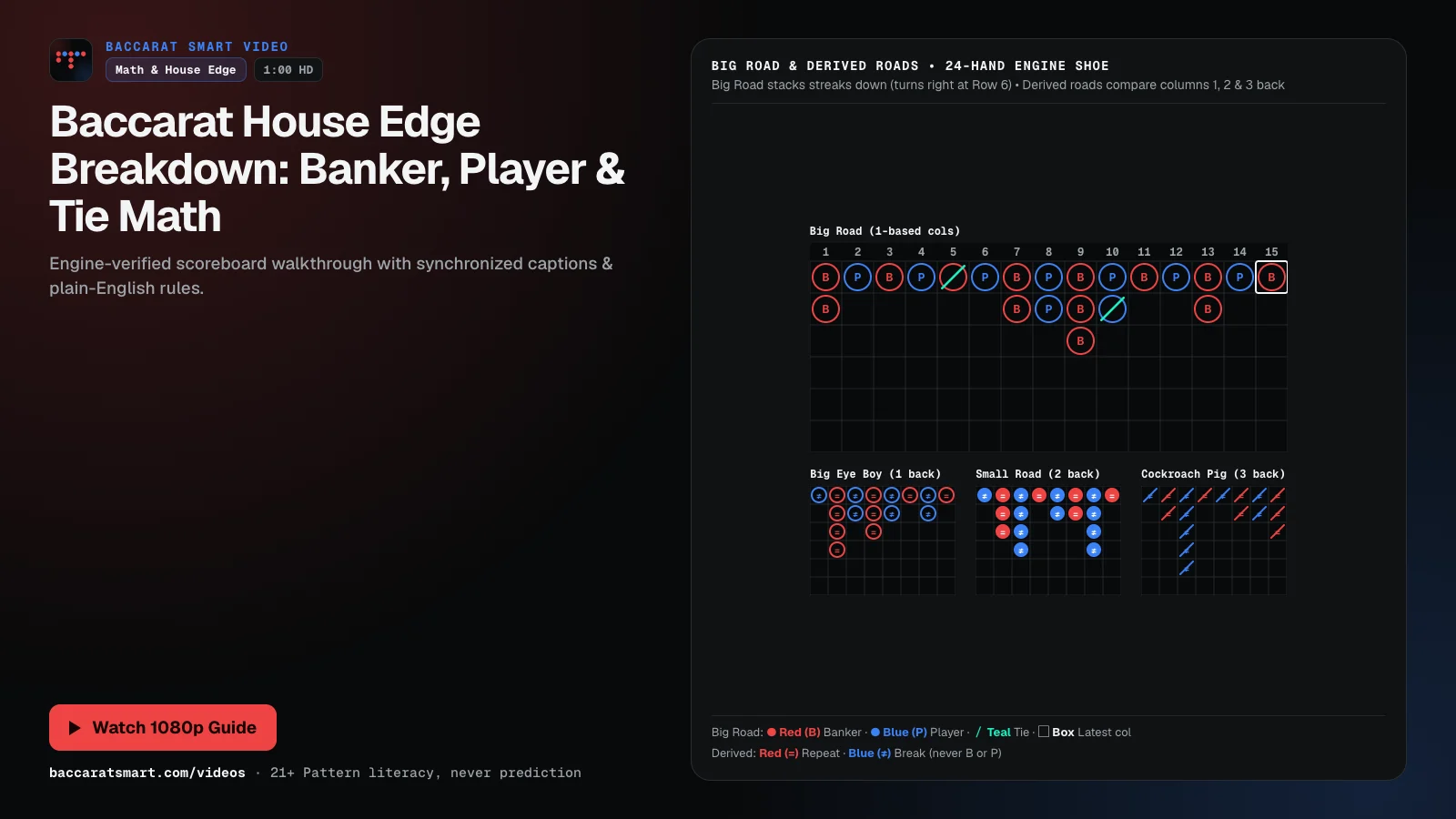
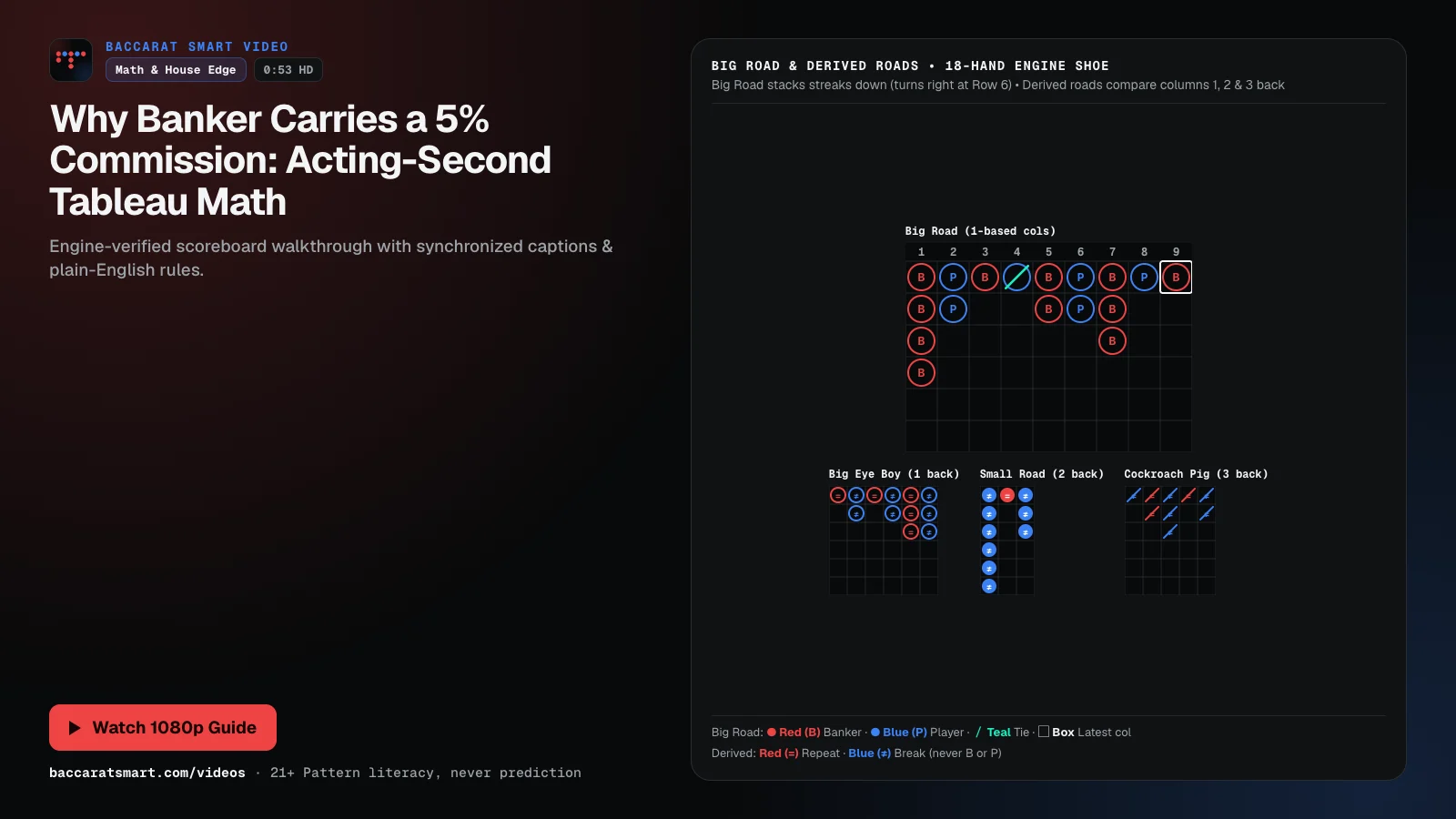
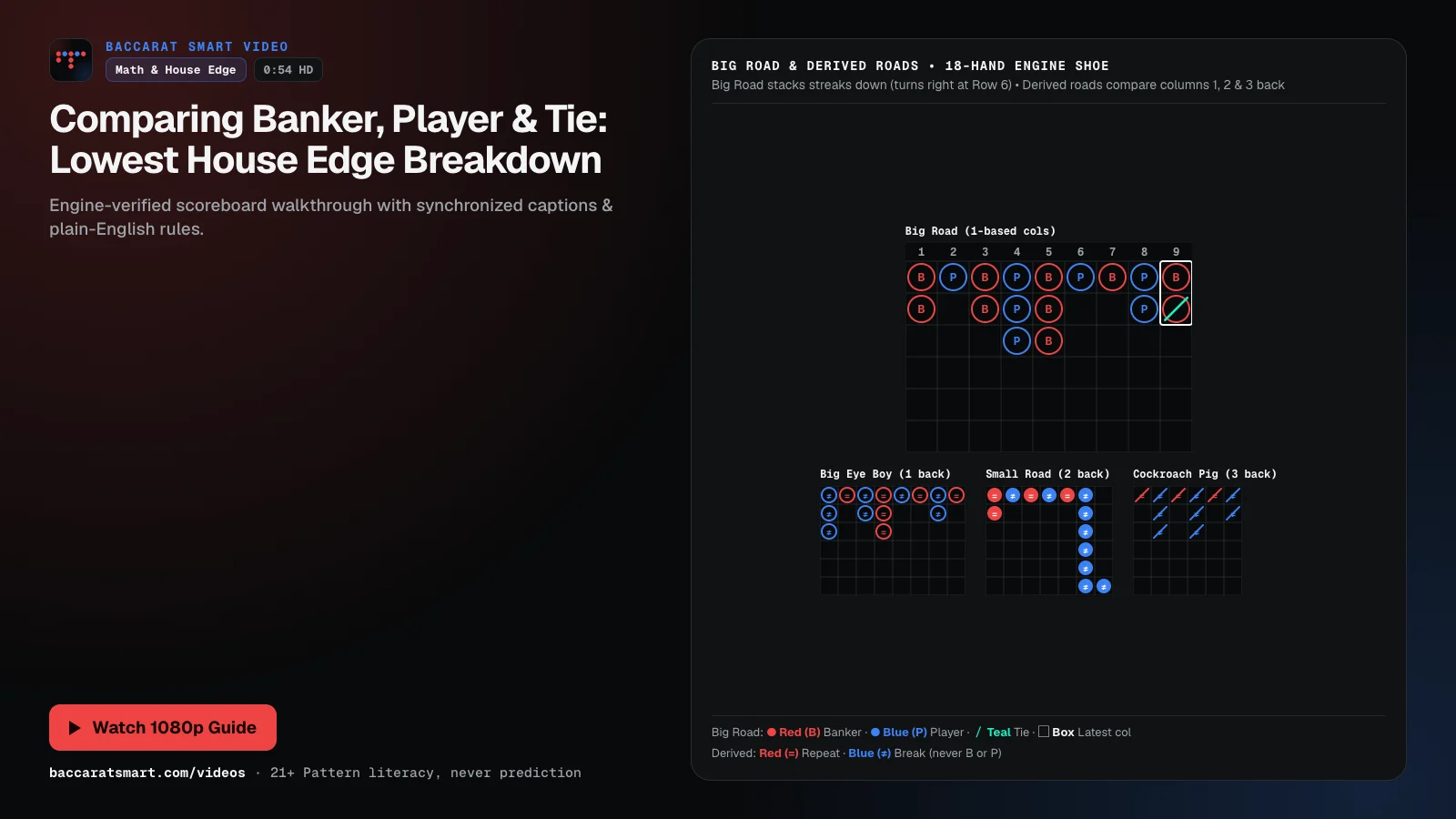
Interactive shoe sandbox (24 hands)Open interactive 4-road boardHide interactive board
Interactive 5-Road Sandbox · Bead Plate + Big Road + Derived Roads
Try this video's shoe live
Deal extra hands onto this shoe to watch the Bead Plate, Big Road, and all three casino derived roads react live. On derived roads, red = pattern repeating and blue = pattern breaking.
Bead Plate (Chronological)
Read ↓ then →Big Road (24 hands)
9 streak columnsBig Eye Boy
1 backSmall Road
2 backCockroach Pig
3 backHand #24 · Why the newest marks are red or blue
- Big Eye Boy: Column 8 has 1 bead. Column 7 has 5 beads. Different depth → blue (≠).
- Small Road: Column 8 has 1 bead. Column 6 has 1 bead. Same depth → red (=).
- Cockroach Pig: Column 8 has 1 bead. Column 5 has 2 beads. Different depth → blue (≠).
Opens with this exact 24-hand sequence preloaded—and archives any shoe already on your board first.
Frequently asked questions about this walkthrough
Show 4 FAQsHide FAQs
- Why does Banker win slightly more often than Player in baccarat?
- Player must draw on 0–5 first without knowing Banker's hand. When Player draws, Banker uses a selective tableau based on Player's third card instead of drawing blindly on 3, 4, 5, and 6.
- What happens to Banker and Player bets when a hand ends in a Tie?
- On a Tie hand, both Banker and Player wagers push — your chips stay in place and neither win nor lose.
- How big is the cost difference between Banker and Player over 100 hands?
- At $10 per hand ($1,000 total action), expected long-run cost is $10.60 on Banker (1.06%) versus $12.40 on Player (1.24%) — a difference of $1.80.
- Do Banker and Player alternate equally on the Big Road?
- Columns strictly alternate colors because each column groups one side's consecutive wins, while Banker columns average marginally deeper due to the 50.68% decided rate.