Read full video transcriptShowHide
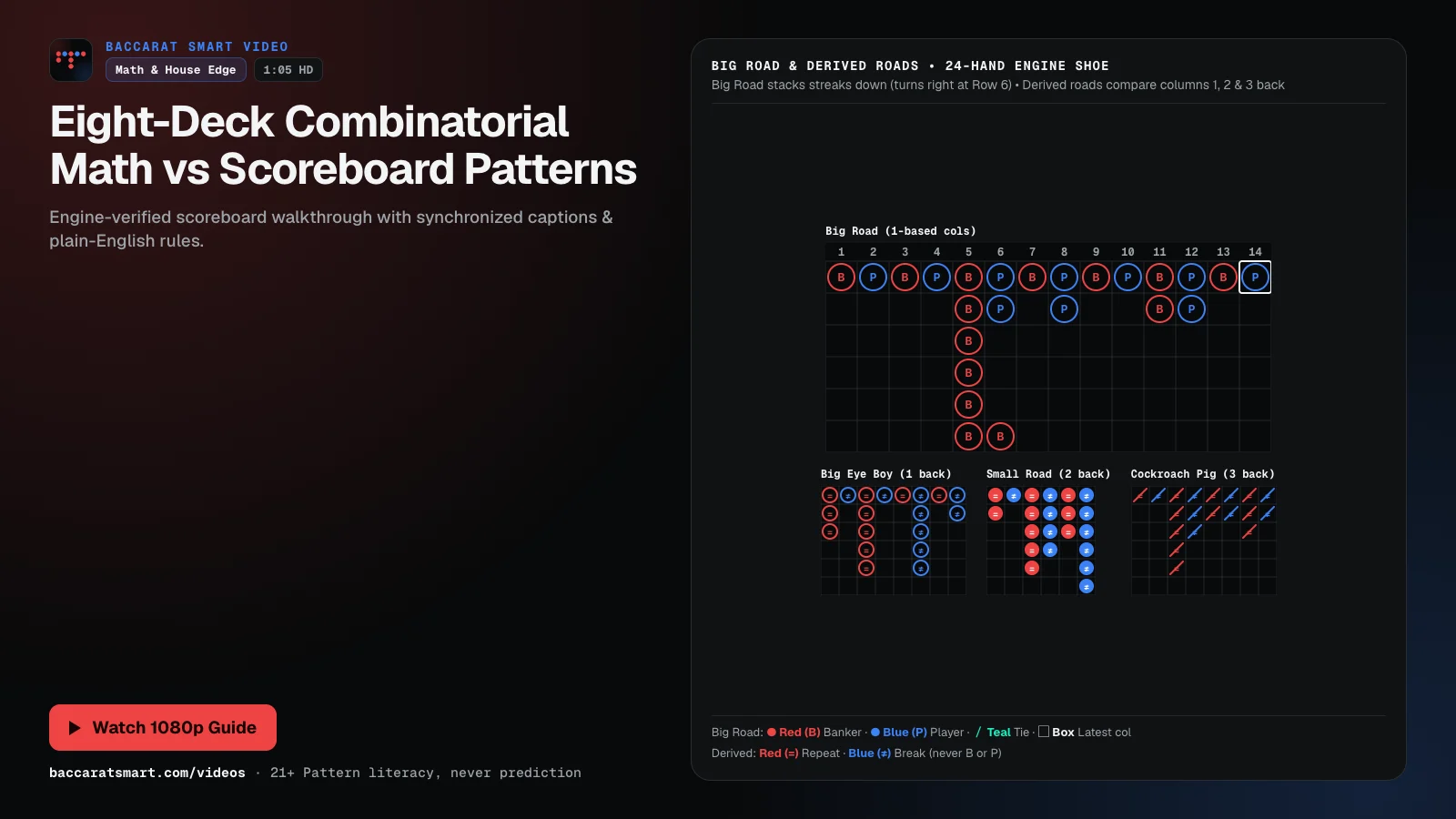
Where do the famous eight-deck baccarat numbers — 45.86% Banker, 44.62% Player, and 9.52% Tie — actually come from? Combinatorial math enumerates all 4.998 quadrillion ordered 6-card sequences from 416 cards and resolves each one by official rules. Roughly 34.3% of hands end immediately on a two-card Natural 8 or 9, while the remaining hands enter the automatic third-card tableau. Inside those third-card branches, Banker's selective rules lift Banker to 50.68% of decided hands — verified across our 100,000-shoe study. 21+.
Adults 21+ educational content only. Baccarat scoreboards record completed outcomes and never change the mathematical odds of the next hand. Review our Responsible Gambling policy.
How Eight-Deck Baccarat Probabilities Are Calculated
A 60-second walkthrough of how combinatorial mathematics enumerates every 6-card sequence in a 416-card shoe to derive Natural frequencies, third-card rates, and exact outcome probabilities.
Practice What You Just Watched
Paired written guide: Baccarat Probability Explained: How Odds Work
Key takeaways from this video
- Exact 8-deck outcome split: Banker 45.8597%, Player 44.6247%, Tie 9.5156% (summing to 100.0000%).
- Excluding the 9.52% of hands that Tie, decided coups split 50.68% Banker and 49.32% Player.
- Our empirical 100,000-shoe simulation (8.14M hands) matched theoretical 8-deck probabilities within 0.01 percentage points.
Interactive shoe sandbox (18 hands)Open interactive 4-road boardHide interactive board
Interactive 5-Road Sandbox · Bead Plate + Big Road + Derived Roads
Try this video's shoe live
Deal extra hands onto this shoe to watch the Bead Plate, Big Road, and all three casino derived roads react live. On derived roads, red = pattern repeating and blue = pattern breaking.
Bead Plate (Chronological)
Read ↓ then →Big Road (18 hands)
9 streak columnsBig Eye Boy
1 backSmall Road
2 backCockroach Pig
3 backHand #18 · Why the newest marks are red or blue
- Big Eye Boy: This bead is at Row 2. Column 8 has a bead at Row 2 too → red (=).
- Small Road: This bead is at Row 2. Column 7 has a bead at Row 2 too → red (=).
- Cockroach Pig: This bead is at Row 2. Column 6 stopped at Row 1, one row above → blue (≠).
Opens with this exact 18-hand sequence preloaded—and archives any shoe already on your board first.
Frequently asked questions about this walkthrough
Show 4 FAQsHide FAQs
- How often does a baccarat round end on a two-card Natural 8 or 9?
- Each two-card hand hits an 8 or 9 about 18.9% of the time; accounting for overlap when both sides hold naturals, roughly 34.3% of all 8-deck rounds end immediately on a natural.
- Do 6-deck and 8-deck baccarat have slightly different probabilities?
- Yes, by hundredths of a percent — fewer decks make Ties slightly rarer (9.505% in 6 decks vs 9.516% in 8 decks), nudging Banker's house edge from 1.058% to 1.056%.
- Why can't you just divide 1 by 3 (33.3%) for Banker, Player, and Tie?
- Ties require both hands to land on the exact same final digit (0–9), whereas Banker and Player cover all 90 non-matching digit pairs weighted by the third-card rules.
- Does a streak of 6 Player wins change the baseline probability on hand 7?
- Aside from negligible physical card removal, hand 7 still carries near-baseline 8-deck probabilities (~45.9% Banker, ~44.6% Player, ~9.5% Tie).