Read full video transcriptShowHide
A fresh eight-deck baccarat shoe begins with 416 cards: 32 of each rank Ace through 9, and 128 zero-value tens and court cards. Evaluating every possible 4-, 5-, and 6-card deal produces the exact baseline splits: 45.86% Banker, 44.62% Player, and 9.52% Tie. As physical cards leave the shoe, remaining rank ratios nudge probabilities by tiny fractions of a percent — far smaller than in blackjack because symmetrical drawing rules balance both sides. Scoreboard roads record only who won past hands, not which ranks were burned, so road shapes never measure deck composition. 21+.
Adults 21+ educational content only. Baccarat scoreboards record completed outcomes and never change the mathematical odds of the next hand. Review our Responsible Gambling policy.
Eight-Deck Combinatorial Math vs Scoreboard Patterns
A 65-second look at 8-deck (416-card) Punto Banco combinatorics: how 32 cards per rank A–9 and 128 zero-value cards determine exact outcomes, and why card removal differs completely from scoreboard road patterns.
Practice What You Just Watched
Paired written guide: Baccarat Deck Composition & Combinatorial Math vs Scoreboards
Key takeaways from this video
- Zero-value cards (10, J, Q, K) make up 128 of 416 cards (30.77% of the shoe), anchoring modulo-10 hand totals and natural frequencies.
- Unlike blackjack where 10s heavily favor the player, Punto Banco deals from the same shoe to both Player and Banker under near-symmetric rules.
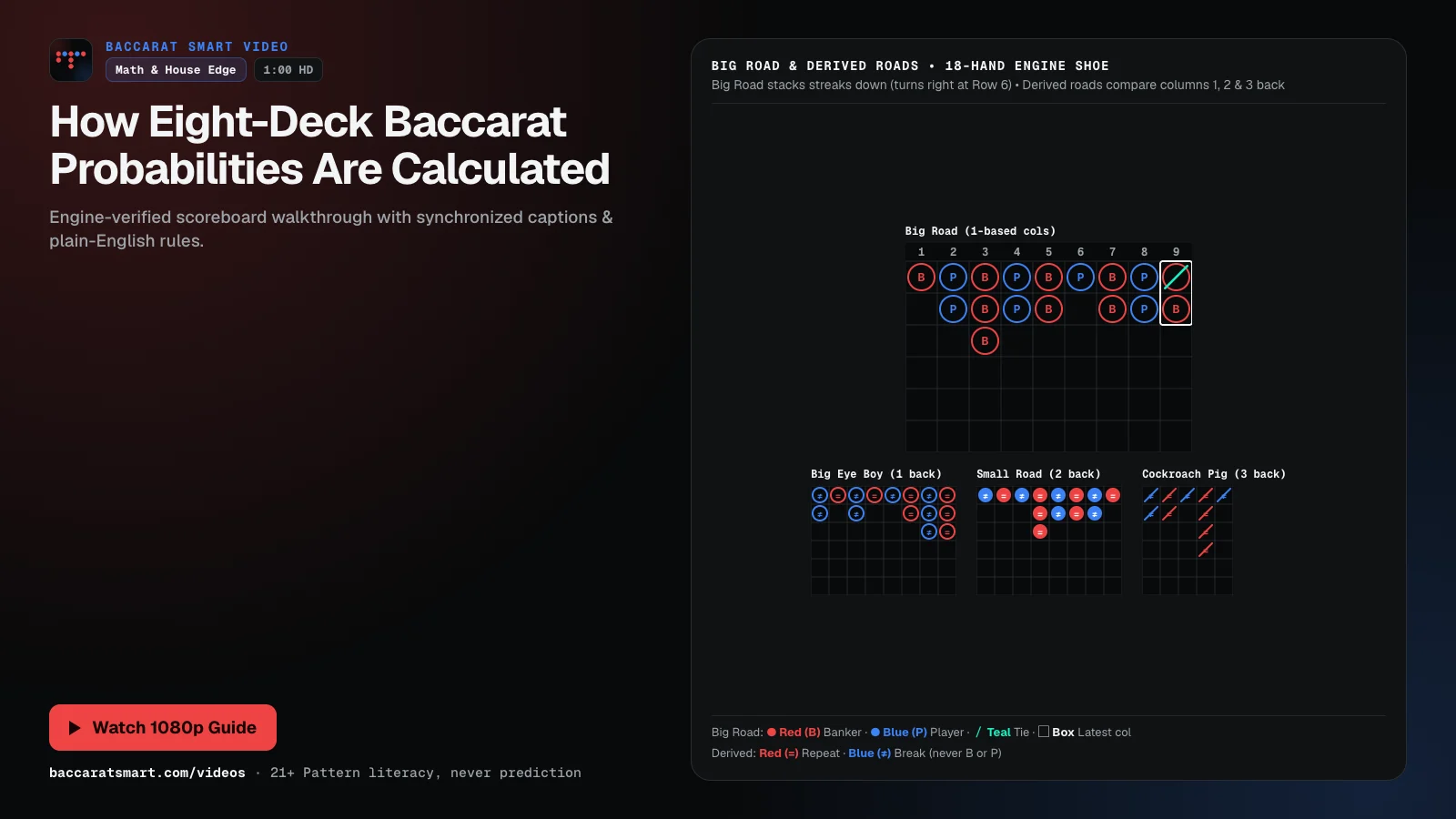
- Two shoes can display the exact same Big Road pattern while holding completely different remaining ranks behind the cut card.
Interactive shoe sandbox (24 hands)Open interactive 4-road boardHide interactive board
Interactive 5-Road Sandbox · Bead Plate + Big Road + Derived Roads
Try this video's shoe live
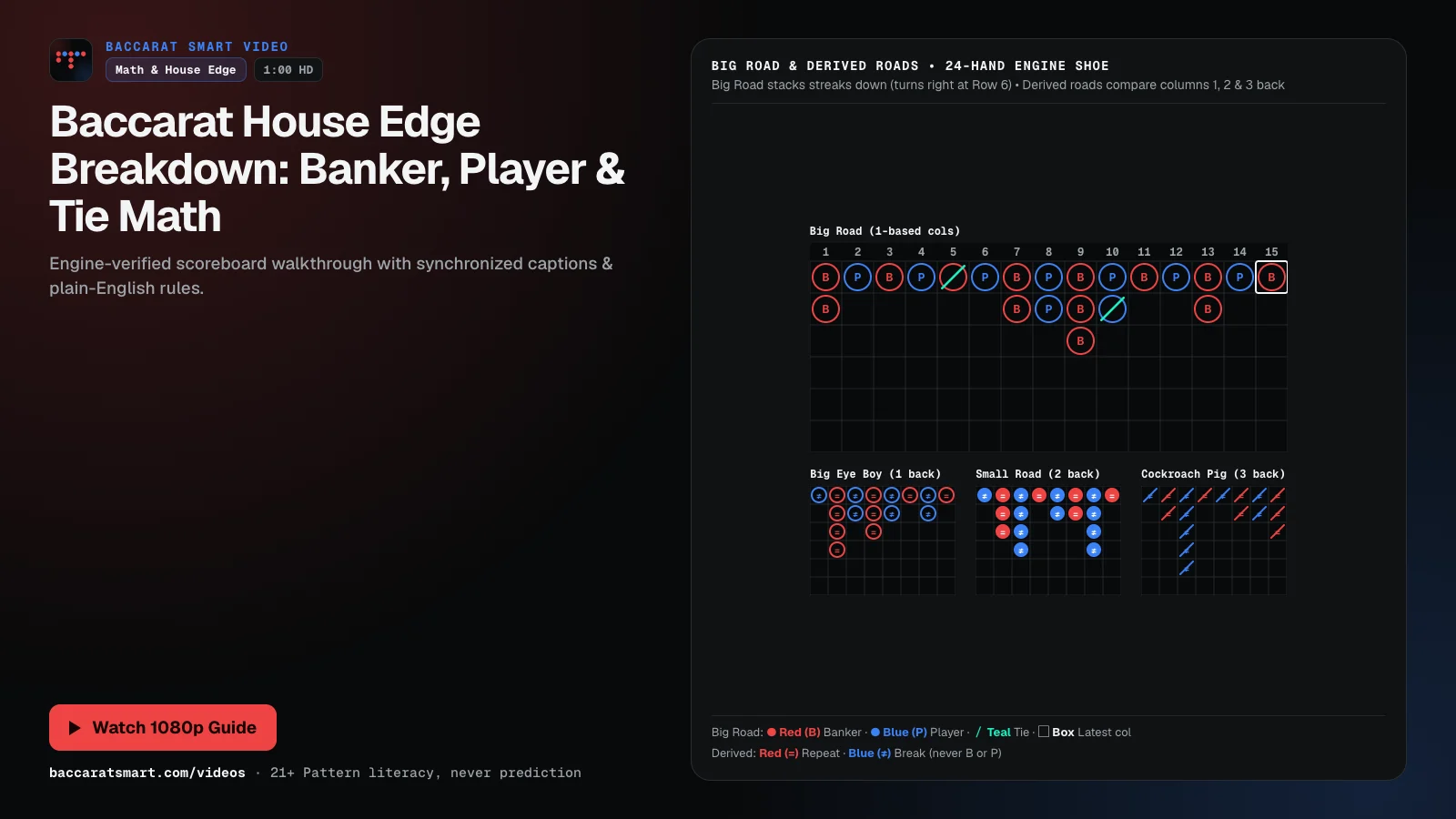
Deal extra hands onto this shoe to watch the Bead Plate, Big Road, and all three casino derived roads react live. On derived roads, red = pattern repeating and blue = pattern breaking.
Bead Plate (Chronological)
Read ↓ then →Big Road (24 hands)
14 streak columnsBig Eye Boy
1 backSmall Road
2 backCockroach Pig
3 backHand #24 · Why the newest marks are red or blue
- Big Eye Boy: Column 13 has 1 bead. Column 12 has 2 beads. Different depth → blue (≠).
- Small Road: Column 13 has 1 bead. Column 11 has 2 beads. Different depth → blue (≠).
- Cockroach Pig: Column 13 has 1 bead. Column 10 has 1 bead. Same depth → red (=).
Opens with this exact 24-hand sequence preloaded—and archives any shoe already on your board first.
Frequently asked questions about this walkthrough
Show 4 FAQsHide FAQs
- How many zero-value cards start in an 8-deck baccarat shoe?
- Each deck contains sixteen zero-value cards (four 10s, Jacks, Queens, and Kings), giving an 8-deck shoe 128 zero-value cards out of 416 total (30.77%).
- Are consecutive hands in a physical 8-deck shoe mathematically independent?
- Deals without replacement are slightly dependent on removed ranks, though in 8-deck baccarat the shift on Banker and Player edges is minuscule across normal cut-card depths.
- Why doesn't the Big Road tell you which cards remain in the shoe?
- A red Banker ring on the Big Road could come from two face cards and a 9 or from three low pip cards; the scoreboard records the winner, not the depleted ranks.
- Which ranks slightly favor Banker versus Player in combinatorial studies?
- Combinatorial analysis shows low ranks (especially 4s) nudge Banker's edge slightly while 6s, 7s, and 8s nudge slightly toward Player, though card counting remains impractical.