Read full video transcriptShowHide
Once both hands clear the Natural check with zero through seven, Player's two-card total splits the coup into two clean branches. Branch A: when Player holds a two-card six or seven, Player stands pat — and Banker copies that exact same rule, drawing on zero through five and standing on six or seven! Branch B: when Player holds zero through five, Player draws one third card face up — switching Banker onto the full third-card tableau for totals three through six. Remembering that two-branch fork makes 90% of third-card deals effortless — drill both branches free at /practice! 21+.
Adults 21+ educational content only. Baccarat scoreboards record completed outcomes and never change the mathematical odds of the next hand. Review our Responsible Gambling policy.
Player Third-Card Rule: Drawing on 0 to 5 vs Standing on 6 & 7
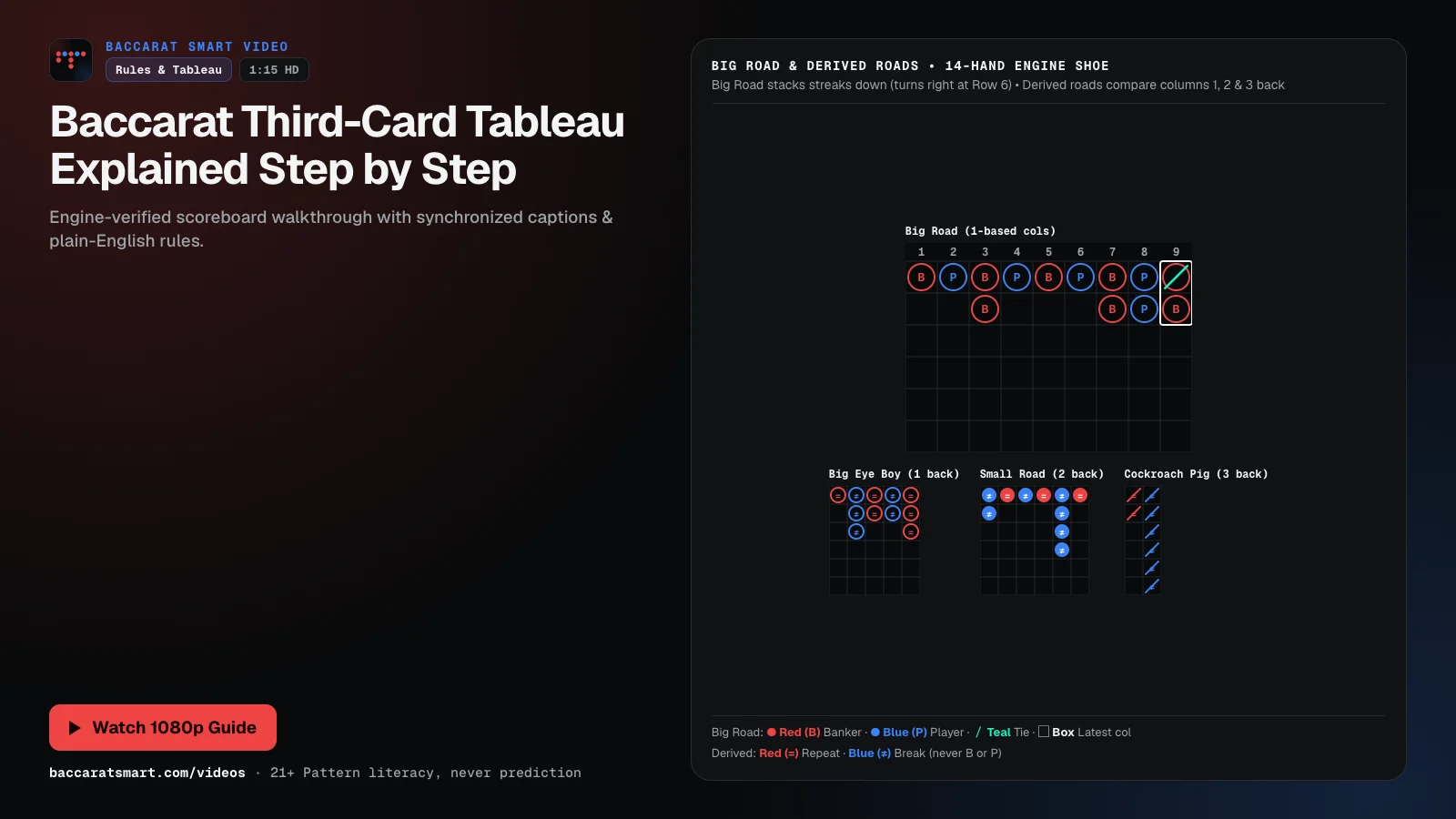
Tableau decision-tree walkthrough alongside BPPBBP (6 hands), contrasting Branch A (Player stands on 6–7 → Banker draws 0–5) with Branch B (Player draws on 0–5 → Banker uses third-card matrix).
Practice What You Just Watched
Paired interactive surface: Open /courses
Key takeaways from this video
- Key memory shortcut: Banker ONLY uses the complex third-card matrix when Player actually DREW a third card!
- Whenever Player stood on a two-card 6 or 7, Banker uses the identical simple rule — draw on 0, 1, 2, 3, 4, or 5 and stand pat on 6 or 7.
- Contrast Banker holding two-card 6: stands if Player stood on two-card 6 or 7; draws if Player drew a third card of 6 or 7!
Interactive shoe sandbox (6 hands)Open interactive 4-road boardHide interactive board
Interactive 5-Road Sandbox · Bead Plate + Big Road + Derived Roads
Try this video's shoe live
Deal extra hands onto this shoe to watch the Bead Plate, Big Road, and all three casino derived roads react live. On derived roads, red = pattern repeating and blue = pattern breaking.
Bead Plate (Chronological)
Read ↓ then →Big Road (6 hands)
4 streak columnsBig Eye Boy
1 backSmall Road
2 backCockroach Pig
3 backHand #6 · Why the newest marks are red or blue
- Big Eye Boy: Column 3 has 2 beads. Column 2 has 2 beads. Same depth → red (=).
- Small Road: Column 3 has 2 beads. Column 1 has 1 bead. Different depth → blue (≠).
Opens with this exact 6-hand sequence preloaded—and archives any shoe already on your board first.
Frequently asked questions about this walkthrough
Show 4 FAQsHide FAQs
- If Player stands on a two-card 7 and Banker holds a two-card 6, does Banker draw?
- No! Because Player stood on two cards (no third card was drawn), Banker uses the simple rule (draw 0–5, stand 6–7) — so Banker stands on 6 and Player wins 7 to 6.
- If Player instead held 1 + 0 = 1 and drew a 6 (making 7), and Banker holds a two-card 6, does Banker draw?
- Yes! Because Player DREW a third card whose value was 6, Banker's Tableau applies on Banker 6 (draw against P3 = 6 or 7) — so Banker draws!
- Why is distinguishing 'two-card Player 6/7' from 'Player third-card 6/7' the #1 dealer school exam question?
- In both cases you see a 6 or 7 on Player's side, yet Banker stands on 6 against a two-card stand and draws on 6 against a drawn third-card 6 or 7!
- Where can I test tricky two-card vs three-card 6/7 hands interactively?
- Open the untimed Third-Card Rule drill inside /practice for instant visual feedback on every deal.