Read full video transcriptShowHide
Look at the Banker-3 row of the Punto Banco tableau and one cell jumps right off the card: Banker draws against every Player third card EXCEPT an eight. Why stand against an eight? Remember Player only drew because Player started with zero through five — so adding an eight wraps totals of two, three, four, or five down to zero, one, two, or three! Standing pat on three already beats zero, one, and two and ties three without risking a card that wraps Banker's own three downward. Against a nine, however, Player's four wraps to three and five wraps to four — nudging expected value slightly back toward drawing! Drill this rule at /practice. 21+.
Adults 21+ educational content only. Baccarat scoreboards record completed outcomes and never change the mathematical odds of the next hand. Review our Responsible Gambling policy.
Banker 3 vs Player Third-Card 8: The Classic Stand Exception
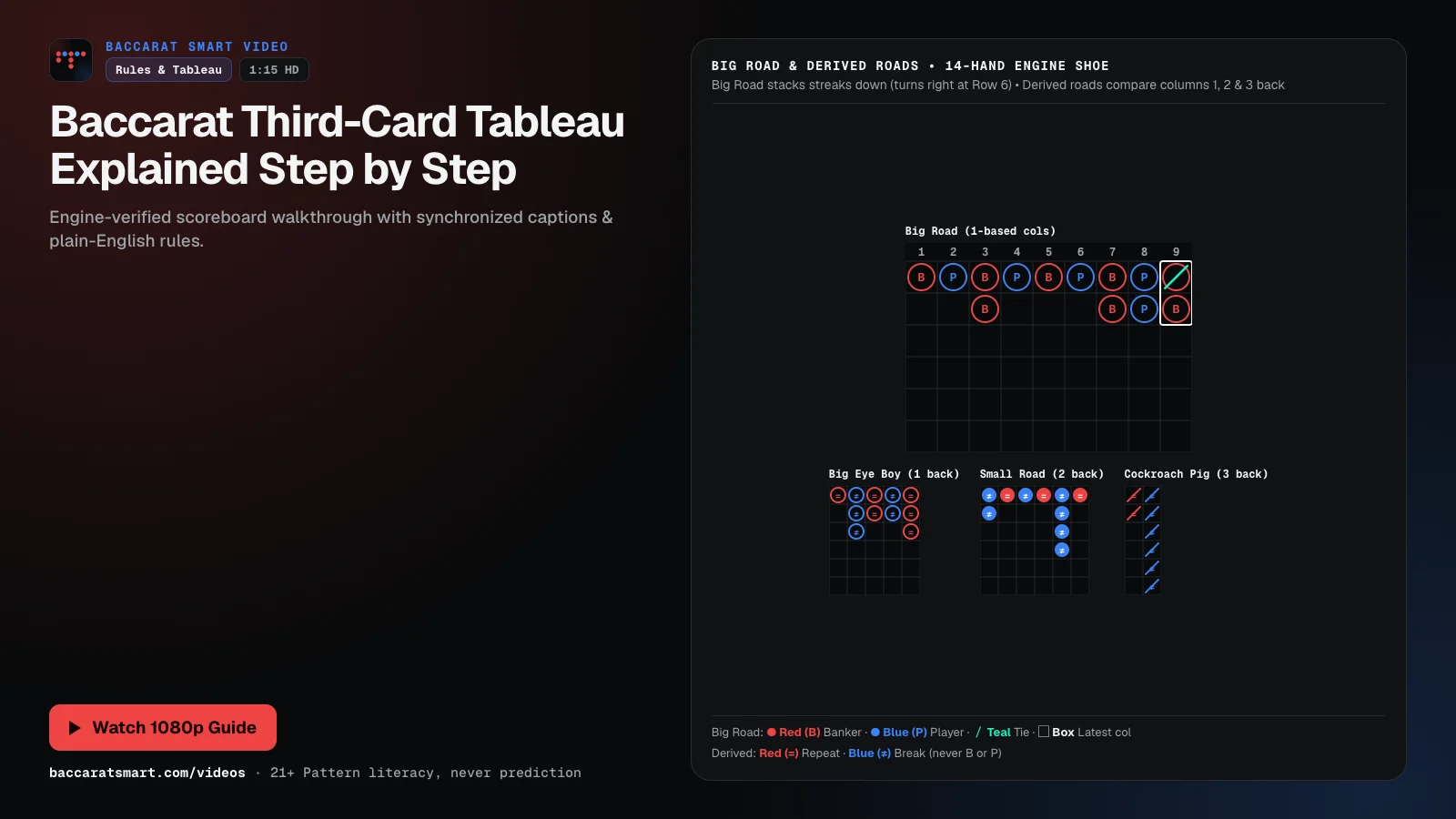
Deep dive into the iconic Banker-3 tableau exception alongside BBPBPP (6 hands), explaining the modulo-10 math behind standing against Player's third-card 8 and drawing against 9.
Practice What You Just Watched
Paired interactive surface: Open /courses
Key takeaways from this video
- Banker two-card 3 (when Player drew): STANDS only if Player's third card = 8; DRAWS if Player's third card = 0, 1, 2, 3, 4, 5, 6, 7, or 9.
- Modulo-10 proof: `(0..5) + 8 mod 10` produces `8, 9, 0, 1, 2, 3` — four of those six outcomes (`0, 1, 2, 3`) do not beat Banker's standing 3!
- Note that Banker checks ONLY that the third card was an 8 — even if Player had `1 + 0 = 1` and drew `8` to reach `9`, Banker still stands on 3.
Interactive shoe sandbox (6 hands)Open interactive 4-road boardHide interactive board
Interactive 5-Road Sandbox · Bead Plate + Big Road + Derived Roads
Try this video's shoe live
Deal extra hands onto this shoe to watch the Bead Plate, Big Road, and all three casino derived roads react live. On derived roads, red = pattern repeating and blue = pattern breaking.
Bead Plate (Chronological)
Read ↓ then →Big Road (6 hands)
4 streak columnsBig Eye Boy
1 backSmall Road
2 backCockroach Pig
3 backHand #6 · Why the newest marks are red or blue
- Big Eye Boy: This bead is at Row 2. Column 3 stopped at Row 1, one row above → blue (≠).
- Small Road: This bead is at Row 2. Column 2 stopped at Row 1, one row above → blue (≠).
- Cockroach Pig: This bead is at Row 2. Column 1 has a bead at Row 2 too → red (=).
Opens with this exact 6-hand sequence preloaded—and archives any shoe already on your board first.
Frequently asked questions about this walkthrough
Show 4 FAQsHide FAQs
- Why does Banker draw on 3 when Player's third card is a 9?
- Adding 9 to Player's 0–5 produces `9, 0, 1, 2, 3, 4`: because `5 + 9 = 14 → 4` beats a standing 3 (whereas `5 + 8 = 13 → 3` only tied it), combinatorial EV favors Banker drawing by a thin margin!
- In historical French Chemin de Fer, was Banker 3 vs Player 9 an optional decision?
- Yes! Classic Chemin de Fer strategy tables list Banker 3 vs third-card 9 as the famous 'tirer ou rester' (draw or stand) borderline play because the EVs are nearly tied.
- If Player did NOT draw (Player stood on 6 or 7), what does Banker do on a two-card 3?
- Banker always draws! Against a standing 6 or 7, a standing 3 would lose 100% of the time.
- Does Banker stand on 4 when Player's third card is an 8?
- Yes — on a two-card 4, Banker draws ONLY against 2–7 and stands against 0, 1, 8, and 9.