Read full video transcriptShowHide
Where do the famous baccarat percentages — 45.86% Banker, 44.62% Player, and 9.52% Tie — actually come from? Not from rough estimates: mathematicians enumerate every possible six-card deal from a 416-card eight-deck shoe — nearly five quadrillion ordered permutations! Tallying every deal under the Punto Banco tableau gives Banker 45.8597%, Player 44.6247%, and Tie 9.5156% of all coups. Divide Banker's 45.86% by the 90.48% of coups that don't tie and Banker wins 50.68% of decided hands — explore our 100,000-shoe data at /shoe-study. 21+.
Adults 21+ educational content only. Baccarat scoreboards record completed outcomes and never change the mathematical odds of the next hand. Review our Responsible Gambling policy.
8-Deck Math Proof: Why Banker Wins 50.68% of Decided Hands
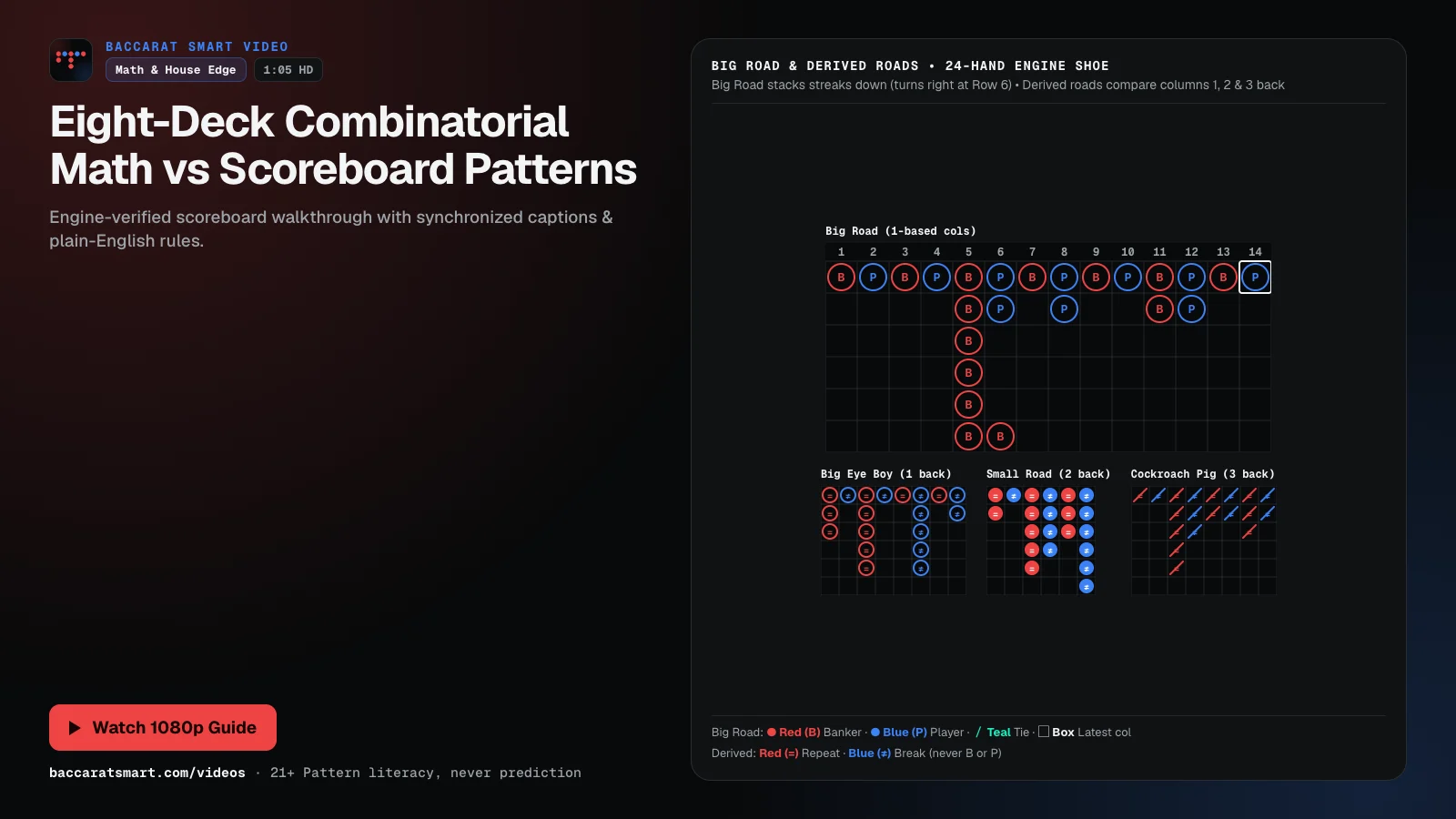
Exact 416-card combinatorial breakdown alongside BPBBPB (6 hands), showing how enumerating all 4,998,398,275,503,360 ordered 6-card deals yields 45.86% Banker, 44.62% Player, and 9.52% Tie.
Practice What You Just Watched
Paired interactive surface: Open /shoe-study
Key takeaways from this video
- Exact 8-deck probabilities: Banker = `0.458597` (45.86%), Player = `0.446247` (44.62%), Tie = `0.095156` (9.52%).
- Conditional on a non-tie decision (`B / (B + P)`): Banker = `50.68%`, Player = `49.32%` (a `1.36` percentage-point positional spread).
- Expected value check: Banker `0.458597 × 0.95 − 0.446247 = −0.010579` (`1.06%` cost); Player `0.446247 × 1.00 − 0.458597 = −0.012351` (`1.24%` cost).
Interactive shoe sandbox (6 hands)Open interactive 4-road boardHide interactive board
Interactive 5-Road Sandbox · Bead Plate + Big Road + Derived Roads
Try this video's shoe live
Deal extra hands onto this shoe to watch the Bead Plate, Big Road, and all three casino derived roads react live. On derived roads, red = pattern repeating and blue = pattern breaking.
Bead Plate (Chronological)
Read ↓ then →Big Road (6 hands)
5 streak columnsBig Eye Boy
1 backSmall Road
2 backCockroach Pig
3 backHand #6 · Why the newest marks are red or blue
- Big Eye Boy: Column 4 has 1 bead. Column 3 has 2 beads. Different depth → blue (≠).
- Small Road: Column 4 has 1 bead. Column 2 has 1 bead. Same depth → red (=).
- Cockroach Pig: Column 4 has 1 bead. Column 1 has 1 bead. Same depth → red (=).
Opens with this exact 6-hand sequence preloaded—and archives any shoe already on your board first.
Frequently asked questions about this walkthrough
Show 4 FAQsHide FAQs
- If Player and Banker received cards under the exact same drawing rule, what would their probabilities be?
- Completely identical! If both sides simply drew on 0–5 and stood on 6–7, Banker and Player would split decided hands 50.00% to 50.00%.
- How does Banker gain that extra +0.68% above 50% simply by acting second?
- When Player draws a high card (like 8 or 9) onto a 0–5 hand, Player often wraps via modulo-10 to a low total, and Banker's tableau avoids drawing and breaking a winning 3, 4, 5, or 6!
- Why are there `4,998,398,275,503,360` six-card permutations in an 8-deck shoe?
- Multiplying `416 × 415 × 414 × 413 × 412 × 411` counts every distinct ordered 6-card draw from a 416-card shoe.
- Does any Big Road streak or derived-road pattern alter that 416-card combinatorial foundation?
- No — only the specific card ranks physically removed from the shoe nudge the remaining combinatorics, typically by hundredths of a percent.