Read full video transcriptShowHide
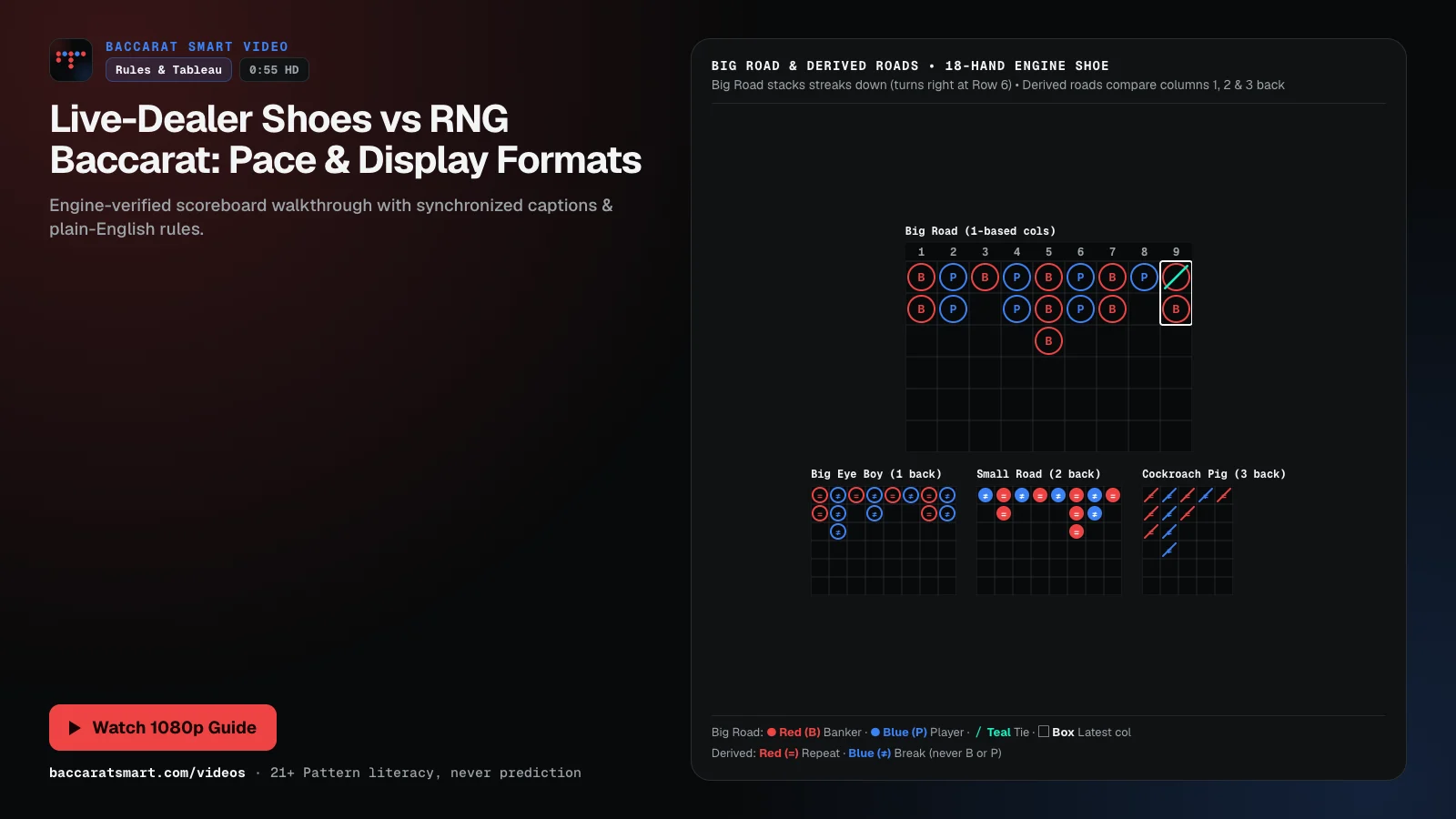
Have you ever wondered how digital scoreboards update Big Eye Boy, Small Road, and Cockroach Pig the instant a card turns over? At a live-dealer table, an optical sensor in the shoe lip or felt reads each physical card's rank as it slides out and runs the third-card check. At an RNG table, a certified cryptographic generator permutes a 416-card array in memory and deals four to six cards through the same state machine. Once the hand resolves to B, P, or T, the road engine computes every mark deterministically — test PBBPBBPPPBBPPBBPTB (18 hands) on /calculator. 21+.
Adults 21+ educational content only. Baccarat scoreboards record completed outcomes and never change the mathematical odds of the next hand. Review our Responsible Gambling policy.
How Digital RNG & Physical-Shoe Baccarat Scoreboards Work
A 64-second systems-engineering look under the hood of digital baccarat displays: how shoe optical sensors, Fisher-Yates RNG shuffles, and deterministic road engines build an 18-hand board (10 columns).
Practice What You Just Watched
Paired written guide: How Online Baccarat Works (RNG vs Live)
Key takeaways from this video
- Pipeline separation: card generation (physical shoe + optical reader vs cryptographic RNG) produces a B/P/T outcome; the road engine is 100% deterministic math on top.
- Because the road algorithm is pure geometry on the Big Road, any valid display must render the exact same rings, dots, and slashes for a given B/P/T string.
- Verify on /calculator: shoe PBBPBBPPPBBPPBBPTB (18 hands, 10 Big Road columns) always yields 15 Big Eye Boy, 13 Small Road, and 12 Cockroach Pig marks.
Interactive shoe sandbox (18 hands)Open interactive 4-road boardHide interactive board
Interactive 5-Road Sandbox · Bead Plate + Big Road + Derived Roads
Try this video's shoe live
Deal extra hands onto this shoe to watch the Bead Plate, Big Road, and all three casino derived roads react live. On derived roads, red = pattern repeating and blue = pattern breaking.
Bead Plate (Chronological)
Read ↓ then →Big Road (18 hands)
10 streak columnsBig Eye Boy
1 backSmall Road
2 backCockroach Pig
3 backHand #18 · Why the newest marks are red or blue
- Big Eye Boy: Column 9 has 1 bead. Column 8 has 2 beads. Different depth → blue (≠).
- Small Road: Column 9 has 1 bead. Column 7 has 2 beads. Different depth → blue (≠).
- Cockroach Pig: Column 9 has 1 bead. Column 6 has 2 beads. Different depth → blue (≠).
Opens with this exact 18-hand sequence preloaded—and archives any shoe already on your board first.
Frequently asked questions about this walkthrough
Show 4 FAQsHide FAQs
- What happens if an optical shoe scanner misreads a physical card at a live-dealer table?
- Floor supervisors verify the physical cards on the felt via overhead cameras; physical card ranks on the felt always govern settlement and scoreboard correction.
- How does a computer shuffle an 8-deck (416-card) digital shoe fairly?
- Certified RNG systems draw high-entropy cryptographic bytes to drive an unbiased Fisher-Yates permutation across all 416 card indices.
- Can two different electronic displays show different Big Eye Boy colors for the same shoe?
- Under the standard Macau algorithm, never — Rule 1 and three-case Rule 2 are completely deterministic. If a screen disagrees, you can audit it hand by hand on /calculator.
- Does our browser-based Road Decoder send entered hands to a server?
- No. Our locked TypeScript road engine runs 100% client-side in your browser at instant zero-latency speed.