Read full video transcriptShowHide
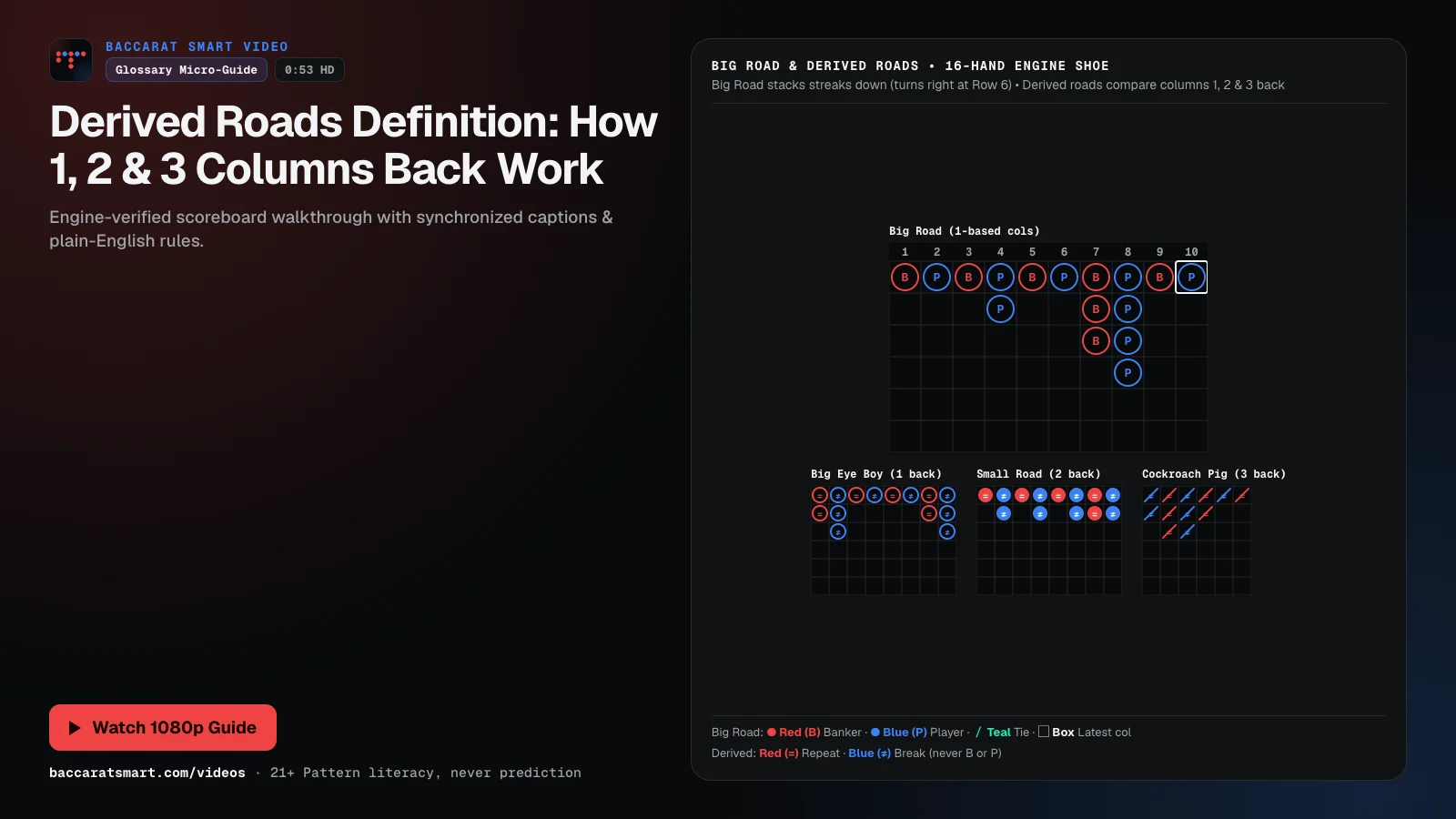
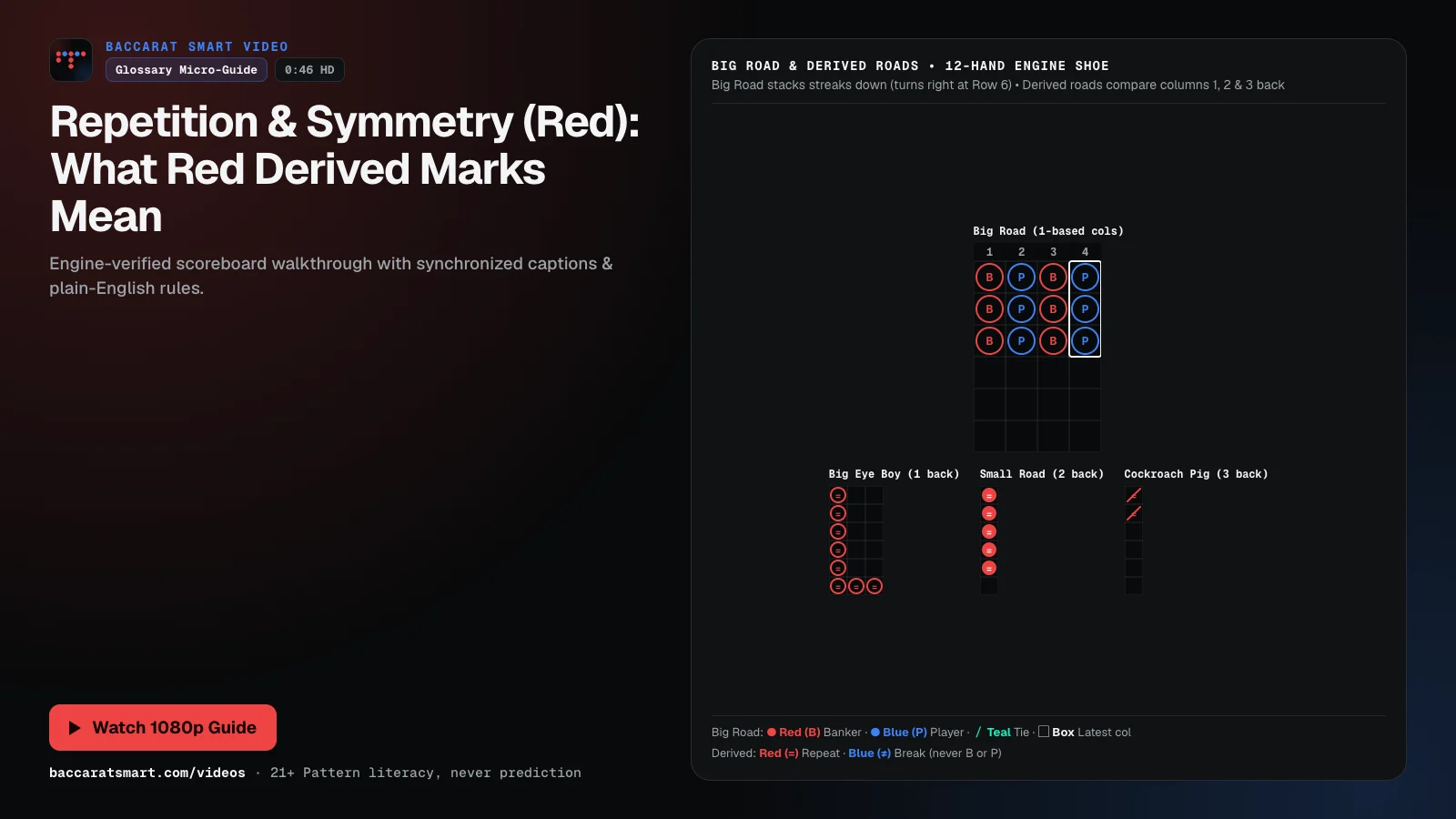
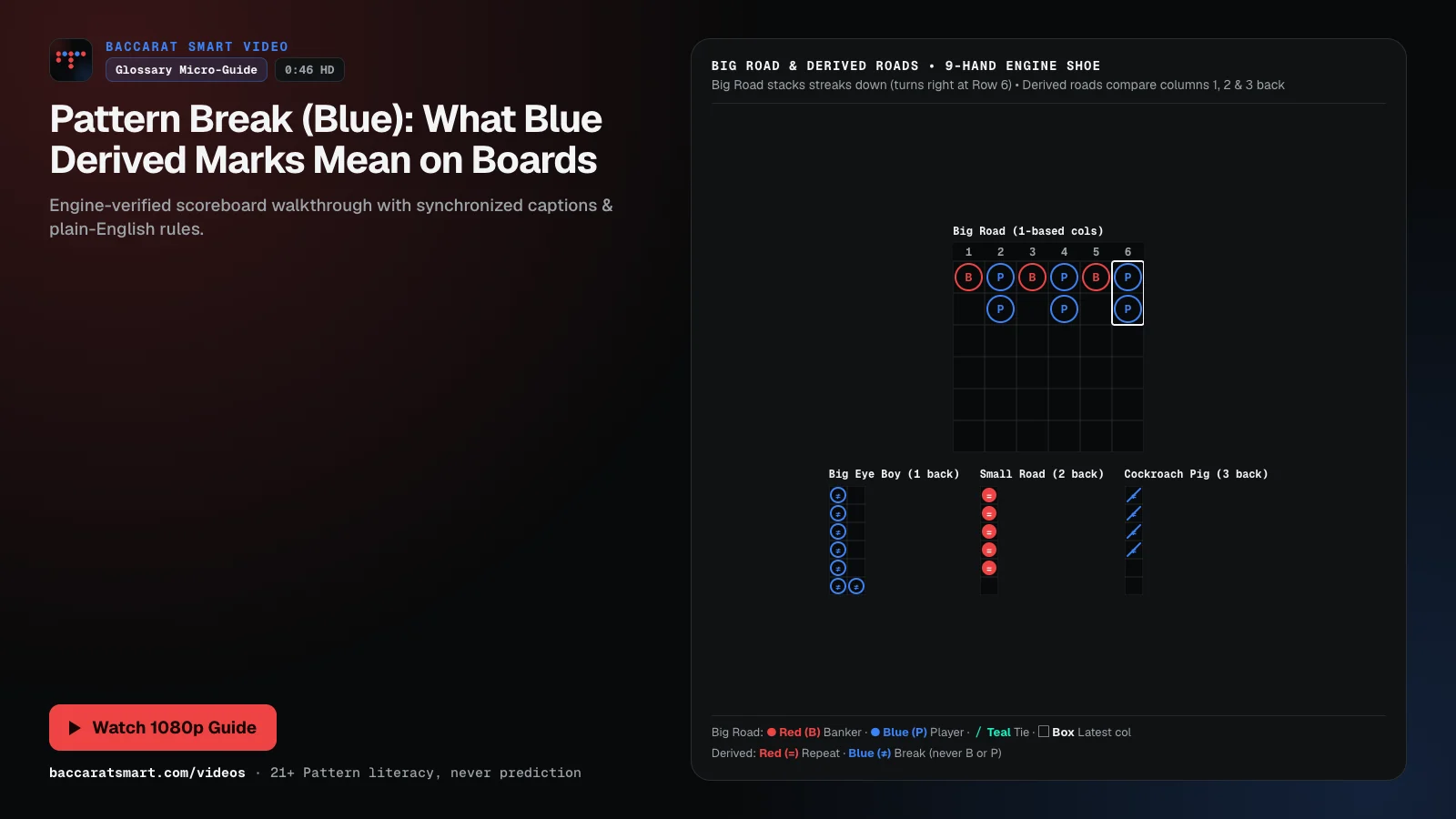
Scoreboard pattern reading is the practical table skill of reading the Big Road and all three derived roads together at a glance. Each derived road acts like a symmetry lens at its own width: one column back spots single-column repeats, two back spots pairs, and three back spots wider rhythms. On shoe BBPBPPBBPBPP, depths 2-1-1-2 repeat twice — turning Small Road solid blue (8 of 8) while 4-Back Road spots the four-column repeat in pure red! Mastering this visual grammar gives you complete fluency at any table while knowing past beads never alter future card odds. 21+.
Adults 21+ educational content only. Baccarat scoreboards record completed outcomes and never change the mathematical odds of the next hand. Review our Responsible Gambling policy.
Scoreboard Pattern Reading: Structural Literacy at the Table
Visual glossary guide to Scoreboard Pattern Reading on BBPBPPBBPBPP (12 hands, 8 columns), showing how 2-1-1-2 Big Road symmetry registers differently across Big Eye Boy, Small Road, and Cockroach Pig.
Practice What You Just Watched
Paired glossary definition: Pattern Recognition (Scoreboard Reading)
Key takeaways from this video
- True scoreboard literacy means knowing WHY every mark is red or blue from Big Road geometry — never guessing future cards from screen shapes.
- Different derived roads disagree whenever the Big Road's repeating cycle width matches one comparison distance and mismatches another.
- On BBPBPPBBPBPP (12 hands, depths 2-1-1-2-2-1-1-2), Big Eye Boy is 4R/5B, Small Road is 0R/8B, and Cockroach Pig is 4R/3B.
Interactive shoe sandbox (12 hands)Open interactive 4-road boardHide interactive board
Interactive 5-Road Sandbox · Bead Plate + Big Road + Derived Roads
Try this video's shoe live
Deal extra hands onto this shoe to watch the Bead Plate, Big Road, and all three casino derived roads react live. On derived roads, red = pattern repeating and blue = pattern breaking.
Bead Plate (Chronological)
Read ↓ then →Big Road (12 hands)
8 streak columnsBig Eye Boy
1 backSmall Road
2 backCockroach Pig
3 backHand #12 · Why the newest marks are red or blue
- Big Eye Boy: This bead is at Row 2. Column 7 stopped at Row 1, one row above → blue (≠).
- Small Road: This bead is at Row 2. Column 6 stopped at Row 1, one row above → blue (≠).
- Cockroach Pig: This bead is at Row 2. Column 5 has a bead at Row 2 too → red (=).
Opens with this exact 12-hand sequence preloaded—and archives any shoe already on your board first.
Frequently asked questions about this walkthrough
Show 4 FAQsHide FAQs
- Why did our 2,000-shoe computer audit confirm that derived-road agreement has zero predictive value?
- Wagering whenever all six derived roads agreed across 2,000 simulated shoes won 49.50% of decided hands — losing roughly twice as fast as flat-betting Banker due to Player's slightly higher 1.24% cost.
- If roads don't forecast the next card, why learn scoreboard pattern reading?
- Scoreboards are the shared language of every baccarat pit worldwide; understanding them lets you audit displays, follow table conversation, and avoid superstitious traps.
- Why does shoe BBPBPPBBPBPP produce 8 straight blue marks on Small Road?
- Because depths are 2, 1, 1, 2, 2, 1, 1, 2 — stepping 2 columns back always compares a depth-2 column against a depth-1 column!
- Where can I practice multi-road reading across realistic shoes?
- Try the Mixed Roads and Rule Hunt drills free inside /practice, or explore Module 5 in the full 36-lesson curriculum.