Read full video transcriptShowHide
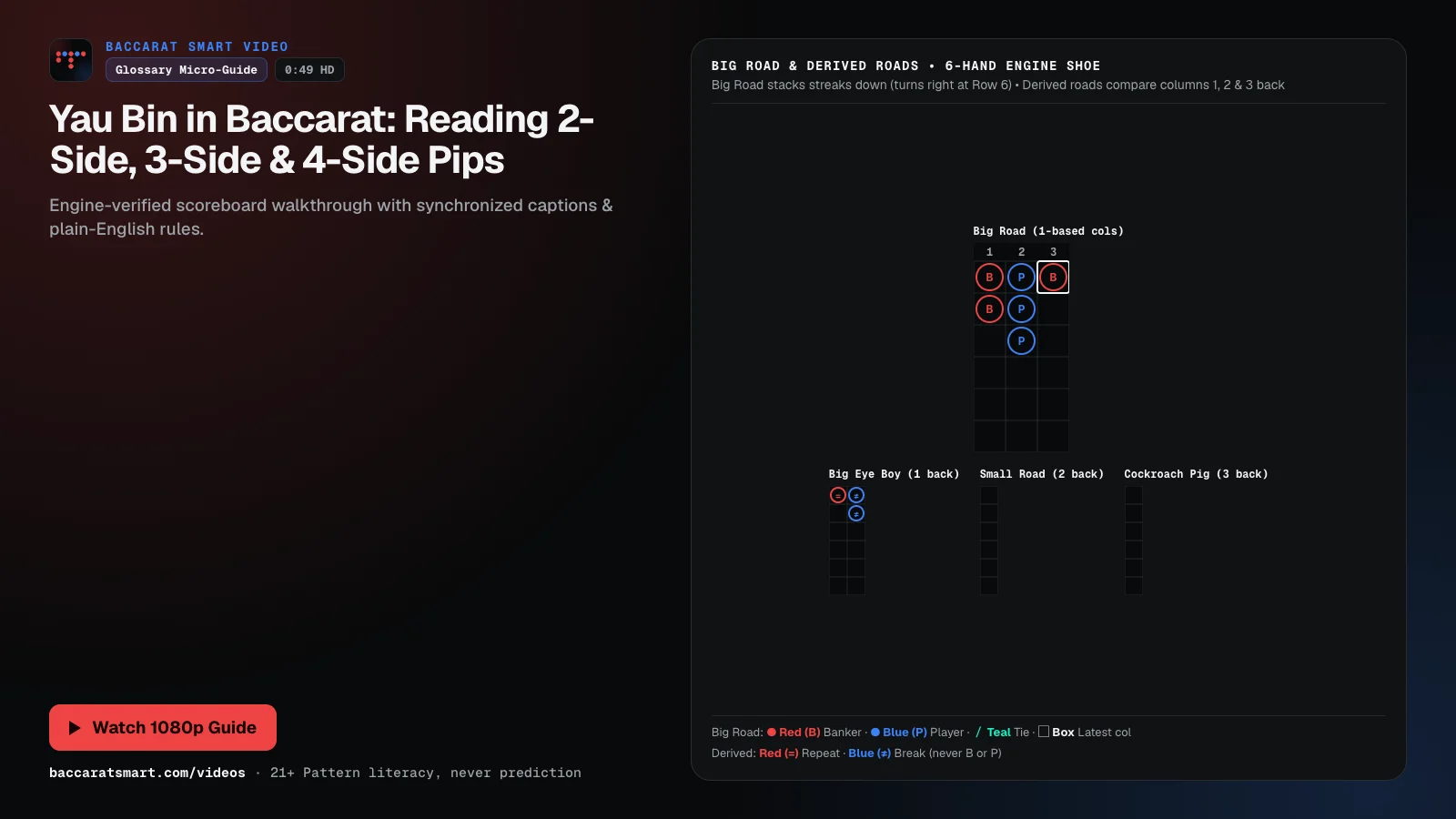
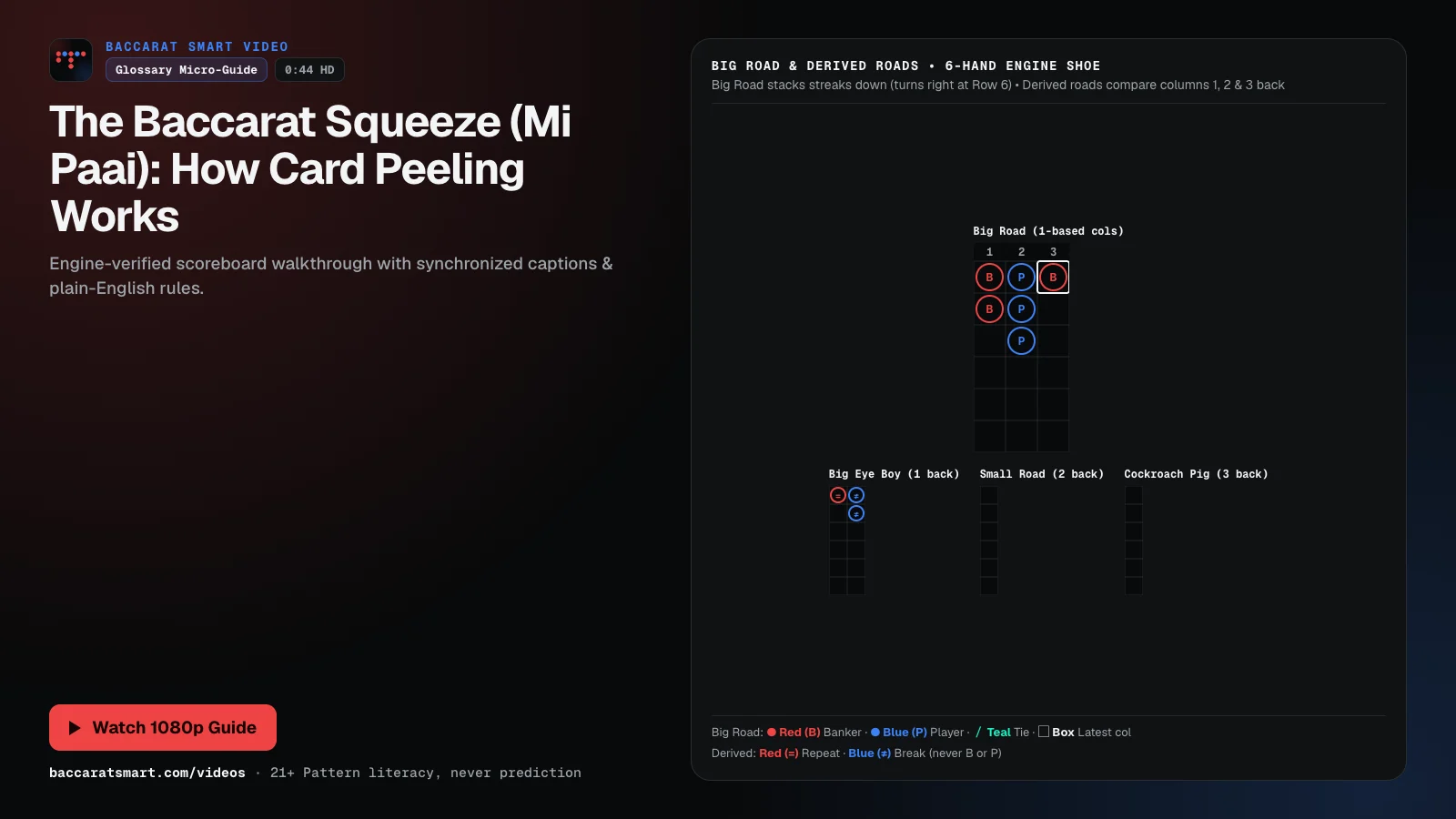
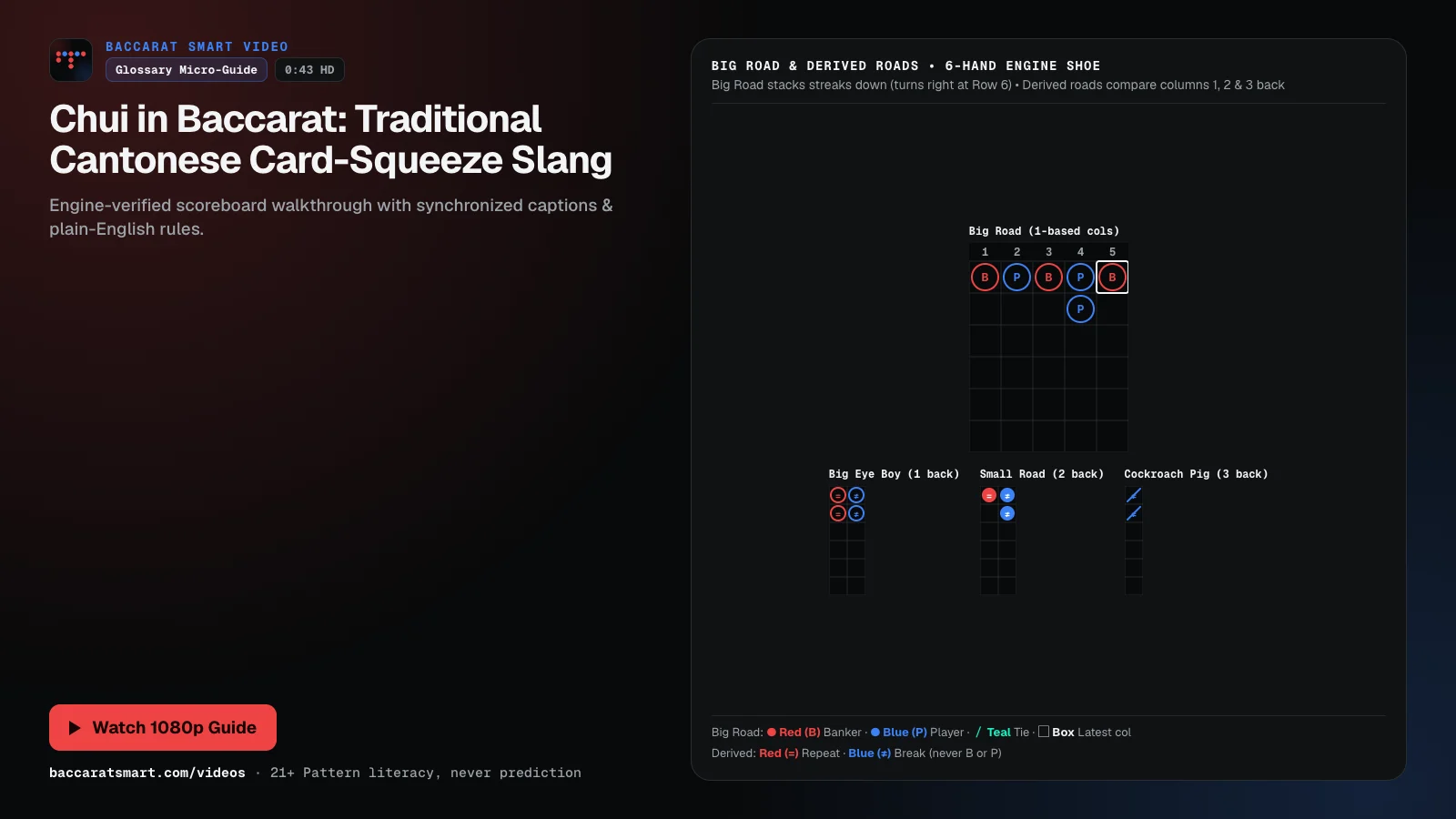
Experienced squeeze players peel the long edge of a face-down card first because standard playing-card pip columns group ranks into neat families. When that long edge reveals pure white space with zero side pips and no picture frame, Cantonese players call 'Mou Bin' — literally 'no side.' Only three ranks in the deck have center-column pips with blank sides: Ace, 2, and 3! Rotating to peel the short end then reveals whether it adds 1, 2, or 3 points — inspect BBPPPB (6 hands) free on /calculator. 21+.
Adults 21+ educational content only. Baccarat scoreboards record completed outcomes and never change the mathematical odds of the next hand. Review our Responsible Gambling policy.
Mou Bin in Baccarat: Blank-Edge Card Squeeze Calls Explained
A 40-second Cantonese card-squeeze guide illustrating how peeling a completely clean long edge — Mou Bin (無邊, mou4 bin1) — narrows a hidden card strictly to Ace, 2, or 3 alongside a 6-hand board.
Practice What You Just Watched
Paired glossary definition: Mou Bin (無邊 — 'No Side')
Key takeaways from this video
- Pip geometry: Ace (1 center pip), 2 (top + bottom center pips), and 3 (top + middle + bottom center pips) leave both left and right long edges blank.
- In an 8-deck shoe, Ace, 2, and 3 account for 3 × 32 = 96 of 416 cards (23.08% of the shoe).
- Once turned face up, the resolved coup updates BBPPPB (3 Big Road columns, 3 Big Eye Boy marks).
Interactive shoe sandbox (6 hands)Open interactive 4-road boardHide interactive board
Interactive 5-Road Sandbox · Bead Plate + Big Road + Derived Roads
Try this video's shoe live
Deal extra hands onto this shoe to watch the Bead Plate, Big Road, and all three casino derived roads react live. On derived roads, red = pattern repeating and blue = pattern breaking.
Bead Plate (Chronological)
Read ↓ then →Big Road (6 hands)
3 streak columnsBig Eye Boy
1 backSmall Road
2 backCockroach Pig
3 backHand #6 · Why the newest marks are red or blue
- Big Eye Boy: Column 2 has 3 beads. Column 1 has 2 beads. Different depth → blue (≠).
Opens with this exact 6-hand sequence preloaded—and archives any shoe already on your board first.
Frequently asked questions about this walkthrough
Show 4 FAQsHide FAQs
- When is seeing 'Mou Bin' best news during a squeeze?
- When your first card is a 6 or 7! Holding a 6, a Mou Bin card (Ace, 2, or 3) guarantees landing on 7, Natural 8, or Natural 9!
- How do you distinguish an Ace from a 2 or 3 when peeling the short edge of a Mou Bin card?
- A 2 and a 3 display a center pip near the top/bottom short edge right away, whereas an Ace stays blank deeper toward the very center of the card.
- Why don't squeeze players just look at the corner index number (A, 2, 3)?
- Thumb-and-index grip deliberately covers both printed corner indices so the rank unfolds gradually from the pip geometry alone!
- What is the companion Cantonese term when side pips DO appear on the long edge?
- 'Yau Bin' (有邊, 'has side'), subdivided into two-side (4–5), three-side (6–8), and four-side (9–10).